UNITED STATES
SECURITIES AND EXCHANGE COMMISSION
Washington, D.C. 20549
SCHEDULE 14A
Proxy Statement Pursuant to Section 14(a) of the
Securities Exchange Act of 1934
(Amendment No. )
(Amendment No. )
| ☑ | Filed by the Registrant | ||||||||||
| ☐ | Filed by a Party other than the Registrant | ||||||||||
| Check the appropriate box: | |||||||||||
| ☐ | Preliminary Proxy Statement | ||||||||||
| ☐ | Confidential, For Use of the Commission Only (as permitted by Rule 14a-6(e)(2)) | ||||||||||
| ☑ | Definitive Proxy Statement | ||||||||||
| ☐ | Definitive Additional Materials | ||||||||||
| ☐ | Soliciting Material under § 240.14a-12 | ||||||||||

Lockheed Martin Corporation
(Name of Registrant as Specified in its Charter)
(Name of Person(s) Filing Proxy Statement, if Other Than the Registrant)
| Payment of Filing Fee (Check all boxes that apply): | |||||||||||
| ☑ | No fee required | ||||||||||
| ☐ | Fee paid previously with preliminary materials | ||||||||||
| ☐ | Fee computed on table in exhibit required by Item 25(b) per Exchange Act Rules 14a-6(i)(1) and 0-11 | ||||||||||

Notice of 2026 Annual Meeting of Stockholders
| Voting Matters and Board Recommendations | ||||||||||||||||||||||||||
Lockheed Martin Virtual Annual Meeting When: Tuesday, May 12, 2026, 9:00 a.m. EDT Live Webcast Access: Online audio webcast at: https://meetnow.global/LMT2026 (You may log in beginning at 8:30 a.m. EDT) Who Can Vote: Stockholders of record at the close of business on March 2, 2026 are entitled to vote. Whether or not you plan to attend the Annual Meeting, we encourage you to vote and submit your proxy in advance of the meeting by one of the methods described below. See Frequently Asked Questions beginning on page 68 for additional information regarding accessing the Annual Meeting and how to vote your shares. | ||||||||||||||||||||||||||
| Proposal 1 | Election of Nine Directors |  | FOR each Nominee | |||||||||||||||||||||||
 | See page 17 for further information. | |||||||||||||||||||||||||
| Proposal 2 | Advisory Vote to Approve the Compensation of our Named Executive Officers (Say-on-Pay) | | FOR | |||||||||||||||||||||||
| See page 28 for further information. | |||||||||||||||||||||||||
| Proposal 3 | Ratification of the Appointment of Ernst & Young LLP as our Independent Auditors for 2026 | | FOR | |||||||||||||||||||||||
| See page 61 for further information. | |||||||||||||||||||||||||
Proposal 4 | Stockholder Proposal as described in the proxy statement |  | AGAINST | |||||||||||||||||||||||
 | See page 64 for further information. | |||||||||||||||||||||||||
We welcome and encourage you to attend Lockheed Martin Corporation’s 2026 Annual Meeting, which will be conducted exclusively online through a live audio webcast to facilitate stockholder attendance and to enable stockholders to participate fully and equally, regardless of size of holdings, resources or physical location. Our 2025 Annual Report, which is not part of the proxy soliciting materials, is available at www.edocumentview.com/LMT. The proxy materials or a Notice of Internet Availability were first sent to stockholders on or about March 26, 2026. We will consider the four proposals noted above and any other matters that may properly come before the meeting. Your vote is extremely important. Please vote at your earliest convenience to ensure the presence of a quorum at the meeting. Promptly voting your shares in accordance with the instructions you receive will save the expense of additional solicitation. Sincerely,  Kevin J. O’Connor Senior Vice President, General Counsel and Corporate Secretary March 26, 2026 | ||||||||||||||||||||||||||
| How to Vote in Advance: | ||||||||||||||||||||||||||
 | Via Internet: At the website listed on the Notice of Internet Availability, proxy card or voting instruction form you received. | |||||||||||||||||||||||||
 | By Telephone: Call the telephone number provided on the proxy card or voting instruction form you received. | |||||||||||||||||||||||||
 | By Mail: Mark, date and sign your proxy card or voting instruction form and return it in the accompanying postage prepaid envelope. | |||||||||||||||||||||||||
Important Notice Regarding the Availability of Proxy Materials for the Annual Meeting of Stockholders to be Held on May 12, 2026: The 2026 Proxy Statement and 2025 Annual Report are available at www.edocumentview.com/LMT. | ||
 | 2026 Proxy Statement | i | ||||||||||||
Letter from Our Board Leaders
March 26, 2026 Dear Fellow Stockholders: | |||||
 | Throughout 2025, Lockheed Martin demonstrated scale, agility and performance. We delivered the capabilities our soldiers, sailors, marines, airmen, guardians and other customers rely on to deter wider conflict, protect citizens, and sustain a decisive military advantage in an increasingly complex global security environment. Our Board’s disciplined oversight of strategy and operational execution underpin the company’s notable achievements. 2025 Performance and Demand Lockheed Martin’s products and solutions in 2025, showed what our four business areas – Aeronautics, Missiles and Fire Control, Rotary and Mission Systems and Space – can deliver as one cohesive company with unmatched integration, reliability and scale. There is unprecedented demand for Lockheed Martin’s technology. We finished 2025 with a record backlog of nearly $194 billion, representing more than two-and-a-half years of sales. Elevated demand has continued in 2026 with Lockheed Martin reaching landmark, long-term agreements with the Department of War to triple Patriot PAC-3 MSE missile production and quadruple THAAD production. Investing and Innovating Lockheed Martin is significantly increasing its investments while maintaining our historical practice of using a disciplined and dynamic approach to capital allocation. Every investment decision is guided by our mission to provide decisive capability to our customers, and by our focus on growing the business and delivering shareholder value in 2026 and beyond. •Air Dominance: We are accelerating upgrades to the F-35 through Block 4 enhancements; advancing concepts informed by sixth-generation development; improving sensors, electronic warfare and data links; and integrating autonomous systems such as drone wingmen. •Homeland Defense: Lockheed Martin is ready to help make the promise of the Golden Dome for America a reality. We are investing in our production capacity for our proven land-, sea- and space-based systems, as well as command and control technology, to advance allied homeland defense systems—an important growth area for Lockheed Martin. | ||||
ii | 2026 Proxy Statement | | ||||||||||||
•Transformation: Our strategic investments over many years have positioned Lockheed Martin to succeed under the Department of War’s acquisition transformation framework. By developing autonomous systems with internal investment ahead of formal requirements and continuing to partner with leading tech companies, we are delivering more advanced solutions faster and more affordably. •Evolution: Through our 1LMX initiative, we are driving enterprise-wide modernization—adopting advanced digital tools, harnessing artificial intelligence, improving speed and affordability and enhancing our ability to deliver best-value solutions at the pace required to stay ahead of the threat landscape. 2026 Strategic Execution In 2026, the Board of Directors will continue its active oversight of management and guide Lockheed Martin’s execution of its strategy to position the company for future growth opportunities by: •Accelerating digital technology across the defense enterprise through commercial partnerships, targeted investments and in-house innovation. •Increasing the resilience of the defense industrial base through close collaboration with our customers and Congress on acquisition transformation and anti-fragility measures. •Advancing American and allied interoperability by expanding our international operations that strengthen manufacturing, increase efficiency and ultimately deliver greater capability than any of us could achieve alone. Gen. Joseph F. Dunford, Jr. has decided not to stand for reelection to the Board. We thank Gen. Dunford for his distinguished service to our company for the past six years and wish him well in his future endeavors. On behalf of the Board, thank you for your continued investment and confidence in Lockheed Martin. Sincerely, |  | |||||||
 James D. Taiclet Chairman, President and Chief Executive Officer |  Thomas J. Falk Independent Lead Director | |||||||
| | 2026 Proxy Statement | iii | ||||||||||||
Table of Contents
Frequently Requested Information | |||||||||||
iv | 2026 Proxy Statement | | ||||||||||||
About Lockheed Martin
Lockheed Martin Corporation (Lockheed Martin, the Company, us or we) (NYSE: LMT) is a global aerospace and defense technology company that builds and sustains the solutions America and its allies need to deter conflict and advance national security and scientific exploration objectives. We offer integrated solutions, at scale, across all warfighting domains. Our defense, space, intelligence, homeland security, information technology and cybersecurity capabilities serve U.S. and international customers in defense, civil and commercial applications. Our principal customers are agencies of the U.S. Government and allies.
Our Mission is to deliver reliable, innovative and affordable technology solutions to keep our customers Ahead of Ready to succeed in any mission and return home safely to their families.
 | PERFORM |  | TRANSFORM |  | GROW | ||||||||||||||||||
Lead in delivering advanced, integrated solutions to our customers at scale. Drive business outcomes. Deliver outstanding results for our customers and stockholders. | Transform ourselves and our supply chain. Innovate our solutions. Adopt new processes and tools to become more agile for customers. | Expand existing core business. Go after new segments and adjacent markets. Disrupt ourselves through new developments, programs and products. | |||||||||||||||||||||
As a leader in the global security and aerospace industry, we are a pathfinder for 21st Century Security, our vision to accelerate the adoption of advanced networking and digital technologies into the defense enterprise of the U.S. and allied nations while enhancing the performance and value of our platforms and products for our customers. We deliver on our vision by integrating new and existing systems across all domains with advanced, open-architecture networks including third-party technology, to make forces more agile, adaptive and unpredictable, while developing and deploying advanced technologies such as:
 |  |  |  |  |  | ||||||||||||
Advanced Communications and 5G.MIL® Solutions | Artificial Intelligence (AI) and Machine Learning | Autonomy and Human-Machine Teaming | Cyber | Directed Energy | Hypersonic Solutions | ||||||||||||
Our People | |||||||||||||||||||||||||||||||||||
 | 123,000 Employees Worldwide |  | 72,000 Engineers, Scientists and IT Professionals |  | 20% are Veterans | ||||||||||||||||||||||||||||||
Employee data as of December 31, 2025
| | 2026 Proxy Statement | 1 | ||||||||||||
Lockheed Martin is Committed to Sound Corporate Governance
As a leader in the global security and aerospace industry, the Company’s Board of Directors, through the Nominating and Corporate Governance Committee (Governance Committee), has established best-in-class governance practices aligning with our business. Our active and independent Board insists upon a dynamic governance model to ensure stockholder rights and robust oversight of our business. Our Charter, Bylaws, Corporate Governance Guidelines (Governance Guidelines) and Committee Charters establish the primary framework for our governance practices and are available on the Company’s website at www.lockheedmartin.com/corporate-governance.
Governance Highlights
We are an original signatory to the Commonsense Corporate Governance Principles 2.0 (a framework for sound, long-term oriented governance). Our governance highlights include:
BOARD-RELATED | STOCKHOLDER RIGHTS-RELATED | |||||||||||||
 | Entirely independent Board other than the Chairman | | One class of voting stock | |||||||||||
| Strong and engaged independent Lead Director | | One share, one vote | |||||||||||
| Entirely independent standing committees of the Board | | Annual election of directors | |||||||||||
| Annual review of Board leadership structure | | Majority voting for directors in uncontested elections | |||||||||||
| Annual Board and Committee evaluations | | Mandatory tender of resignation if majority vote not received in uncontested election | |||||||||||
| Active Board refreshment | | Proactive, year-round stockholder engagement | |||||||||||
| Regular executive sessions of independent directors | | No super-majority voting requirements | |||||||||||
| Meaningful director stock ownership guidelines | | Market-standard proxy access | |||||||||||
| Policy against “overboarding” | | Right to call a special meeting under the Bylaws | |||||||||||
| Retirement policy | | Right to amend Bylaws | |||||||||||
| Regular review of Committee Charters and Governance Guidelines | | No poison pill | |||||||||||
| Access to officers and employees | | Active engagement with stockholder proponents | |||||||||||
| Active succession planning for key executive roles | |||||||||||||
| Disclosure of related person transactions | |||||||||||||
| 100% attendance at 2025 Board and Committee meetings | |||||||||||||
For a summary of our compensation best practices, see “Compensation Discussion and Analysis” beginning on page 29.
2 | 2026 Proxy Statement | | ||||||||||||
Board Leadership Structure | ||||||||||||||||||||
The Board has determined that a combined Chairman and CEO role along with a strong independent Lead Director best serves our current business needs Each year, and more frequently as conditions warrant, the Governance Committee reviews the Board leadership structure and determines whether to recommend any changes to the full Board. At present, the Board believes that the unified Chairman and CEO role, combined with the extensive authority given to the independent Lead Director, effectively represents the interests of stockholders and enables the Board to exercise independence and oversight in service of the Company. The Board does this through frequent executive sessions, wholly independent Board committees and an independent Lead Director with significant experience and clearly delineated and comprehensive duties. The Board also believes that presenting a single face to our customers through the combined Chairman and CEO role is valuable. Further, the combined Chairman and CEO role facilitates real-time, transparent communication with the Board on critical business matters and best positions the Company to successfully implement its strategy, particularly in the current dynamic and challenging geopolitical and economic environment. The Board believes that Mr. Taiclet, a former independent Board member and a veteran with deep knowledge of complex industries and our primary customer, is well qualified to serve as Chairman and that the Board operates effectively and efficiently under his leadership. The Governance Committee will continue to review the leadership structure on an annual basis to ensure that it continues to meet the needs of the Company and supports the generation of stockholder value over the long term. | ||||||||||||||||||||
 | ||||||||||||||||||||
Chairman, President and CEO James D. Taiclet | ||||||||||||||||||||
 Independent Lead Director & Governance Committee Chair Thomas J. Falk Elected annually by the independent directors | ||||||||||||||||||||
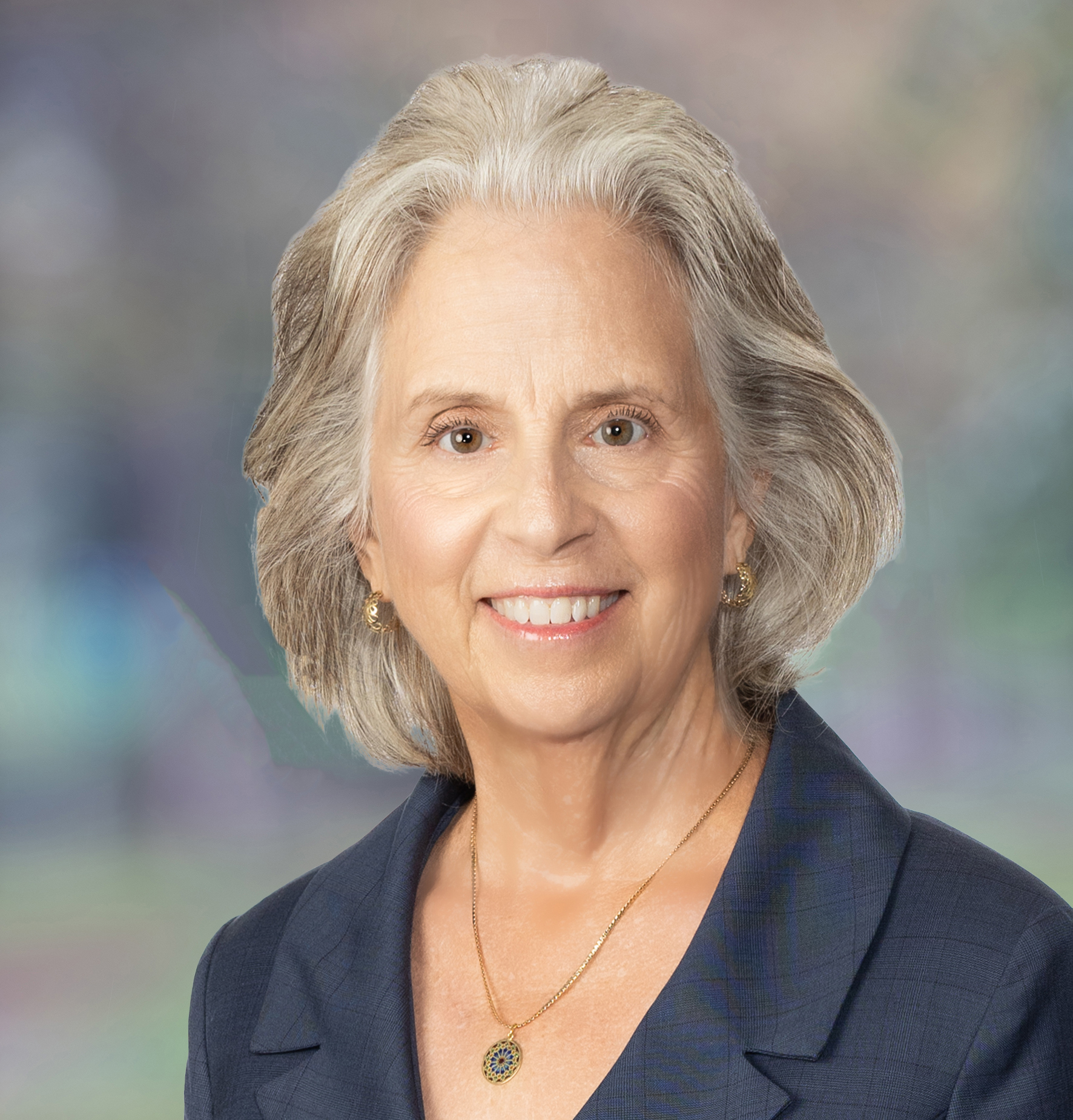   | ||||||||||||||||||||
Other Committee Chairs Patricia E. Yarrington (Audit) Joseph F. Dunford, Jr. (CBS)* John M. Donovan (Compensation) All committees are fully independent | ||||||||||||||||||||
* Gen. Dunford is not standing for reelection. This is because of a change in his professional circumstances and not because of a disagreement with the Company. He will remain CBS Committee chair until the Annual Meeting, after which the Board will appoint a new chair.
The Board has vested significant authority with the independent Lead Director
The Board has structured the independent Lead Director’s role to optimize Board oversight of management and provide an outside perspective. The independent Lead Director has defined responsibilities specified in the Bylaws and Governance Guidelines or as otherwise assigned by the Board, which include:
•Serving as Leader of the Independent Directors, by chairing executive sessions of the independent directors and presiding as Chair at Board meetings when the Chairman is not present, determining the frequency and timing of executive sessions of independent directors, providing Board feedback and counsel to the Chairman and serving as Chairman of the Governance Committee and an ex officio member of each Board committee.
•Approving Board and Committee Meeting Agendas and Schedules in consultation with the Chairman and committee chairs.
•Providing Feedback to Management on the scope and quality of information sent to the Board, acting as liaison between the Board and management and among the directors and the committees of the Board and leading discussions among the independent directors to evaluate the Board’s and the Chairman and CEO’s performance.
•Advancing Board Refreshment and Development, by leading the Governance Committee’s efforts to recruit directors and leading the Board’s annual self-assessment process.
•Communicating with Stockholders, by serving as the Board’s primary point of contact for stockholders and other stakeholders and meeting with investors when appropriate.
•Having Authority to Call Special Meetings of the Board or independent directors at any time for any purpose.
| | 2026 Proxy Statement | 3 | ||||||||||||
Our independent Lead Director was elected unanimously by his peers and provides robust oversight of management and the Company
In accordance with our Bylaws and Governance Guidelines, the independent directors annually elect from among themselves a Lead Director who has been determined to be “independent” for purposes of the New York Stock Exchange (NYSE) listing standards. In 2025, the Board re-elected Mr. Falk to serve as independent Lead Director, noting Mr. Falk’s deep understanding of the Company from his service as a director and chair of a key Board Committee, his past experience leading boards of directors as Chairman of Kimberly-Clark Corporation and of the Federal Reserve Bank of Dallas, and his strategic perspective on global trends and business transformation.
Mr. Falk engages with Mr. Taiclet frequently to provide independent oversight of and strategic counsel to management and feedback from himself and from other directors on management and Company performance. Mr. Falk also leads the Board’s annual self-evaluation process and conducts one-on-one meetings with each independent director to seek feedback on Board and Company operations and priorities, the Chairman and CEO’s performance and composition of the Board itself. Mr. Falk actively advances Board refreshment by interviewing all potential director candidates. He also leads discussions of the independent directors on executive succession matters. Additionally, as chair of the Governance Committee and an ex officio member of the other committees, Mr. Falk has insight into and oversight of all matters before the Board.
Our independent directors hold executive sessions without management present and provide direct feedback to the Chairman and CEO
Our Governance Guidelines require that at least three Board meetings per year include an executive session of the independent directors and every Board and committee meeting agenda includes an executive session of the independent directors. The independent Lead Director presides over Board executive sessions and encourages direct feedback by the directors to the Chairman and CEO on matters discussed during executive session and supplements, or provides directly, that feedback when appropriate. Each committee chairman presides during that committee’s executive sessions. In 2025, the Board met in executive session at every Board meeting to discuss, among other things, management and Board succession planning.
Board Committees
The Board established four standing committees to assist in fulfilling its oversight duties: Audit, Classified Business and Security (CBS Committee), Management Development and Compensation (Compensation Committee) and the Governance Committee. Charters for each committee are available on the Company’s website at www.lockheedmartin.com/corporate-governance. The Board may establish other standing or special committees as necessary.
The Governance Committee regularly reviews the membership, tenure, leadership and commitments of each committee and evaluates composition changes based on the qualifications and expertise of the directors, taking into consideration the membership requirements and responsibilities set forth in the committee charters and Governance Guidelines and the potential benefit of periodic committee rotation or refreshment. The Governance Committee recommends to the Board any proposed changes to committee assignments and leadership, and reviews the operation of the Board generally.
4 | 2026 Proxy Statement | | ||||||||||||
Audit Committee
Patricia E. Yarrington, Chair David B. Burritt Vicki A. Hollub All Audit Committee members are independent within the meaning of the NYSE listing standards, applicable Securities and Exchange Commission (SEC) regulations and our Governance Guidelines. In addition, the Board has determined that all members are financially literate within the meaning of the NYSE listing standards and that all members meet the SEC’s criteria as “audit committee financial experts.” | 2025 Focus Areas | Meetings in 2025: 4 | |||||||||||||||
•Business Segment and Program Performance •Enterprise Risk Management (ERM), including the use of AI in Auditing and Accounting •Audit Plan; Enterprise Transformation Controls •Critical Audit Matter Related to Revenue Recognition; Retirement Plan Funding | |||||||||||||||||
Roles and Responsibilities of the Committee The Audit Committee oversees the Company’s financial statements integrity, compliance with legal and regulatory requirements, internal audit plan and the Company’s ERM processes. It is directly responsible for the appointment, compensation, retention and oversight of the Company’s independent auditors, currently Ernst & Young LLP (EY). The Audit Committee also reviews the Company’s policies regarding derivatives and the financial status, investment performance and funding of the Company’s retirement benefit plans. The Audit Committee meets privately with management, internal audit and EY. The functions of the Audit Committee are further described in the “Audit Committee Report” on page 63. | |||||||||||||||||
Classified Business and Security Committee*
Joseph F. Dunford, Jr., Chair** John C. Aquilino John M. Donovan Heather A. Wilson Patricia E. Yarrington All CBS Committee members are independent within the meaning of the NYSE listing standards and our Governance Guidelines and hold appropriate security clearances. | 2025 Focus Areas | Meetings in 2025: 3 | |||||||||||||||
•Oversight of Classified Program Operational Risk •Strategic Alignment of Classified Programs •Oversight of Classified Program Financial Risk •Security of Personnel, Facilities and Data | |||||||||||||||||
Roles and Responsibilities of the Committee The CBS Committee oversees the Company’s classified business activities and the security of personnel, facilities and data (including classified cybersecurity and AI matters). The CBS Committee consists of independent directors who possess the appropriate security clearance credentials, at least one of whom must be a member of the Audit Committee, and who are free from any relationship that, in the opinion of the Board, would interfere with the exercise of independent judgment as a member of the CBS Committee. | |||||||||||||||||
* In addition to the listed members above, Gen. Bruce A. Carlson served on the Committee until his retirement at the 2025 Annual Meeting.
** Gen. Dunford is not standing for reelection. He will remain CBS Committee chair until the Annual Meeting, after which the Board will appoint a new chair.
| | 2026 Proxy Statement | 5 | ||||||||||||
Management Development and Compensation Committee
John M. Donovan, Chair David B. Burritt Vicki A. Hollub Debra L. Reed-Klages All Compensation Committee members are independent within the meaning of the NYSE listing standards, applicable SEC regulations and our Governance Guidelines. | 2025 Focus Areas | Meetings in 2025: 3 | |||||||||||||||
•Strategic and Operational Performance Goals •Compensation of CEO and Executive Officers •Compensation Risk Oversight | |||||||||||||||||
Roles and Responsibilities of the Committee The Compensation Committee reviews and approves the corporate goals and objectives relevant to the compensation of the CEO and other executive officers, evaluates the performance of the CEO in view of those goals and, either as a committee or together with the other independent members of the Board, determines and approves the compensation philosophy and levels for the CEO and other executive officers. The Compensation Committee administers the Company’s Policy on the Recovery of Incentive-Based Compensation from Executive Officers. The Compensation Committee does not delegate its responsibilities with respect to compensation that is specific to the executive officers. For other employees and for broad-based compensation plans, the Compensation Committee may delegate authority to the CEO or the Senior Vice President and Chief Human Resources Officer, subject to certain limits. | |||||||||||||||||
Nominating and Corporate Governance Committee*
Thomas J. Falk, Chair Joseph F. Dunford, Jr.** Debra L. Reed-Klages All Governance Committee members are independent within the meaning of the NYSE listing standards and our Governance Guidelines. | 2025 Focus Areas | Meetings in 2025: 3 | |||||||||||||||
•Board Recruitment and Refreshment; Board Composition and Expertise/Competencies Alignment •Board Independence •Oversight of Ethics, Product Safety, Employee Culture and Safety, and Sustainability | |||||||||||||||||
Roles and Responsibilities of the Committee The Governance Committee develops and implements policies and practices relating to corporate governance, including our Governance Guidelines. The Governance Committee assists the Board by recommending candidates to be nominated to the Board and the composition of Board committees. The Chair of the Governance Committee leads the annual evaluation of the Board and its committees. The Governance Committee recommends to the Board the compensation of directors. Our executive officers do not play a role in determining director pay. The Governance Committee assists the Board in fulfilling its oversight efforts in corporate responsibility, corporate culture, human rights, environmental stewardship, political spending, ethical business practices, community outreach, philanthropy, sustainability and health and safety programs. The Governance Committee monitors compliance and recommends changes to our Code of Conduct. The Governance Committee also has oversight over the Company’s policies and processes for the safety of the Company’s products and services. | |||||||||||||||||
* In addition to the listed members above, Gen. Carlson served on the Committee until his retirement at the 2025 Annual Meeting.
** Gen. Dunford is not standing for reelection. The Board will appoint another director to the Governance Committee at their meeting immediately following the Annual Meeting.
6 | 2026 Proxy Statement | | ||||||||||||
Director Independence and Related Person Transactions
Director independence is a central tenet of our Company’s strong governance practices The Governance Committee annually reviews the independence of all directors and reports its findings to the Board. Under the NYSE listing standards and our Governance Guidelines, a director is not independent if the director has a direct or indirect material relationship with the Company. To further clarify this, the Board has adopted director independence standards in our Governance Guidelines that identify certain types of relationships between the Company and directors (and their immediate family members or affiliated entities) it deems to be either material or not material for purposes of assessing a director’s independence. If a director has a relationship with the Company that is not addressed in the independence standards, then the independent members of the Board would determine whether the relationship is material. All of our directors are independent except for our Chairman and CEO The Board has determined that all of our directors are independent under applicable NYSE listing standards and our Governance Guidelines except Mr. Taiclet, our Chairman, President and CEO. The Governance Committee also concluded that all members of the Audit, CBS, Compensation and Governance Committees are independent within the meaning of the NYSE listing standards, including the additional independence requirements applicable to members of the Audit Committee and the Compensation Committee. The Governance Committee and Board considered that the Company, in the ordinary course of business, purchases products and services from, or sells products and services to, entities at which some of our directors - or their immediate family members - are or have been directors, officers, employees or otherwise related. In determining that these relationships did not affect the independence of those directors, the Board considered that none of the directors had any direct or indirect material interest in, or received any special compensation in connection with, the Company’s business relationships with those entities. The Governance Committee and the Board relied on the director independence standards included in our Governance Guidelines to conclude that contributions to tax-exempt organizations by the Company did not create any direct or indirect material interest when assessing director independence. | ||||||||
DIRECTOR NOMINEE INDEPENDENCE | ||||||||
| 89% | ||||||||
Independent John C. Aquilino David B. Burritt John M. Donovan Thomas J. Falk Vicki A. Hollub Debra L. Reed-Klages Heather A. Wilson Patricia E. Yarrington Not Independent James D. Taiclet | ||||||||
| | 2026 Proxy Statement | 7 | ||||||||||||
We transparently assess and disclose related person transactions
The Board has approved a written policy and procedures for the review, approval and ratification, if necessary, of transactions among the Company and its directors, executive officers and their related interests. A copy of the policy is available on the Company’s website at www.lockheedmartin.com/corporate-governance.1 Our policy requires each director and executive officer to complete an annual questionnaire identifying any related interests and persons and to notify the Company promptly of changes in that information. The Company maintains a list of related persons for purposes of tracking and reporting related person transactions.
Our policy requires that the Governance Committee conduct a reasonable prior review of each related person transaction2 and it may choose to approve the transaction at its discretion if deemed fair and reasonable to the Company and not inconsistent with the interests of the Company and its stockholders. No director may participate in the decision-making process regarding a transaction in which the director may have an interest (except when approval occurs by unanimous written consent).
Although our policy requires that all related person transactions be pre-approved, the Governance Committee has the authority to ratify a transaction (using the same standard of review) if a transaction is identified after it has occurred or commenced. The Governance Committee has also pre-approved certain categories of transactions or relationships, as provided in the policy. If the Governance Committee declines to approve or ratify a transaction, the related person transaction is referred to management to make a recommendation to the Governance Committee concerning whether the transaction should be terminated or amended in a manner that is acceptable to the Governance Committee.
Related person transactions
We considered the following transactions or relationships since January 1, 2025 to March 2026 to be “related person” transactions under our corporate policy and applicable SEC regulations and NYSE listing standards.
•Employment Relationships: As of December 31, 2025, we employed approximately 123,000 employees, and we have an active recruitment program for soliciting job applications from qualified candidates. We seek to hire the most qualified candidates and consequently do not preclude the employment of family members of directors or executive officers. The following non-executive Lockheed Martin employees are related to directors or executive officers: (i) Scott A. Cahill, the son of Timothy S. Cahill, President, Missiles and Fire Control, is employed as a senior software engineer (2025 salary of $161,720 and annual cash incentive award of $7,000; 2026 base salary of $166,630), (ii) Dr. Scott Carlson, the son of Gen. Carlson, a former member of the Board, is employed as a senior staff aeronautical engineer (2025 salary of $187,011 and annual cash incentive award of $12,000; 2026 base salary of $187,182); (iii) Cole-Stephen Hill, the son of Stephanie C. Hill, President, Rotary and Mission Systems, is employed as a cyber systems security engineer (2025 salary of $127,137 and annual cash incentive award of $3,432; 2026 base salary of $130,913); (iv) Cameron-Davis Hill, the son of Ms. Hill, is employed as a cyber software engineer (2025 salary of $111,239 and annual cash incentive of $4,623; 2026 base salary of $135,960); and (v) Grace St. John, the daughter of Frank A. St. John, Chief Operating Officer, is employed as a systems engineer (2025 salary of $98,629 and annual cash incentive of $4,622; 2026 base salary of $103,472). They each may be eligible to earn an incentive award for 2026 applicable to employees at their level and may participate in other employee benefit plans and arrangements that generally are made available to other employees at the same level (including health, welfare, vacation and retirement plans). Their respective compensation was established in accordance with the Company’s employment and compensation practices applicable to employees with equivalent qualifications, experience and responsibilities, and the Board and executive officers of the Company did not have any involvement in setting their individual compensation.
•Financial Services Arrangements: From time to time, the Company has purchased services in the ordinary course of business from financial institutions that beneficially own five percent or more of our common stock. In 2025, the Company paid approximately (i) $3.8 million to State Street Company and its affiliates (including State Street Bank and Trust Company) (collectively, State Street) for investment management, custodial and benefit plan administration fees; and (ii) $2.2 million to BlackRock, Inc. and its affiliates for investment management fees. A portion of the fees included in the amounts paid to State Street and BlackRock are estimated based on a percentage of net asset value under management.
1 Under our policy, and consistent with applicable SEC regulations and NYSE listing standards, a related person transaction is any transaction in which the Company was, is or will be a participant; where the amount involved exceeds $120,000; and in which a related person had, has, or will have a direct or indirect material interest. A related person includes any director or director nominee, any executive officer of the Company, any person who is known to be the beneficial owner of more than 5% of any class of the Company’s voting securities or an immediate family member of any person described above.
2 This may include situations where the Company provides products or services to related persons on an arm’s length basis on terms comparable to those provided to unrelated third parties.
8 | 2026 Proxy Statement | | ||||||||||||
Director Engagement
Our directors actively attend and participate in Board meetings
Our directors are fully committed to their Board service. In 2025, there were six Board meetings. All directors on the Board during 2025 attended 100% of the Board and committee meetings to which they were assigned and, accordingly, overall attendance of the Board as a whole was 100%. Further, Board members commonly attend meetings of committees on which they do not sit. Board members are also encouraged to attend the annual meeting of stockholders, and all but one director serving on the Board at the time attended the 2025 Annual Meeting.
The directors self-assess their performance annually
The directors conduct a self-assessment of Board and committee performance and effectiveness on an annual basis. The self-assessment helps the Governance Committee identify ways to enhance the Board’s and its committees’ effectiveness and track progress in areas targeted for improvement from year to year. The evaluation process includes the following steps:
 | ||||||||||||||||||||
Open-ended questions to solicit candid feedback. | The independent Lead Director conducts annual and ad hoc one-on-one discussions with each director. | Each committee and the full Board review the results of their respective evaluations. | Continued focus on strategic matters, operational performance and a OneLM approach. | |||||||||||||||||
Board Accountability to Stockholders
The Board and management of the Company view accountability to our stockholders as a key element of our success. Management engages regularly with stockholders representing a majority of our outstanding shares both from a financial performance perspective (led by our Investor Relations team) and from a governance perspective (led by our Corporate Secretary’s Office). Similarly, we engage with proponents of stockholder proposals to understand their perspectives. These engagements provide an opportunity for management to both learn from stockholders and share insights into the Company’s strategy, performance, compensation and governance model. Management shares feedback from these sessions with the Board, and both the Board and management use this feedback to further develop our governance policies and inform our business strategy.
Our stockholders have significant rights
•We elect directors using a majority standard in uncontested elections: The Company’s Charter and Bylaws provide for simple majority voting, and our Governance Guidelines require that, in any uncontested election of directors, any incumbent director who receives more votes “AGAINST” than votes “FOR” is required to offer his or her resignation for Board consideration.
•Our stockholders have the right to amend our Bylaws: Our Bylaws provide the Company’s stockholders the right to amend the Bylaws by the vote of a majority of the votes entitled to be cast. The authority of the stockholders and the Board to amend the Bylaws is subject to the provisions of the Company’s Charter and applicable statutes.
•We have adopted proxy access in our Bylaws: Our Bylaws permit a stockholder or a group of up to 20 stockholders who together have owned at least three percent of the Company’s outstanding common stock continuously for three years to nominate up to two directors for election by the Company’s stockholders and inclusion in the Company’s proxy solicitation materials for its annual meeting.
•Our stockholders have the right to call a special meeting: Any stockholder who individually owns 10 percent, or stockholders who in the aggregate own 25 percent, of the outstanding common stock may demand the calling of a special meeting to consider any business properly brought before the stockholders.
•We have no poison pill: Through our Governance Guidelines, the Board has communicated that it has no intention of adopting a poison pill at this time and, if it were to consider adoption of a full or limited stockholder rights plan, the Board would seek stockholder ratification within 12 months of the date of adoption.
Our Bylaws can be found on the Company’s website at www.lockheedmartin.com/corporate-governance.
| | 2026 Proxy Statement | 9 | ||||||||||||
We seek out and act on investor inputs
We engage year-round with our investors to understand their views and priorities. Our investor discussions during 2025, and the 2025 stockholder votes yielded valuable feedback that informed the Board’s deliberations. We look forward to continued engagement with our stockholders to understand, learn from and respond to their expectations.
 |  |  | ||||||||||||||||||
What we Did | Who Participated | What we Discussed | ||||||||||||||||||
| In 2025, we engaged with institutional investors across our global shareholder base via meetings and written correspondence. We webcast our quarterly earnings calls, annual meeting, and management presentations at investor conferences to enable all investors – regardless of size of holdings or location – to hear from management. | •Senior leadership •Subject matter experts (sustainability, executive compensation, etc.) •Corporate Secretary’s Office •Investor Relations •Independent directors | •Strategic and customer priorities •Financial and operational performance •Competitive landscape •Capital deployment •Board composition, leadership and oversight •Executive compensation •Human rights •Stockholder proposals/votes •Digital transformation | ||||||||||||||||||
10 | 2026 Proxy Statement | | ||||||||||||
Board Oversight of Risk
The Board and its committees undertake an integrated approach to overseeing the Company’s business through a risk- and opportunity-focused lens that balances near- and long-term priorities. Core Board responsibilities include assessing corporate risk tolerance and monitoring management’s processes for identifying and mitigating risks to ensure the Company’s risk exposure is consistent with its strategic objectives. All of our directors have risk management expertise. The Board relies on a sophisticated risk management model and receives regular reports from committees and management covering risks.
Board of Directors While the Board is ultimately responsible for risk oversight, the committees possess primary responsibility for certain risk oversight areas, as shown below. The full Board retains primary oversight over areas such as capital structure/allocation, cybersecurity, AI, executive succession planning and strategy. | |||||||||||||||||||||||||||||||||||
Audit Committee Financial, legal and compliance risks; the ERM process, including risk identification, assessment and management; and pension liability risks | Management Development and Compensation Committee Incentive compensation risks | Classified Business and Security Committee Risks related to classified programs and security of personnel, facilities and data, including classified cybersecurity | Nominating and Corporate Governance Committee Corporate governance, ethics, sustainability, corporate culture, health and safety programs, community outreach, product safety and political spending | ||||||||||||||||||||||||||||||||
Management Management is responsible for ERM, including day-to-day risk identification, assessment, management and mitigation. Corporate executives report to the Board and its committees on enterprise-wide strategic and operational risk, and business segment management provides reports covering business risks. The Chief Operating Officer (COO), Chief Financial Officer (CFO), who is also the Chief Risk Officer, and Senior Vice President, General Counsel and Corporate Secretary report to the Board at every meeting. Each of the Company’s four business segment presidents report to the Board annually, which include a discussion of risks. The Executive Leadership Team participates in an annual risk discussion with the Board as part of the strategy review. | |||||||||||||||||||||||||||||||||||
| | 2026 Proxy Statement | 11 | ||||||||||||
Our risk management process drives risk-informed decision making
Our Enterprise Risk Management (ERM) function, is designed to (i) provide assurance that key strategic, operational and growth risks are identified and effectively managed; (ii) support the development and implementation of sound risk management practices and risk-informed decision making; (iii) drive risk awareness across the Company; and (iv) create a sustainable risk-based culture. The ERM structure and process is outlined below.
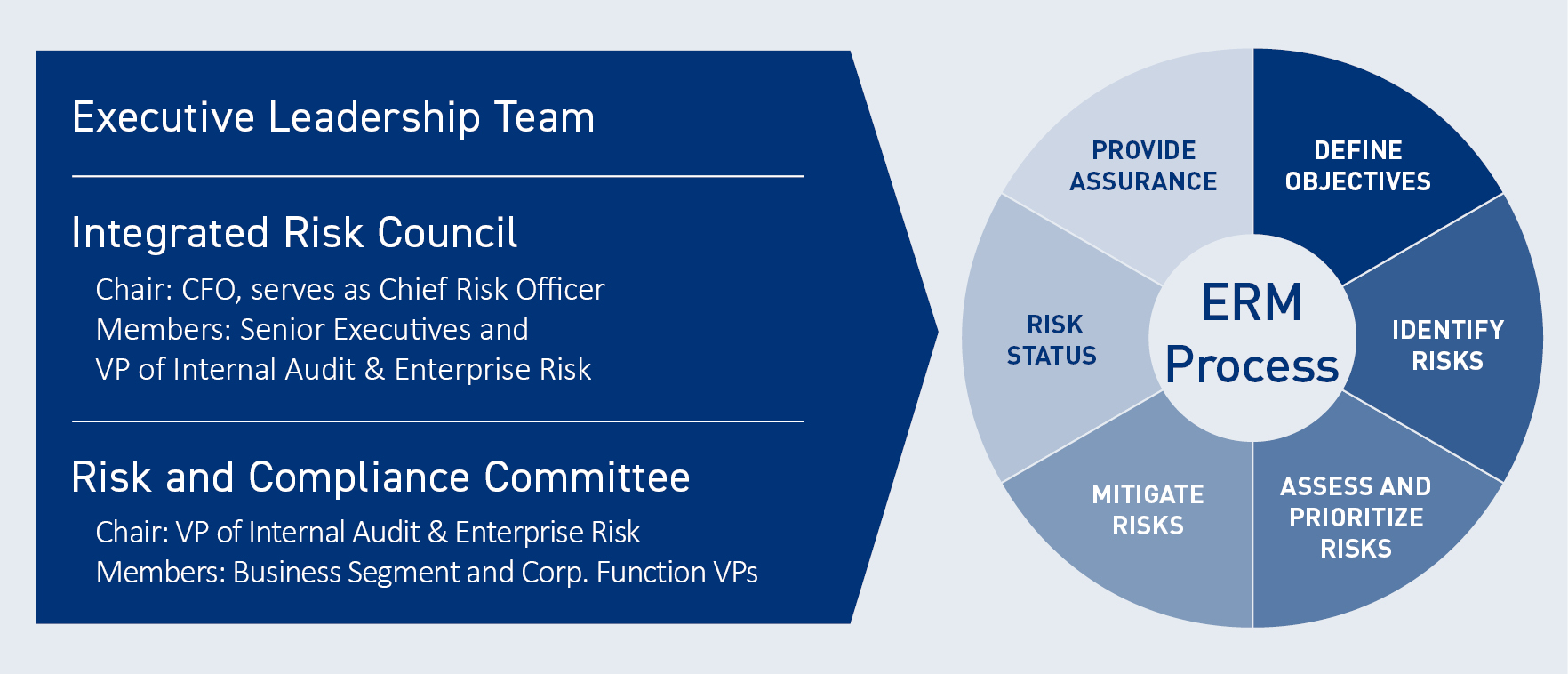
ERM manages risk through risk identification, assessment, controls and mitigation. The two primary components of the ERM process are an annual enterprise risk assessment and a biennial compliance risk assessment.
•The enterprise risk assessment is prepared annually with the engagement of over 1,700 leaders across the Company, including senior executives and internal audit. ERM uses the results of this engagement to prepare an enterprise risk matrix focusing on the top identified risks, and assigns risk owners and recommended mitigation approaches, which are then tracked. The risks assessed are generally ones that could materialize over a one-to-three-year horizon. We also monitor emerging risks, sourced from internal sources, industry benchmarks and external risk management entities.
•The compliance risk assessment is conducted every two years and includes a survey of approximately 800 subject matter experts. The assessment focuses on specialized areas of compliance and sustainability topics, whereas the enterprise risk assessment encompasses strategic and operational risks.
The Risk and Compliance Committee and the Integrated Risk Council, which are detailed below, review and approve the outcome of both assessments and their recommended mitigation actions. Subsequently, the results, which inform our public disclosures, are reported to the Audit Committee.
Risk management is built into decision-making processes at all levels across the Company. We view ERM as inextricably linked with our internal control environment and, as such, there is an overarching policy that covers both internal control and ERM. We also have other key processes designed to reduce risk, including executive proposal reviews, disclosure controls committee risk reviews and comprehensive external and internal audit processes.
12 | 2026 Proxy Statement | | ||||||||||||
The Board evaluates numerous dynamic and emerging risk focus areas
The full Board retains primary oversight of the following risks due to their importance to our stakeholders.
Extensive cybersecurity protections
•Senior leadership, including our Chief Information Security Officer (CISO), regularly updates the Board on our cybersecurity and information security posture and cybersecurity incidents deemed to have a moderate or higher business impact, even if immaterial to us.
•Senior leadership briefs the CBS Committee on the cybersecurity of classified programs and the security of our classified business supply chain.
•Cybersecurity-related risks are integrated into our overall ERM process, and we maintain cybersecurity insurance to further mitigate associated risks.
Ethical, governable artificial intelligence development & deployment
•The full Board reviews our AI strategy with senior leadership, including the Chief Digital and Artificial Intelligence Officer.
•We analyze AI risks through our ERM process, discuss them with the Audit Committee and, in the context of our classified programs, discuss them with the CBS Committee.
•The Governance Committee oversees our 2025 Sustainability Management Plan (SMP), which includes an achieved goal for providing AI developers with training on system engineering approaches to AI ethical principles.
•Our Code of Ethics and Business Conduct (Code of Conduct) and our “Ethical Development and Use of Artificial Intelligence” policy guide the Company’s development and use of AI. Our cross-enterprise AI Ethics Subcommittee meets monthly to oversee AI design, development, deployment and use aligned to our adopted principles for the responsible use of AI: responsible, equitable, traceable, reliable and governable. The subcommittee reports quarterly to the AI Executive Steering Committee.
•Both our Senior Vice President, Technology and Strategic Innovation and our Senior Vice President, Ethics and Enterprise Assurance review performance on a periodic basis and serve as the Executive Leadership Team’s leaders responsible for ethical use of AI.
In addition, the Governance Committee has primary oversight of the following risks that target particular stakeholders.
Transparent and value-driven political spending
•The Governance Committee receives management reports and reviews policies related to the purposes and benefits of our political and public policy activities.
•Our website extensively discloses our political and public policy activities beyond what is required by law, highlighting the following core principles: compliance with all applicable laws and regulations; commitment to responsible, ethical and non-partisan participation in the political and public policy process; and representing the best interests of the Company and its stockholders only in areas directly related to our core business interests.
•The Senior Vice President, Chief Public Affairs Officer, manages all political and public policy activities in accordance with established policies and procedures, which are ultimately overseen by the Governance Committee.
Respecting human rights
•We continue to advance global security through cutting-edge technologies that enable the defense forces of our primary customers, the U.S. Government and its allies, to promote deterrence and defend human rights by adhering to U.S. Government oversight and policy objectives for all international sales.
•The Board believes that the Company’s commitment to respecting human rights is an essential element of the Company’s long-term success, underlying our Code of Conduct, overseen by the Governance Committee, and our Core Values. This commitment is embodied in our human rights policy, available on our website, and applies to all employees, the Board and others who represent or act for us. We expect our suppliers to adhere to our Supplier Code of Conduct, which draws from our Code of Conduct and emphasizes our expectation of respect for human rights.
•Our human rights due diligence processes are embedded within our operating and decision-making practices and procedures and guided by U.S. Government laws, regulations and policies.
| | 2026 Proxy Statement | 13 | ||||||||||||
•We have pre-contractual procedures to ensure that new contracts meet our standards and values, including proposal review and approval procedures to evaluate risks.
•We conduct risk-based anti-corruption due diligence, subject to audit, before entering relationships with third parties, including business development and strategic business consultants. We will walk away from business rather than risk violating anti-corruption laws or our corporate values.
•Our robust trade compliance program is designed to ensure that sales of our products are conducted in accordance with all international trade laws and regulations of the United States and each foreign country in which we operate.
•Our employees engage in mandatory training, including training on combating human trafficking, and have access to trusted grievance and reporting mechanisms. We also provide resources and support to our suppliers. These actions align the interests of employees and suppliers within established frameworks to enable oversight of our standards and controls.
•Our international military sales are regulated by the U.S. Government and reviewed and approved by the Executive Branch and subject to Congressional oversight. This includes consideration of whether any arms transfer contributes to the risk of human rights abuses and whether they are being used in potential conflict-affected regions.
•Additionally, in the Foreign Military Sales process, through which we generate the majority of our international sales, the Executive Branch reviews use of our products by non-U.S. customers for compliance with applicable U.S. laws, including the Arms Export Control Act.
Board Strategic Oversight
The Board takes an active role in overseeing strategic planning
The cornerstone of the Board’s strategic planning oversight is an annual session dedicated to a discussion of the Company’s strategy and corresponding financial considerations, giving the Board the opportunity to provide input while the multi-year long-range plan is being developed and to monitor progress on the plan. The Chairman, President and CEO regularly reviews developments against the Company’s strategic framework at Board meetings and provides needed updates between regularly-scheduled sessions, and the COO and CFO similarly share updates and solicit input on the Company’s operational and financial performance against our strategic framework and annual and long-range plans. In addition, the Board and/or its committees:
•Review the progress and challenges to the Company’s strategy and approve specific initiatives, including investments, acquisitions, divestitures and capital expenditures over a certain monetary threshold;
•Regularly review items of strategic interest, such as the Company’s people strategy and AI; and
•Meet with senior management on a rotating basis, including business segment presidents who present to the Board, and business segment chief financial officers who present to the Audit Committee.
The Board discusses management succession planning regularly
Our Board is actively engaged in management succession planning and views CEO succession planning as one of its core responsibilities. The Board regularly reviews our succession strategy and leadership pipeline for key roles, taking into account the Company’s long-term strategy. CEO succession planning discussions are led by the independent Lead Director, and the Board members have direct access to and interaction with members of senior management and high-potential future leaders. The Board of Directors maintains a succession plan for the CEO and other key members of management and has a contingency plan if the CEO were to depart unexpectedly. Company policy imposes a mandatory retirement age of 65 for all executive officers other than the CEO. The CEO’s tenure is at the discretion of the independent members of the Board.
14 | 2026 Proxy Statement | | ||||||||||||
Our people strategy is an integral part of our business strategy
The Board understands that our workforce is a critical asset integral to the Company’s business strategy. Due to the specialized nature of our business, our performance depends on identifying, attracting, developing, motivating and retaining a highly skilled workforce in multiple areas, including engineering, science, manufacturing, artificial intelligence, software development, information technology, cybersecurity, business development, strategy and management. The Board oversees the Company’s people strategy in several ways, including:
•Receiving briefings from the Senior Vice President and Chief Human Resources Officer on the Company’s people strategy, including measures used to manage our workforce such as critical skills, attrition, hiring, promotions, leadership development and talent management, and results from our employee engagement surveys where we obtain feedback and insight directly from our workforce; and
•Engaging with senior executives and high-potential talent as part of its talent development and succession planning efforts.
Our Company builds high-performing teams
Our mission-critical work demands high performing teams. We believe that the highest levels of performance are achieved when employees connect with our customers’ missions, embrace a growth mindset to evolve our business and culture, possess and grow the technical skills needed to be competitive and foster a respectful and collaborative culture. We are intentional about building high-performing teams and we provide tailored education and engagement programs for our global workforce.
Employee satisfaction is essential to attracting and retaining top talent and building high-performing teams, and we regularly conduct employee engagement surveys to gauge employee satisfaction and to understand the effectiveness of our people strategy and assess employees’ intent to stay. We attract and reward our employees by providing market-competitive compensation and benefits, including incentives and recognition plans that extend to non-represented employees of all levels in our organization, and encourage excellence through our pay-for-performance philosophy. We invest in the development of our employees through training, apprenticeship programs, security clearance sponsorship, leadership development plans and tuition assistance programs for continuing education or industry certifications. We believe this employee development makes us more competitive and assists with leadership succession planning throughout the Company. We also monitor employee attrition across our employee population and take action based on the insights we gain from that monitoring process.
Board Sustainability Oversight
The Governance Committee is primarily responsible for the Board’s oversight of the Company’s sustainability efforts.
We integrate sustainability governance through a risk-management lens
We have a long-standing sustainability program built around fostering innovation, integrity and security across our platforms and services to strengthen communities, steward the environment and grow responsibly. We take an integrated approach to managing corporate culture, ethics and business integrity, governance and sustainability issues through a risk-management lens. Our formal sustainability governance structure, depicted below, is responsible for guiding and implementing our sustainability efforts.
| | 2026 Proxy Statement | 15 | ||||||||||||
 |  |  |  | ||||||||
Board of Directors | Executive Leadership Team | Risk and Compliance Committee | Sustainability Management Team | ||||||||
Chairman, President and CEO Nominating and Corporate Governance Committee | Chairman, President and CEO Chief Operating Officer Chief Financial Officer Functional Senior Vice Presidents Business Segment Presidents | Chair: Vice President, Internal Audit and Enterprise Risk Business Segment Vice Presidents and Corporate Functions | Chair: Director of Sustainability Directors and Senior Managers responsible for functions related to specific SMP goals | ||||||||
Monitors the Company’s adherence to our Code of Conduct and oversees performance in corporate sustainability, employee safety and health, environmental stewardship and ethical business practices. | Oversees the sustainability program, supporting the Lockheed Martin strategic plan by enabling business segments and functions to pursue and implement opportunities and practices that support the sustainability policy. | Oversees ERM to inform senior executives and the Board on risk management efforts. It further provides a forum to review and guide enterprise sustainability initiatives and provide input on SMP execution. | Reviews SMP progress and opportunities for program enhancement and shares internal and external insights and best practices. | ||||||||
Our comprehensive sustainability management plan creates value
Our 2025 Sustainability Management Plan (SMP), developed through an extensive materiality assessment using stakeholder input and industry trends and released in 2020, defines our sustainability goals and drives our progress toward them. As depicted below, the 2025 SMP is centered around four strategic priorities, each of which has subsidiary core issues. The 2025 SMP includes goals and key performance indicators (KPIs) established for each core issue that reflect stakeholder feedback, internal and external trends, and the continued evolution of our business to create value well into the future. These metrics help focus our efforts in the areas that provide value to our stakeholders and our business. We comprehensively report our progress annually in our Sustainability Performance Report and will report final performance against our 2025 SMP in our 2025 Sustainability Performance Report, which will be released in mid-2026. We have developed robust processes to monitor emerging issues and continue to evolve our sustainability efforts between our formal five-year assessments.
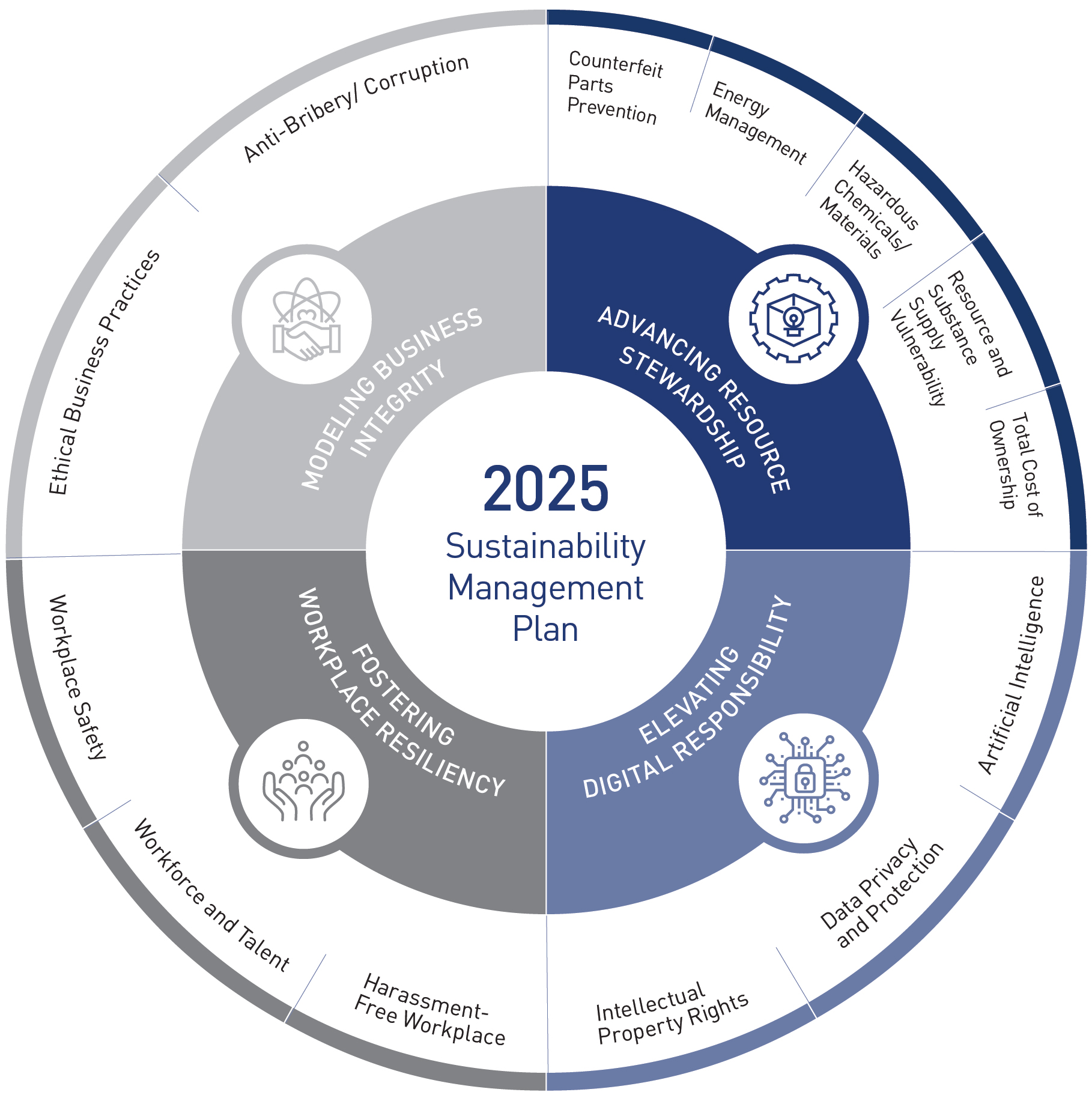 | In 2025, we finalized our latest materiality assessment that engaged more than 8,000 internal and external stakeholders. The process identified, refined and narrowed the material sustainability issues considered most critical to our business and stakeholders from a financial, risk and impact perspective. We look forward to sharing our new set of goals, as defined in our 2030 SMP, on our website in mid-2026. | |||||||||||||
16 | 2026 Proxy Statement | | ||||||||||||
Director Nominees
Proposal 1: Election of Directors | | The Board recommends a vote FOR each director nominee | |||||||||||||||
The Board, upon the recommendation of the Nominating and Corporate Governance Committee, nominates the following nine directors for election to the Board for a one-year term. If elected, each director will hold office until the 2027 Annual Meeting and until their successor is elected and qualified. Please see the following pages for additional information on the director nominees.
| James D. Taiclet Age: 65 Director Since: 2018 | |||||||||||||
CHAIRMAN | ||||||||||||||
Chairman, President & CEO, Lockheed Martin Corporation Committees: None Other Public Boards: None | ||||||||||||||
 | John C. Aquilino Age: 64 Director Since: 2024 | |||||||||||||
INDEPENDENT | ||||||||||||||
Retired United States Navy Admiral Committees: C Other Public Boards: None . | ||||||||||||||
 | David B. Burritt Age: 70 Director Since: 2008 | |||||||||||||
INDEPENDENT | ||||||||||||||
President & CEO, United States Steel Corporation (U.S. Steel) Committees: A, M Other Public Boards: None | ||||||||||||||
| John M. Donovan Age: 65 Director Since: 2021 | |||||||||||||
INDEPENDENT | ||||||||||||||
Retired CEO, AT&T Communications, LLC Committees: C, M* Other Public Boards: Palo Alto Networks, Inc. . . | ||||||||||||||
| Thomas J. Falk Age: 67 Director Since: 2010 | |||||||||||||
INDEPENDENT LEAD DIRECTOR | ||||||||||||||
Retired Chairman & CEO, Kimberly-Clark Corporation Committees: N* Other Public Boards: AbbVie Inc. . | ||||||||||||||
 | Vicki A. Hollub Age: 66 Director Since: 2018 | |||||||||||||
INDEPENDENT | ||||||||||||||
President & CEO, Occidental Petroleum Corporation Committees: A, M Other Public Boards: Occidental Petroleum Corporation | ||||||||||||||
 | Debra L. Reed-Klages Age: 69 Director Since: 2019 | |||||||||||||
INDEPENDENT | ||||||||||||||
Retired Chairman, President & CEO, Sempra Energy Committees: M, N Other Public Boards: Chevron Corporation; Caterpillar Inc. | ||||||||||||||
 | Heather A. Wilson Age: 65 Director Since: 2024 | |||||||||||||
INDEPENDENT | ||||||||||||||
President, University of Texas at El Paso Former Secretary of the United States Air Force Committees: C Other Public Boards: None | ||||||||||||||
| Patricia E. Yarringtion Age: 69 Director Since: 2021 | |||||||||||||
INDEPENDENT | ||||||||||||||
Retired Chief Financial Officer, Chevron Corporation Committees: A*, C Other Public Boards: None | ||||||||||||||
A | Audit | M | Management Development and Compensation | * | Chair | ||||||||||||||||||
C | Classified Business and Security | N | Nominating and Corporate Governance | ||||||||||||||||||||
| | 2026 Proxy Statement | 17 | ||||||||||||
Director Nominees’ Strategic Expertise and Core Competencies
The matrix below illustrates how our directors, individually and as a group, possess the requisite skills and experience to provide disciplined, effective oversight of our Company and help us deliver on our commitments to stockholders and customers. The Board believes these enablers are the differentiators that allow our directors to cohesively address the current and future needs of our business. The directors continually enhance their expertise and competencies through their outside engagements, service on our Board, and targeted development efforts.
STRATEGIC EXPERTISE |  |  |  |  |  |  |  |  |  | |||||||||||||||||||||||
 | Drive Operational Excellence | |||||||||||||||||||||||||||||||
| We know that performance is what matters – for the warfighter, for our customers, for our team, and for our investors – and we are driving operational excellence across our business to achieve high-quality, efficient, and consistent performance | l | l | l | l | l | l | l | l | l | |||||||||||||||||||||||
 | Navigate Industry Reformation | |||||||||||||||||||||||||||||||
Our customers require – and we are delivering – rapid, scalable and cost-effective advanced solutions to promote deterrence and address an evolving threat landscape, and to do that we are shifting our business practices to meet our customers’ needs | l | l | l | l | ||||||||||||||||||||||||||||
 | Grow our Business | |||||||||||||||||||||||||||||||
We are growing organically, including domestically, through first-of-a-kind framework agreements with the U.S. Government, internationally, within the more than 50 countries in which we have a presence, and inorganically, through strategic investments, ventures, acquisitions and divestitures | l | l | l | l | l | l | l | l | l | |||||||||||||||||||||||
 | Insert Defense Tech Across our Offerings | |||||||||||||||||||||||||||||||
| We are leading the charge to provide the best of defense and commercial technology – including AI, autonomy, digital and networking open architecture, and hypersonics – across all our offerings to make forces agile, adaptive and unpredictable, so that they stay ready for any mission—today and in the future | l | l | l | l | ||||||||||||||||||||||||||||
 | Partner Differently | |||||||||||||||||||||||||||||||
We are disrupting the traditional defense industrial base model by collaborating with innovative commercial companies and new defense entrants to leverage the best of our offerings and develop new business models that support our customers’ most critical missions | l | l | l | l | l | l | l | l | l | |||||||||||||||||||||||
 | Transform our Business | |||||||||||||||||||||||||||||||
We are investing ahead of need through our 1LMX effort to fully transform our Company’s digital backbone and business processes to deliver solutions with speed, agility and insight | l | l | l | l | l | l | l | |||||||||||||||||||||||||
CORE COMPETENCIES | ||||||||||||||||||||||||||||||||
 | Senior Leaders | |||||||||||||||||||||||||||||||
Public company C-suite executives, government leaders and military officers, academic thought leaders and others with experience leading large, complex, dynamic organizations | l | l | l | l | l | l | l | l | l | |||||||||||||||||||||||
 | Financial Experts | |||||||||||||||||||||||||||||||
Understand public company financial statements, shareholder expectations, and, for Audit Committee membership, have additional experience and expertise in financial reporting and capital allocation | l | l | l | l | l | l | l | |||||||||||||||||||||||||
 | Tech Savvy | |||||||||||||||||||||||||||||||
Professional experience in advanced technologies including cybersecurity, artificial intelligence, networking and communications, advanced manufacturing, and aerospace, defense, and intelligence disciplines | l | l | l | l | ||||||||||||||||||||||||||||
 | Future Focused | |||||||||||||||||||||||||||||||
| Understand that the nature of our business is changing rapidly and understand the intersection of technology, business, policy, sustainability risks and opportunities | l | l | l | l | l | l | l | l | l | |||||||||||||||||||||||
 | Customer Centric | |||||||||||||||||||||||||||||||
| Intimately understand our customers’ needs and missions, national politics and geopolitical matters, including through service in government or the military | l | l | l | |||||||||||||||||||||||||||||
18 | 2026 Proxy Statement | | ||||||||||||
Director Nominee Biographies
| James D. Taiclet Chairman, President and CEO Director since 2018 Age 65 Committees None | | Thomas J. Falk Independent Lead Director Director since 2010 Age 67 Committees Nominating and Corporate Governance, Chair | ||||||||||||||||||||||||||||||||||||||
Experience, Strategic Expertise and Core Competencies | Experience, Strategic Expertise and Core Competencies | ||||||||||||||||||||||||||||||||||||||||
| Customer Centric | | Drive Operational Excellence | | Drive Operational Excellence | | Financial Expert | ||||||||||||||||||||||||||||||||||
| Financial Expert | | Future Focused | | Future Focused | | Grow our Business | ||||||||||||||||||||||||||||||||||
| Grow our Business | | Insert Defense Tech Across our Offerings | | Partner Differently |  | Transform our Business | ||||||||||||||||||||||||||||||||||
| Navigate Industry Reformation | | Partner Differently | ||||||||||||||||||||||||||||||||||||||
| Senior Leader | | Tech Savvy | ||||||||||||||||||||||||||||||||||||||
| Transform our Business | ||||||||||||||||||||||||||||||||||||||||
Mr. Taiclet brings extensive strategic and operational leadership experience across the aerospace, defense and global infrastructure sectors. He is driving a vision for a more commercial and resilient defense industrial base that accelerates advanced digital and physical technologies into critical national security missions to continually improve capabilities and deter armed conflict. Prior to joining Lockheed Martin, as Chairman and Chief Executive Officer of American Tower Corporation, he expanded the real estate investment trust’s market capitalization from roughly $2 billion to more than $100 billion. As a former U.S. Air Force officer and pilot, Mr. Taiclet has logged over 5,000 flying hours (most of those in a Lockheed C-141B StarLifter) and brings a nuanced perspective on national security, technology modernization and the evolving defense industrial base. | Mr. Falk has substantial leadership and change management experience from his time leading Kimberly Clark, serving on the Dallas Fed Board of Governors until 2025, and serving on our Board since 2010. Notably, through his board service Mr. Falk has provided oversight of the Company across three Chief Executive Officers and four presidential administrations, which has provided him with a unique perspective on our Company, the broader defense industrial base and the opportunities and challenges that arise when defense needs and budgets evolve due to the changing geopolitical and threat landscape. | ||||||||||||||||||||||||||||||||||||||||
Selected Professional Experience | Selected Professional Experience | ||||||||||||||||||||||||||||||||||||||||
•Chairman since March 2021 and President and CEO of Lockheed Martin since June 2020 •Chairman, President and CEO of American Tower Corporation from 2004 until March 2020 and Executive Chairman from March 2020 to May 2020 •President of Honeywell Aerospace Services, a unit of Honeywell International and Vice President, Engine Services of Pratt & Whitney, a unit of then-United Technologies Corporation | •Executive Chairman of Kimberly-Clark Corporation from January 2019 through December 2019 •Chairman and CEO of Kimberly-Clark from 2003 until December 2018 (CEO since 2002) •President and COO of Kimberly-Clark from 1999 to 2002 | ||||||||||||||||||||||||||||||||||||||||
Other Public Company Boards Within Last 5 years | Other Public Company Boards Within Last 5 years | ||||||||||||||||||||||||||||||||||||||||
None | AbbVie Inc. (2025 - present) | ||||||||||||||||||||||||||||||||||||||||
| | 2026 Proxy Statement | 19 | ||||||||||||
| John C. Aquilino Independent Director Director since 2024 Age 64 Committees Classified Business and Security | | David B. Burritt Independent Director Director since 2008 Age 70 Committees Audit; Management Development and Compensation | ||||||||||||||||||||||||||||||||||||||
Experience, Strategic Expertise and Core Competencies | Experience, Strategic Expertise and Core Competencies | ||||||||||||||||||||||||||||||||||||||||
| Customer Centric | | Drive Operational Excellence | | Drive Operational Excellence | | Financial Expert | ||||||||||||||||||||||||||||||||||
| Future Focused | | Grow our Business | | Future Focused | | Grow our Business | ||||||||||||||||||||||||||||||||||
| Insert Defense Tech Across our Offerings | | Navigate Industry Reformation | | Partner Differently | | Senior Leader | ||||||||||||||||||||||||||||||||||
| Partner Differently | | Senior Leader | | Transform our Business | ||||||||||||||||||||||||||||||||||||
| Tech Savvy | ||||||||||||||||||||||||||||||||||||||||
Admiral Aquilino brings extensive expertise with our core customer and industry to our Board. Admiral Aquilino retired from the United States Navy in 2024 as a Four Star Admiral following 40 years of distinguished service. He contributes a wide array of senior leadership experience and a comprehensive understanding of our customers’ evolving requirements. Admiral Aquilino has served as a fighter pilot in every geographic combatant command and has participated in nearly every major military operation since his commissioning in 1984. He later served as the 26th Commander of the U.S. Indo-Pacific Command, the nation’s largest combatant command responsible for all U.S. military activities in the Indo-Pacific. Admiral Aquilino serves on the Board of Directors of Hawaiian Electric Company, Inc., the wholly-owned principle operating subsidiary of Hawaiian Electric Industries, Inc. | Mr. Burritt has a comprehensive understanding of our business and industry as our Company has evolved to meet the demands resulting from new domestic and international customer needs and opportunities. Mr. Burritt garnered extensive expertise in managing and transforming complex manufacturing operations around the world during his nearly 50 year career, including with Caterpillar Inc., where he served as CFO, and United States Steel Corporation (U.S. Steel), where he has served as CFO, COO and President and CEO. | ||||||||||||||||||||||||||||||||||||||||
Selected Professional Experience | Selected Professional Experience | ||||||||||||||||||||||||||||||||||||||||
•Four Star U.S. Navy Admiral retiring in 2024 after 40 years of service, including as the 26th Commander of the U.S. Indo-Pacific Command from 2021 until his retirement; Commander of the U.S. Pacific Fleet; Commander of the U.S. Fifth Fleet and Naval Forces Central Command; and Commander of Carrier Strike Group 2 •Fighter pilot in every geographic combatant command and in nearly every major military operation since 1984, including Operations Deliberate Force, Southern Watch, Enduring Freedom, Iraqi Freedom and Inherent Resolve | •President and CEO of U.S. Steel since 2017 •President and COO of U.S. Steel in 2017 •Executive Vice President and CFO of U.S. Steel from 2013 to 2017 •CFO of Caterpillar Inc. until his retirement in 2010, after more than 32 years with the company | ||||||||||||||||||||||||||||||||||||||||
Other Public Company Boards Within Last 5 years | Other Public Company Boards Within Last 5 years | ||||||||||||||||||||||||||||||||||||||||
None | U.S. Steel (Executive Committee) (2017 - 2025) | ||||||||||||||||||||||||||||||||||||||||
20 | 2026 Proxy Statement | | ||||||||||||
| John M. Donovan Independent Director Director since 2021 Age 65 Committees Classified Business and Security; Management Development and Compensation, Chair | | Vicki A. Hollub Independent Director Director since 2018 Age 66 Committees Audit; Management Development and Compensation | ||||||||||||||||||||||||||||||||||||||
Experience, Strategic Expertise and Core Competencies | Experience, Strategic Expertise and Core Competencies | ||||||||||||||||||||||||||||||||||||||||
| Drive Operational Excellence | | Financial Expert | | Drive Operational Excellence | | Financial Expert | ||||||||||||||||||||||||||||||||||
| Future Focused | | Grow our Business | | Future Focused | | Grow our Business | ||||||||||||||||||||||||||||||||||
| Insert Defense Tech Across our Offerings | | Navigate Industry Reformation | | Partner Differently | | Senior Leader | ||||||||||||||||||||||||||||||||||
| Partner Differently | | Senior Leader | | Transform our Business | ||||||||||||||||||||||||||||||||||||
| Tech Savvy | | Transform our Business | ||||||||||||||||||||||||||||||||||||||
Mr. Donovan contributes his vast experience in overseeing large organizations as they innovate and invest in technology-enabled solutions, including 5G networks, cybersecurity, and artificial intelligence. Mr. Donovan brings a unique perspective to our Board as both a technologist and an experienced executive leader who, while serving in roles such as Chief Technology Officer, Chief Strategy Officer and Chief Executive Officer, drove the adoption of innovative products and technologies at AT&T and throughout the telecommunications industry. | Ms. Hollub is the President and Chief Executive Officer of Occidental Petroleum Corporation (Occidental), an international oil and gas exploration and production company. She has over 40 years of operational and executive experience at Occidental. Her leadership over complex, multinational supply-chain networks, Occidental’s $55 billion Anadarko acquisition, and enterprise-wide sustainability and technology-driven transformation initiatives equips the Board with a deep understanding of the strategic, technical, and global dimensions of large-scale industrial programs. | ||||||||||||||||||||||||||||||||||||||||
Selected Professional Experience | Selected Professional Experience | ||||||||||||||||||||||||||||||||||||||||
•CEO of AT&T Communications, LLC, a wholly owned subsidiary of AT&T Inc. responsible for AT&T’s telecommunications and video services, from 2017 until his retirement in 2019 •Chief Strategy Officer and Group President of AT&T Technology and Operations from 2012 to 2017 •Chief Technology Officer of AT&T from 2008 to 2012 •Chair of the President’s National Security Telecommunications Advisory Committee from 2019 to 2023 | •President and CEO of Occidental Petroleum Corporation (Occidental) since 2016 •President and COO of Occidental from 2015 to 2016 •Senior Executive Vice President, Occidental and President, Oxy Oil and Gas - Americas from 2014 to 2015 •Executive Vice President, Occidental and Executive Vice President, U.S. Operations and Oxy Oil and Gas from 2013 to 2014 | ||||||||||||||||||||||||||||||||||||||||
Other Public Company Boards Within Last 5 years | Other Public Company Boards Within Last 5 years | ||||||||||||||||||||||||||||||||||||||||
Palo Alto Networks, Inc. (Lead Director; ESG and Nominating, Co-Chair; Security Committee, Chair; Compensation and People) (2012 - present) | Occidental (2015 - present) | ||||||||||||||||||||||||||||||||||||||||
| | 2026 Proxy Statement | 21 | ||||||||||||
| Debra L. Reed-Klages Independent Director Director since 2019 Age 69 Committees Management Development and Compensation; Nominating and Corporate Governance | | Heather A. Wilson Independent Director Director since 2024 Age 65 Committees Classified Business and Security | ||||||||||||||||||||||||||||||||||||||
Experience, Strategic Expertise and Core Competencies | Experience, Strategic Expertise and Core Competencies | ||||||||||||||||||||||||||||||||||||||||
| Drive Operational Excellence | | Financial Expert | | Customer Centric | | Drive Operational Excellence | ||||||||||||||||||||||||||||||||||
| Future Focused | | Grow our Business | | Future Focused | | Grow our Business | ||||||||||||||||||||||||||||||||||
| Partner Differently | | Senior Leader | | Insert Defense Tech Across our Offerings | | Navigate Industry Reformation | ||||||||||||||||||||||||||||||||||
| Transform our Business | | Partner Differently | | Senior Leader | ||||||||||||||||||||||||||||||||||||
| Tech Savvy | ||||||||||||||||||||||||||||||||||||||||
Ms. Reed-Klages contributes a comprehensive portfolio of senior leadership experience in energy infrastructure and highly regulated industries to our Board. As the retired Chairman, Chief Executive Officer and President of Sempra Energy (Sempra), she oversaw the development, investment and operation of a multi-billion dollar portfolio of electric and gas infrastructure assets across North and South America, steering the company through major renewable energy transformations, complex regulatory environments and capital intensive projects. This combination of strategic, financial and technical experience equips her to advise the Board on complex regulatory environments, business transformations, multinational operations and evolving technology landscapes. | Dr. Wilson brings a broad portfolio of leadership across government, academia, and technology to our Board. As the 24th Secretary of the U.S. Air Force (2017‑2019), she oversaw the welfare of 666,000 Active‑Duty, Guard, Reserve and civilian forces and managed an annual budget of more than $138 billion. Dr. Wilson is the current President of the University of Texas at El Paso, ranked among the top public research universities nationwide, and previously served as President of the South Dakota School of Mines & Technology, following distinguished service as a Congresswoman from New Mexico in the U.S. House of Representatives (1998‑2009), where she served on the Armed Services, Intelligence and Energy & Commerce Committees. Dr. Wilson’s extensive background in Air Force acquisition, congressional oversight, and research-university leadership gives our Board a distinctive perspective on Lockheed Martin’s position within the defense industrial base and as an engine for innovation. | ||||||||||||||||||||||||||||||||||||||||
Selected Professional Experience | Selected Professional Experience | ||||||||||||||||||||||||||||||||||||||||
•Executive Chairman of Sempra Energy from May 2018 to December 2018 •Chairman (2012-2018), President (2017-2018) and CEO (2011-2018) of Sempra Energy •Executive Vice President of Sempra Energy and President and CEO of SDG&E and SoCalGas, Sempra Energy’s regulated California utilities •President, COO and CFO of SDG&E and SoCalGas | •President of the University of Texas at El Paso since 2019 •Secretary of the U.S. Air Force from 2017 to 2019 •President of the South Dakota School of Mines & Technology from 2013 to 2017 •Member of the U.S. House of Representatives from 1998 to 2009 representing New Mexico, serving on the House Armed Services Committee, the House Permanent Select Committee on Intelligence and the House Energy and Commerce Committee | ||||||||||||||||||||||||||||||||||||||||
Other Public Company Boards Within Last 5 years | Other Public Company Boards Within Last 5 years | ||||||||||||||||||||||||||||||||||||||||
Chevron Corporation (Audit, Chair) (2018 - present) Caterpillar Inc. (Lead Independent Director; Nominating and Governance, Chair; Executive) (2015 - present) | Maxar Technologies, Inc. (2021 - 2023) | ||||||||||||||||||||||||||||||||||||||||
22 | 2026 Proxy Statement | | ||||||||||||
| Patricia E. Yarrington Independent Director Director since 2021 Age 69 Committees Audit, Chair; Classified Business and Security | ||||||||||||||||
Experience, Strategic Expertise and Core Competencies | |||||||||||||||||
| Drive Operational Excellence | | Financial Expert | ||||||||||||||
| Future Focused | | Grow our Business | ||||||||||||||
| Partner Differently | | Senior Leader | ||||||||||||||
| Transform our Business | ||||||||||||||||
Ms. Yarrington contributes deep financial and operational leadership experience forged through more than 38 years in the energy sector to our Board. As Vice President and Chief Financial Officer of Chevron Corporation (Chevron), she oversaw a global finance organization, managed risk, disclosure, and financial system management and oversaw the financial aspects of the company’s digital business transformation. Earlier roles at Chevron—including Treasury, Government & Public Affairs, and Strategic Planning—provided her with extensive experience in international business expansion, M&A, and sustainability. Ms. Yarrington’s extensive background in public company accounting, internal controls, and overseeing multi-billion dollar financial statements makes her exceptionally qualified to chair the Audit Committee. | |||||||||||||||||
Selected Professional Experience | |||||||||||||||||
•Vice President and Chief Financial Officer of Chevron Corporation from 2009 to 2019 •Previously at Chevron, Vice President and Treasurer, 2007 to 2008; Vice President of Policy, Government and Public Affairs, 2002 to 2007 and Vice President of Strategic Planning, 2000 to 2002 •Served as director of Chevron Phillips Chemical Company LLC (a 50-50 joint venture with Phillips 66) and the Federal Reserve Bank of San Francisco, serving as the Chairman of the Bank’s board from 2013 to 2014 | |||||||||||||||||
Other Public Company Boards Within Last 5 years | |||||||||||||||||
None | |||||||||||||||||
| | 2026 Proxy Statement | 23 | ||||||||||||
Director Nomination Process
Our Board’s nomination and selection process is rigorous and dynamic
Our Board seeks a dynamic boardroom culture that encourages independent thought and intelligent debate on critical matters to achieve a higher level of success for the Company and its stockholders. Achieving this goal requires the right mix of people who bring different perspectives, business and professional experiences, and competencies, as well as professional integrity, sound judgment and collegiality, and who will expand or complement the Board’s existing expertise in overseeing a global security and aerospace company. As part of the Board’s continuous refreshment process, we maintain a robust pipeline of director candidates who we are actively evaluating. Given the complex needs and circumstances of our business and resulting needs of our Board, including the importance of considering candidates with knowledge of our key customers and classified business and security credentials, our refreshment process requires time to identify and nominate the most suitable candidates.
| 1 | Assess the Board’s needs The Governance Committee and Board, as a whole, consider both the short- and long-term strategies of the Company to determine what current and future expertise and experiences are required of the Board in exercising its oversight function. Board succession planning is a topic at every meeting. | ||||||||||||||||
| 2 | Identify candidates The Board seeks candidates who, at a minimum, possess the background, skills, expertise and time to make a significant contribution to the Board, to the Company and its stockholders. Board members primarily recommend potential candidates to the Board for nomination, drawing upon their professional networks. The Chairman, independent Lead Director or Governance Committee then screens those candidates. Director candidates also may be identified by stockholders and will be evaluated under the same criteria applied to other director nominees and considered by the Governance Committee. Information on the process and requirements for stockholder nominees may be found in Sections 1.10 and 1.11 of our Bylaws (available at www.lockheedmartin.com/corporate-governance). | ||||||||||||||||
| 3 | Review and evaluate candidates Our Governance Guidelines (available at www.lockheedmartin.com/corporate-governance) list criteria against which candidates are evaluated, including: •needs identified from the Board’s self-assessment process; •investor feedback; •alignment of the candidates’ expertise and competencies to the Company’s future strategic challenges and opportunities; •needs in light of Board retirements or resignations; •a balance between public company and government customer-related experience; •candidates’ other time commitments, including service on boards of other companies; and •for incumbent directors, attendance, past performance on the Board and contributions to the Board and Board committees. | ||||||||||||||||
| 4 | Interview and recommend candidates The Chairman, independent Lead Director and other Board members interview highly accomplished candidates and provide their input to the Governance Committee. The Governance Committee then recommends, and the Board then votes on, the selected candidate. | ||||||||||||||||
24 | 2026 Proxy Statement | | ||||||||||||
Our Board considers director tenure
Refreshment over time is critical to ensuring that the Board maintains an appropriate balance of tenure, perspective, expertise and experience. The Board believes it is desirable to maintain a mix of longer-tenured, experienced directors who have developed increased knowledge and insight into the Company’s operations, and newer directors with fresh perspectives and new ideas. Our Bylaws and Governance Guidelines provide that a director is not eligible to be renominated for election at the annual meeting following their 75th birthday unless the Board grants an exemption after considering the expertise, experience, background and perspectives of the director and their ongoing contributions to the Board. We do not have term limits for directors, as they can result in losing unnecessarily the contributions of experienced directors. Each director’s continued service will be re-considered annually as part of the annual Board self-evaluation and nomination process.
Director Commitments, Onboarding and Stock Ownership Guidelines
Our Board evaluates directors’ other commitments
The Board recognizes that its members benefit from service on the boards of other companies, and it encourages such service provided that directors dedicate sufficient time to their service on the Company’s Board. Our Governance Guidelines include a policy limiting public company board service without obtaining the approval of the Governance Committee, as set forth below. The Governance Committee, as part of its annual director nomination process, evaluated the commitments of our director nominees and confirmed that all are compliant with this policy. The Governance Committee reviews this policy from time to time.
DIRECTORS A director may not serve on the boards of more than 4 public companies (including Lockheed Martin) | PUBLIC COMPANY CEO Active CEOs or equivalent may not serve on the boards of more than 3 public companies (including Lockheed Martin) | AUDIT COMMITTEE Audit Committee members may not serve on more than 3 public company audit committees (including Lockheed Martin) | ||||||||||||
The Governance Committee also reviews new commitments or changes in responsibility that could potentially interfere with a director’s ability to perform his or her duties and responsibilities, including conflicts of interest, independence or related person transactions, regulatory issues and time commitments. Directors should be expected to resign upon any significant change in principal employment or responsibilities, unless the Governance Committee approves their continued service.
Our directors receive extensive onboarding and continuing education opportunities
New directors are provided a comprehensive orientation about the Company, including our business operations, strategy and governance. New directors have one-on-one sessions with the CEO, the independent Lead Director and members of senior management. New Audit Committee members also have one-on-one sessions with the Company’s independent auditors. Directors are encouraged to attend outside director continuing education programs to assist them in staying abreast of developments in corporate governance and critical issues relating to the operation of public company boards.
We require directors to own a significant amount of Lockheed Martin stock
To align their interests with our stockholders, non-employee directors have five years from the time they join the Board to achieve stock ownership levels (common stock or stock units) equivalent to five times their annual cash retainer. As of December 31, 2025, each non-employee director met the stock ownership guidelines or is on track to timely satisfy them. Mr. Taiclet, as CEO, is subject to the stock ownership requirements described in “Stock Ownership Requirements for Key Employees” on page 43.
| | 2026 Proxy Statement | 25 | ||||||||||||
Director Compensation
Director compensation is an important tool used to attract and retain qualified directors and to address the time, effort, expertise and accountability required of active Board membership. The Governance Committee annually reviews publicly available data for the companies in the comparator group we use for benchmarking executive compensation disclosed in the “Compensation Discussion and Analysis” section (see page 33) and makes recommendations to the Board regarding compensation for non-employee directors.
Although the Governance Committee reviews director compensation annually, it has been the practice of the Governance Committee to recommend changes no more frequently than every two years, and, when making changes, to set compensation above the median with the expectation that compensation will decline relative to the median over the two year cycle. In 2025, Meridian Compensation Partners, acting as independent compensation consultant to the Governance Committee, assisted in its review of director compensation and best practices in director compensation design. Based upon that review and the market data, the Board did not make any changes to director compensation in 2025. The last changes to director compensation were approved by the Board in September 2022 and were effective January 1, 2023. Equity is granted once annually, and the cash retainers are paid in quarterly installments.
Annual Compensation | ||||||||||||||
$170,000 Equity Retainer |  | $170,000 Cash Retainer | | 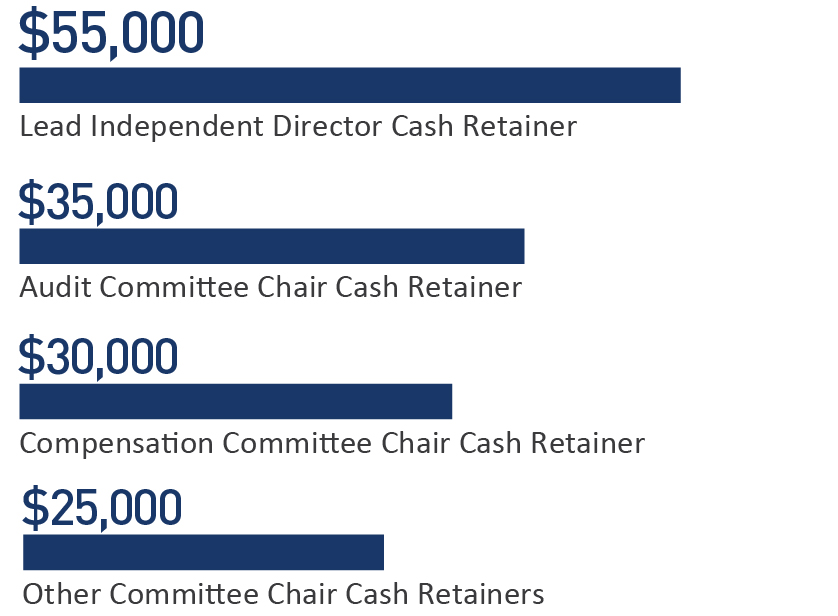 | ||||||||||
Equity Compensation
The annual equity retainer is paid in stock units under the Lockheed Martin Corporation Amended and Restated Directors Equity Plan (Directors Equity Plan). Except in certain circumstances, stock units vest 50 percent on June 30 and 50 percent on December 31 following the grant date. Stock units become fully vested upon a change in control or a director’s retirement, death or disability. Vested stock units are distributed upon a director’s termination of service, at the director’s election, in whole shares of stock or in cash, and in a lump sum or in up to 20 annual installments. Prior to distribution, a director has no voting, dividend or other rights with respect to the stock units, but is credited with additional stock units representing dividend equivalents as they are accrued.
A director who has satisfied the Board’s stock ownership guidelines may elect to have their annual award of stock units (together with any dividend equivalents thereon) paid in a lump sum in whole shares of stock or in cash on the first business day of April following the first anniversary of the grant date. Any director who has not elected early payments or has not satisfied the stock ownership guidelines will have vested stock units paid (along with any accumulated dividend equivalents) upon termination or retirement from the Board. Pursuant to a June 2014 Board resolution, each non-employee director must receive the annual equity retainer in the form of stock units.
Deferred Compensation
Non-employee directors may defer the cash portion of their fees under the Lockheed Martin Corporation Directors Deferred Compensation Plan (Directors Deferred Compensation Plan). At the director’s election, deferred amounts track the performance of: (i) the investment options available under the Salaried Savings Plan, the qualified savings plan for employees, or (ii) our common stock (with dividends reinvested). Deferred amounts are distributed in a lump sum or in up to 15 annual installments commencing at a time designated by the director following termination of service.
26 | 2026 Proxy Statement | | ||||||||||||
2025 Director Compensation Table
The following table provides information on the compensation of our directors for the fiscal year ended December 31, 2025. Mr. Taiclet did not receive separate compensation for service as a director of the Company during 2025.
| Name | Fees Earned or Paid in Cash(1) ($) | Stock Awards(2) ($) | All Other Compensation(3) ($) | Total ($) | ||||||||||
| (a) | (b) | (c) | (g) | (h) | ||||||||||
John C. Aquilino | 170,000 | 170,000 | — | 340,000 | ||||||||||
| David B. Burritt | 170,000 | 170,000 | 357 | 340,357 | ||||||||||
| Bruce A. Carlson | 60,247 | 56,667 | 755 | 117,669 | ||||||||||
| John M. Donovan | 200,000 | 170,000 | 625 | 370,625 | ||||||||||
| Joseph F. Dunford, Jr. | 195,000 | 170,000 | — | 365,000 | ||||||||||
| Thomas J. Falk | 250,000 | 170,000 | — | 420,000 | ||||||||||
| Vicki A. Hollub | 170,000 | 170,000 | 1,000 | 341,000 | ||||||||||
| Debra L. Reed-Klages | 170,000 | 170,000 | 3,041 | 343,041 | ||||||||||
Heather A. Wilson | 170,000 | 170,000 | 1,045 | 341,045 | ||||||||||
| Patricia E. Yarrington | 205,000 | 170,000 | — | 375,000 | ||||||||||
(1)The amounts reported in the Fees Earned or Paid in Cash column reflect the aggregate dollar amount of 2025 fees earned or paid in cash for services as a director, including annual retainer, committee chairman retainer and independent Lead Director retainer.
(2)The amounts reported in the Stock Awards column represent the aggregate grant date fair value computed in accordance with ASC 718 for stock units granted in 2025 under the Directors Equity Plan. For 2025, each independent director other than Mr. Carlson, was credited with 401.7108 stock units with an aggregate grant date fair value of $170,000 vesting 50% on June 30, 2025 and 50% on December 31, 2025. Mr. Carlson was credited with a one-third prorated award of 133.9036 stock units with an aggregate grant date fair value of $56,667 that vested on May 9, 2025 upon his retirement from the Board of Directors at the annual meeting. The grant date fair value of these awards was the closing price of our stock ($423.19) on the date of the grant (February 14, 2025). There were no outstanding unvested stock units as of December 31, 2025. See “Security Ownership of Management and Certain Beneficial Owners” on page 66 for information on the directors’ ownership of shares of Company stock.
(3)The amounts reported in the All Other Compensation column represent (i) matching contributions made to non-profit organizations under the Lockheed Martin Political Action Committee (LMEPAC)’s charity match program in accordance with the LMEPAC’s guidelines applicable to all contributors: Mr. Donovan $625; Ms. Hollub $1,000; and Dr. Wilson $1,000; and (ii) tax assistance provided for a family member accompanying a director for a business purpose. Perquisites and other personal benefits provided to directors did not exceed $10,000 for any individual director.
| | 2026 Proxy Statement | 27 | ||||||||||||
Executive Compensation
Proposal 2: Advisory Vote to Approve the Compensation of our Named Executive Officers (Say-on-Pay) | | The Board recommends a vote FOR this proposal | |||||||||||||||
As required by Section 14A of the Securities Exchange Act of 1934, as amended, we ask our stockholders to vote annually to approve, on an advisory (non-binding) basis, the compensation of our named executive officers (NEOs) as described in detail in the Compensation Discussion and Analysis (CD&A) and the accompanying tables in the Executive Compensation section of this Proxy Statement. This vote is commonly known as Say-on-Pay.
Stockholders should review the entire Proxy Statement including, in particular, the CD&A beginning on page 29 and the Summary Compensation Table and other executive compensation information and tables beginning on page 45, for information on our executive compensation programs and other important items.
We believe that the information provided in this Proxy Statement demonstrates that our executive compensation programs are designed to link pay to performance. Accordingly, the Board recommends that stockholders approve the compensation of our NEOs by approving the following Say-on-Pay resolution:
RESOLVED, that the stockholders of Lockheed Martin Corporation approve, on an advisory basis, the compensation of the named executive officers identified in the “Summary Compensation Table,” as disclosed in the Lockheed Martin Corporation 2026 Proxy Statement pursuant to Item 402 of Regulation S-K, including the Compensation Discussion and Analysis, the compensation tables and the accompanying footnotes and narratives. This vote is not intended to address any specific item of compensation, but rather our overall compensation policies and procedures related to the NEOs. Although the results of the Say-on-Pay vote do not bind the Company, the Board will, as it does each year, continue to review the results carefully and plans to continue to seek the views of our stockholders throughout the year.
Compensation Committee Report
The Management Development and Compensation Committee makes recommendations to the Board of Directors concerning the compensation of the Company’s NEOs. We have reviewed and discussed with management the Compensation Discussion and Analysis that will be included in the Company’s Schedule 14A Proxy Statement, filed pursuant to Section 14(a) of the Securities Exchange Act of 1934, as amended. Based on that review and discussion, we recommended to the Board of Directors that the Compensation Discussion and Analysis be included in the Proxy Statement. The Board approved our recommendation.
| | | | ||||||||||||||
John M. Donovan, Chairman | David B. Burritt | Vicki A. Hollub | Debra L. Reed-Klages | ||||||||||||||
28 | 2026 Proxy Statement | | ||||||||||||
Compensation Discussion and Analysis
This Compensation Discussion and Analysis (CD&A) provides information about our 2025 compensation program and decisions for our 2025 named executive officers (NEOs). Our executive compensation program, underpinned by our pay-for-performance philosophy, delivers compensation to our NEOs that is intrinsically and strongly linked to Company performance.
2025 Leadership Changes
In 2025, our executive leadership team experienced two changes impacting our NEOs:
•Kevin J. O’Connor was appointed as Senior Vice President, General Counsel and Corporate Secretary effective January 13, 2025, replacing Maryanne R. Lavan.
•Evan T. Scott was appointed as Chief Financial Officer effective April 17, 2025, replacing Jesus Malave.
The NEOs currently serving are shown below.
|  |  |  |  | |||||||||||||||||||||||||
James D. Taiclet Chairman, President and Chief Executive Officer Years of Service: 6 years | Evan T. Scott Chief Financial Officer Years of Service: 27 years | Frank A. St. John Chief Operating Officer Years of Service: 39 years | Timothy S. Cahill President Missiles & Fire Control Years of Service: 31 years | Kevin J. O’Connor Senior Vice President, General Counsel and Corporate Secretary Years of Service: 1 year | |||||||||||||||||||||||||
Executive Compensation Highlights
2025 Say-on-Pay Results and Investor Engagement
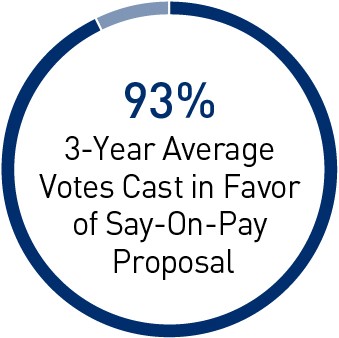 | At our 2025 Annual Meeting, more than 92% of the votes cast by our stockholders approved our Say-on-Pay proposal. We meet with our investors throughout the year to seek their views on the topics that matter most to them and consider their input in our decision making (please see “Board Accountability to Stockholders” on page 9 for more details). | |||||||||||||
Executive Compensation Practices
 | Best Practices in Our Programs |  | Practices we do not engage in or allow | |||||||||||
•Pay aligns with performance •Market-based (50th percentile) approach for determining NEO target pay levels •Caps on annual and long-term incentives, including when Total Stockholder Return (TSR) is negative •Supplemental discretionary clawback policy on variable pay •Double-trigger provisions for change in control •Robust stock ownership requirements •Low equity burn rate and dilution •No payment of dividends or dividend equivalents on unvested equity awards •Annual say-on-pay vote | •No employment agreements •No option backdating, cash-out of underwater options or repricing (no employee options granted since 2012) •No gross-ups upon a change in control •No tax gross-ups on personal use of corporate aircraft •No individual change in control or severance agreements •No automatic acceleration of unvested incentive awards in the event of termination •No enhanced retirement formula or inclusion of long-term incentives in pensions •No enhanced death benefits for executives •No hedging or pledging of Company stock | |||||||||||||
| | 2026 Proxy Statement | 29 | ||||||||||||
2025 Performance & Incentives Summary
2025 was a year of unprecedented demand for Lockheed Martin’s advanced, integrated capabilities. We delivered solid financial results, including sales of approximately $75.0 billion, segment operating profit of $6.7 billion, free cash flow of $6.9 billion and ended the year with a record backlog of $194.0 billion with strong orders from both domestic and international customers. Consistent with the Company’s pay-for-performance philosophy, our results are reflected in the annual and long-term incentive outcomes shown. From a financial perspective, despite the impact of losses recognized on certain classified programs within the Aeronautics and Missiles and Fire Control business segments, which adversely affected segment operating profit performance, performance across other areas of the business reflected the strong demand and execution across our portfolio. During 2025, we achieved several notable operational and technology milestones that demonstrate the application of these priorities. Production and sustainment increased across Aeronautics, Missiles and Fire Control, Rotary and Mission Systems, and Space, including on key programs such as F-35, PAC-3, JASSM/LRASM, HIMARS, CH-53K, and strategic missile defense programs. One of many innovative highlights includes the X-59 Quiet Supersonic Technology (QueSST) aircraft, which completed key flight milestones, advancing low-boom supersonic capability and supporting NASA’s mission to enable future supersonic flight over land. We also continued to mature operational autonomy across air, ground and rotary platforms, demonstrating mission-relevant capabilities designed to enhance survivability and operational flexibility while reducing risk to personnel. Overall, our 2025 performance reflects a continued focus on execution, delivery reliability, and mission outcomes in support of the United States warfighter and its allies. In 2026, we are significantly increasing our investments while maintaining our historical practice of using a disciplined and dynamic approach to capital allocation. | 2025 Financial Performance | |||||||||||||||||||
Sales of $75.0B |  | Segment Operating Profit* of $6.7B |  | |||||||||||||||||
Free Cash Flow* of $6.9B |  | Earnings per Share of $21.49 |  | |||||||||||||||||
* See Appendix A for an explanation of Non-GAAP measures. | ||||||||||||||||||||
2025 Annual Incentive Results | ||||||||||||||||||||
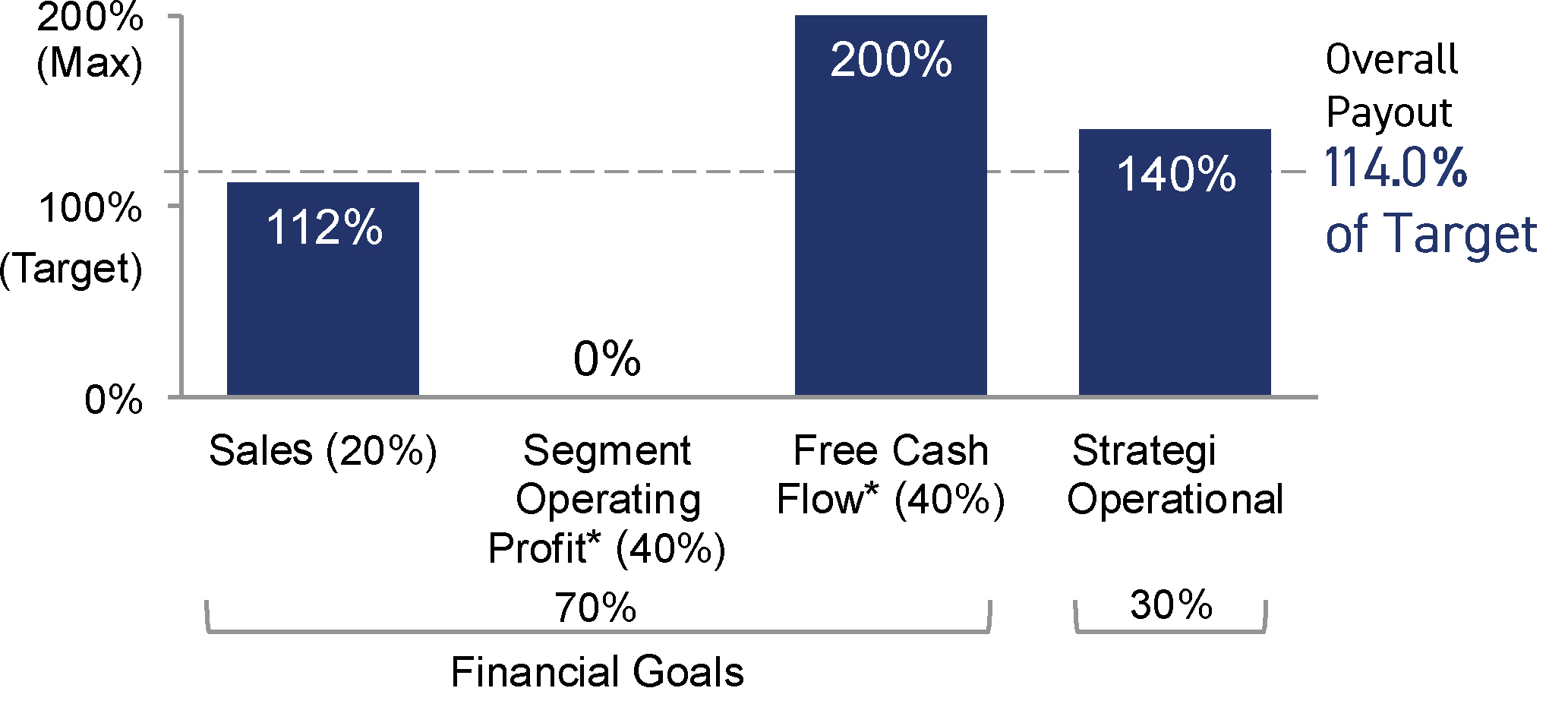 | ||||||||||||||||||||
2023 - 2025 Long-Term Incentive Results | ||||||||||||||||||||
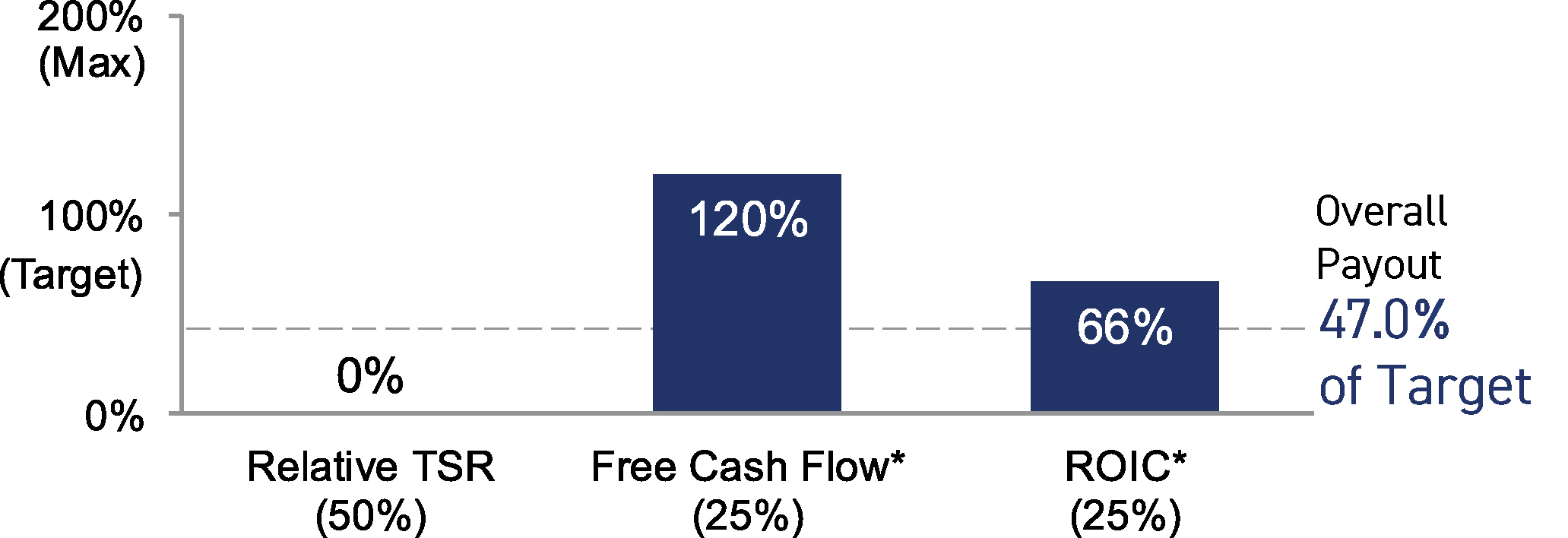 | ||||||||||||||||||||
30 | 2026 Proxy Statement | | ||||||||||||
Compensation Overview
Our executive compensation programs covering our NEOs are designed to attract and retain critical executive talent, to motivate behaviors that align with stockholders’ interests and to pay for performance. The Compensation Committee also considers experience, performance and value in role when setting target compensation levels for our NEOs, while allowing incentive payouts to exceed or fall below the target levels based upon actual performance.
2025 CEO Compensation
2025 CEO Target Pay Mix. We believe that the compensation opportunities of our CEO should be predominantly variable, and the variable elements of the compensation package should tie to the Company’s long-term success and sustainable long-term total returns to our stockholders. As shown in the chart to the right, a significant portion of our CEO’s target compensation is variable and in the form of long-term incentives (LTI) with more than half of total target pay in the form of equity-based incentives. Base Salary. In 2025, Mr. Taiclet’s annual base salary was set at $1,751,000, which has remained unchanged since 2021. 2025 Annual Incentive. Mr. Taiclet’s target annual incentive amount for 2025 was 200% of salary, or $3,502,000. 2025-2027 Long-Term Incentives. In 2025, Mr. Taiclet was granted an annual LTI award of $17 million, which was allocated 50% in Performance Stock Units (PSUs), 30% in Restricted Stock Units (RSUs) and 20% in the cash-based LTI performance award (LTIP). RSUs will cliff-vest after three years, while the payout of PSUs and LTIP will be based upon our results at the end of the three-year performance period relative to the three-year performance goals that were established in the beginning of 2025. Benefit and Retirement Plans. Mr. Taiclet is eligible for benefit and retirement programs, similar to other salaried employees. None of our NEOs received additional years of service credits or other forms of formula enhancements under our benefit or retirement plans. Mr. Taiclet does not participate in our pension plan. | 2025 CEO Target Opportunity Mix * | |||||||
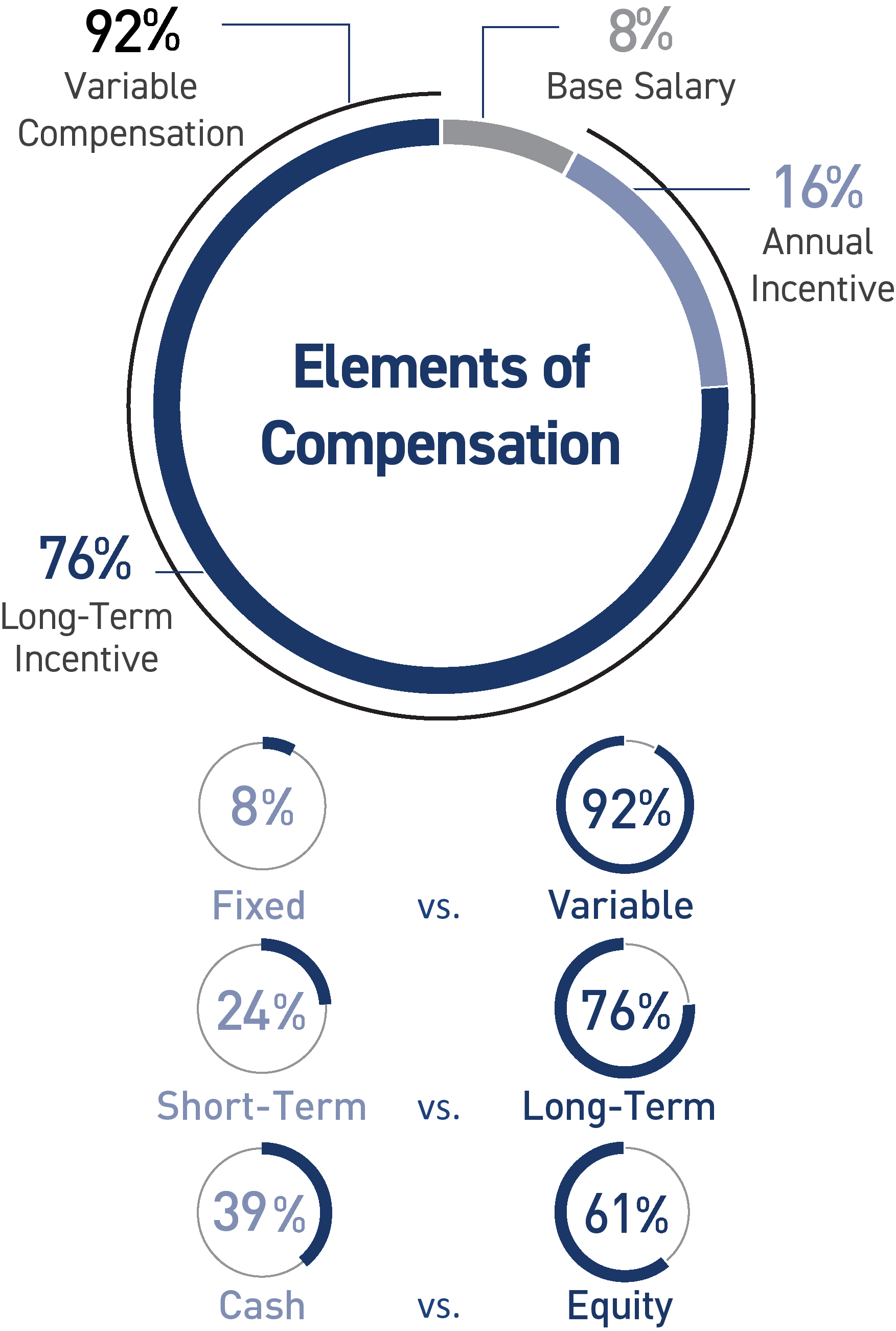 | ||||||||
* Fixed vs. variable and cash vs. equity components are designated in the 2025 Compensation Elements table on page 34. We consider base salary and annual incentives as short-term pay and PSUs, LTIP and RSUs as long-term pay. Cash represents base salary, annual incentive target and LTIP target. We do not include retirement or other compensation components in the chart. | ||||||||
| | 2026 Proxy Statement | 31 | ||||||||||||
Our Compensation Approach
Guiding Pay Principles
Attract, motivate and retain executive talent | Market-based 50th percentile approach on target total compensation | Link executive pay to Company performance | Provide an appropriate mix of short-term vs. long-term pay and fixed vs. variable pay | Align to stockholder interests and long-term Company value | ||||||||||||||||||||||
The compensation best practices described on page 29 also guide and shape our compensation approach.
Our Decision-Making Process
The Compensation Committee seeks input from our CEO and other members of our management team as well as input and advice from an independent compensation consultant to ensure the Company’s compensation philosophy and information relevant to individual compensation decisions are considered. Mr. Taiclet did not participate in the Board’s or the Compensation Committee’s deliberations on his compensation.
Independent Pay Governance
 | INDEPENDENT BOARD MEMBERS |  | INDEPENDENT COMPENSATION COMMITTEE |  | INDEPENDENT COMPENSATION CONSULTANT |  | STOCKHOLDERS & OTHER KEY STAKEHOLDERS | |||||||||||||||||||||||||||||||||||||
Review and approve compensation of the CEO and review and ratify compensation of other NEOs. Review with management, at least annually, the succession plan for the CEO and other senior positions. | Reviews and approves incentive goals relevant to NEO compensation. Reviews and approves the compensation for each NEO. Recommends CEO compensation to the independent members of the Board. | Provides advice on executive pay programs, pay levels and best practices. Provides design advice on incentive vehicles and other compensation programs. | Provide feedback on various executive pay practices and governance through annual Say-on-Pay vote and during periodic meetings with management. | |||||||||||||||||||||||||||||||||||||||||
| Role | Management | CEO | Management Compensation Consultant(1) | Independent Compensation Consultant(2) | Independent Compensation Committee | Independent Board Members | ||||||||||||||
Peer Group / External Market Data and Best Practices for Compensation Design and Decisions | Reviews | Reviews | Develops | Develops / Reviews | Reviews | — | ||||||||||||||
| Annual NEO Target Compensation | — | Recommends | — | Reviews | Approves | Ratify | ||||||||||||||
| Annual CEO Target Compensation | — | — | — | Advises | Recommends | Approve | ||||||||||||||
| Annual and Long-Term Incentive Measures, Performance Targets and Performance Results | Develops | Reviews | — | Reviews | Approves | Ratify | ||||||||||||||
| Long-Term Incentive Grants, Dilution, Burn Rate | Develops | Reviews | — | Reviews | Approves | Ratify | ||||||||||||||
| Risk Assessment of Incentive Plans | Reviews | Reviews | — | Develops | Reviews | — | ||||||||||||||
| Succession Plans | Develops | Reviews | — | — | — | Review | ||||||||||||||
(1)Aon plc (Aon) and Willis Towers Watson
(2)Meridian Compensation Partners (Meridian)
32 | 2026 Proxy Statement | | ||||||||||||
How We Determine Market Rate Compensation
For each of the principal elements of executive compensation, we define the “market rate” as the size-adjusted 50th percentile of our comparator group of companies. Size-adjusted market rates are calculated for us by Aon, using revenue regression analysis. This statistical technique accounts for revenue size differences within the peer group and results in a market rate for all compensation elements consistent with our revenue relationship to our peers. We also may adjust the market rate to reflect differences in an executive’s job scope relative to the industry or the comparator group of companies, as appropriate.
Our NEOs’ target compensation for 2025 was closely aligned to the market rate. When determining pay for our NEOs, the Compensation Committee considers the current market data in combination with other internal factors when setting annual target pay levels, such as changes to market data year-over-year, internal pay equity, individual performance, job scope and criticality to the Company.
Our incentive plans are designed so that actual performance in excess of established performance targets results in payouts above target and actual performance below established performance targets results in payouts below target or no payout.
How We Select the Comparator Group for Market Rate Purposes
The Compensation Committee annually reviews our comparator group to maintain relevancy and to ensure the availability of data, while seeking to avoid significant annual changes in the group to ensure a level of consistency. The criteria used to determine the comparator group is set forth below:
Set an Initial List of Companies Attributes •Traded on a major U.S. exchange •Similarity in annual revenue •Participation in Aon executive compensation survey |  | Apply Refining Criteria to Select Final Comparator Group Refining Criteria •Industrial companies that face similar macro-economic pressures •Companies we compete with for executive talent •Companies with comparable executive officer positions | ||||||
The comparator group data presented to and considered by the Compensation Committee was developed from the proprietary results of the Aon executive compensation survey, subject to review by Meridian. For 2025, Dow Inc. was removed from the comparator group as it no longer participates in the Aon Benchmarking Survey. GE Aerospace was maintained in the comparator group after the completion of the GE Healthcare/Vernova spin-offs. Two new companies, Verizon and Dell Technologies, were added. Our 2025 revenues represented the 65th percentile of the comparator group.
Lockheed Martin Comparator Group
2025 Comparator Group Companies | ||||||||
| 3M Company | GE Aerospace* | Northrop Grumman Corporation* | ||||||
| Caterpillar Inc. | General Dynamics Corporation* | RTX Corporation* | ||||||
| Cisco Systems, Inc. | Honeywell International Inc.* | The Boeing Company* | ||||||
| Deere & Company | HP Inc. | United Parcel Service, Inc. | ||||||
Dell Technologies | IBM Corporation | Verizon | ||||||
| FedEx Corporation | Intel Corporation | |||||||
* Aerospace & Defense Industry | ||||||||
2025 Comparator Group Revenue Percentile | ||||||||
 | ||||||||
| | 2026 Proxy Statement | 33 | ||||||||||||
Leadership Transitions
As mentioned above, there were two key senior leadership changes during 2025.
Mr. Scott was appointed Chief Financial Officer effective April 17, 2025. Target compensation for Mr. Scott was set based on the market rate associated with the Chief Financial Officer role and did not include any special or one-time awards.
Mr. O’Connor was appointed Senior Vice President, General Counsel and Corporate Secretary effective January 13, 2025. Upon his termination of employment with his prior employer, Mr. O’Connor forfeited annual and LTI awards. To offset the value of these awards, Mr. O’Connor received compensation as follows: a $600,000 cash sign-on bonus, primarily to offset his forfeited 2024 annual incentive payout, and an approximately $11 million LTI grant, $7M of which was to offset his forfeited LTI awards. Considering the economic value and vesting schedules of his forfeited LTI awards, the $7 million new hire grant was comprised of time-based RSUs with three-year ratable vesting with the remaining $4 million constituting his 2025 annual grant using the same mix and terms as other NEOs described below.
2025 Compensation Elements
Our compensation programs are designed to provide a mix of short- and long-term compensation, fixed and variable pay and cash and equity-based compensation, as well as to reflect our philosophy of providing pay for performance. Benefit, retirement and perquisite programs are not included in our compensation elements below (information about these programs can be found later in the CD&A).
| Fixed | Variable | ||||||||||||||||||||||||||||
| Base Salary | + | Annual Incentive | + | Long-Term Incentives | |||||||||||||||||||||||||
| 50% PSUs | 20% LTIP | 30% RSUs | |||||||||||||||||||||||||||
| WHAT? | Cash | Cash | Equity | Cash | Equity | ||||||||||||||||||||||||
| WHEN? | Annual | Annual | 3-year Performance Cycle | 3-year Performance Cycle | 3-year Cliff Vesting | ||||||||||||||||||||||||
HOW? Measures, Weightings & Payouts | Market rate, as well as internal pay equity, experience and critical skills | 70% Financial •20% Sales •40% Segment Operating Profit* •40% Free Cash Flow* 30% Strategic & Operational Payout: 0-200% of target | Relative TSR ROIC* Free Cash Flow* | (50%) (25%) (25%) | Value delivered through long-term stock price performance | ||||||||||||||||||||||||
•Award 0-200% of target # of shares •Relative TSR measure capped at 100% if TSR is negative •Value capped at 400% of stock price on date of grant times shares earned | •Payout 0-200% of target •Relative TSR measure capped at 100% if TSR is negative | ||||||||||||||||||||||||||||
| WHY? | Provides competitive levels of fixed pay to attract and retain executives. | Attracts and motivates executives by linking annual Company performance to an annual cash incentive. | Creates strong alignment with stockholder interests by linking long-term pay to key performance metrics and stock price. Provides a balance of internal and market-based measures to assess long-term performance. | Promotes retention of key talent and aligns executive and stockholder interests. | |||||||||||||||||||||||||
* Refer to Appendix A for definitions of non-GAAP measures, including adjustments made for compensation purposes.
34 | 2026 Proxy Statement | | ||||||||||||
Base Salary
Base salaries are reviewed annually taking into account the market rate (50th percentile), the executive’s individual performance and internal pay equity.
2025 Annual Incentive
The 2025 annual incentive plan for our CEO, other NEOs and all other officers elected by the Board was based 70% on financial goals and 30% on strategic and operational goals measured at the enterprise level, as illustrated in the graphic below. Although the annual incentive plan uses a formulaic approach, the Compensation Committee retains discretion in administering the plan, which discretion includes choosing and approving goals, assessing strategic and operational results and modifying payouts based on business segment and individual performance for any officer elected by the Board, including the NEOs. The Compensation Committee did not exercise any discretion in modifying payouts for the NEOs in 2025.

Under the terms of our annual incentive plan, the CEO’s annual incentive and the annual incentive for each of the other NEOs cannot exceed 0.3% and 0.2%, respectively, of Cash from Operations. Annual incentive payouts range from 0% to 200% of target.
2025 Annual Incentive Goals and Results
At its February 2025 meeting, the Compensation Committee approved enterprise-wide objectives for 2025 reflecting financial and strategic and operational goals. These goals are used as the Enterprise Component for all executives in the Company and serve as the only goals for the CEO, NEOs and all other officers elected by the Board.
Financial Assessment (70% Weight). The financial metrics used in the 2025 annual incentive plan were Sales, Segment Operating Profit and Free Cash Flow. The target (100%) payout levels for each metric aligned with the annual financial outlook we disclosed publicly in January 2025. As required by a Compensation Committee resolution adopted in February 2025, the Compensation Committee makes certain adjustments to Free Cash Flow and Segment Operating Profit when calculating incentive compensation so that annual incentive payouts would not be positively or negatively impacted by specified events that would result in a difference between planned and actual financial results. For 2025 and consistent with prior years, the Compensation Committee approved adjustments per its resolution, which only impacted Free Cash Flow and did not relate to our performance or program losses. See Appendix A for a description of these potential adjustments and actual adjustments for 2025. As reflected below and in alignment with our pay for performance philosophy, Segment Operating Profit was primarily impacted by program losses recognized in the second quarter, which reduced the payout for this measure from above target to 0% because the result was below the threshold performance required to generate a payout. This table sets out the 2025 annual incentive financial goals, results, weighting and payout approved by the Compensation Committee:
Measure | Weight | Threshold (50% Payout) | Target (100% Payout) | Maximum (200% Payout) | Calculated Payout | Weighted Payout | ||||||||||||||
| Sales | 20% |  | 112.2% | 22.4% | ||||||||||||||||
Seg. Operating Profit* | 40% |  | 0.0% | 0.0% | ||||||||||||||||
| Free Cash Flow* | 40% |  | 200% | 80% | ||||||||||||||||
| Overall Financial Payout Factor | 102.4% | |||||||||||||||||||
* See Appendix A for definitions of non-GAAP measures.
** For purposes of calculating 2025 performance, the Compensation Committee approved adjustments to Free Cash Flow for unplanned pension contributions (net of tax), tariffs, and the favorable tax impacts from the One Big Beautiful Bill Act (OBBB). See Appendix A for details.
| | 2026 Proxy Statement | 35 | ||||||||||||
Strategic & Operational Assessment (30% Weight). At the start of 2025, the Compensation Committee established a broad set of strategic and operational goals aligned to the Company’s priorities. These strategic and operational goals are both quantitative and qualitative in nature and measured against pre-established criteria using a scorecard approach. When determining the payout factor, the Compensation Committee considers the Company’s results and evaluates performance in totality. Our overall strategic and operational performance was strong across the enterprise and exceeded our goals in multiple areas. The Compensation Committee determined a 140% payout factor to recognize the Company’s strong operational performance in a highly competitive environment while undertaking and executing major strategic initiatives. Key accomplishments are highlighted below.
•Record year-end backlog of $194 billion
•Exceptional performance in Mission Success, 1LMX Progress and Adoption, Model-Based Enterprise Adoption, and OneLM Culture
•Exceeded internal cost-takeout goal and continued targeted investment in digital engineering, manufacturing, and infrastructure to support scalable execution
•Exceptional performance in supply chain growth, including abroad
•Significantly exceeded 21st Century Security Demo outcome goals and subsequent conversions to R&D
•Expanded production and delivery across missile defense and precision strike programs in response to elevated global demand
•Continued strong performance in safety, cyber and environmental stewardship
Summary of Annual Incentive Payout Calculations
The final payout factor, as determined by the Board, is shown below.
Weight | 2025 Factors | Weighted Payout | |||||||||
| Financial | 70% | 102.4% | 72.0% | ||||||||
| Strategic & Operational | 30% | 140.0% | 42.0% | ||||||||
| Overall Payout Factor | 114.0 | % | |||||||||
As shown in the table below, each NEO’s targets are established at the beginning of the year aligned to the market rate. The payout amounts are calculated using the overall Payout Factor based on the time in role.
NEO* | Base Salary ($) | Target % of Salary (%) | Target Award ($) | X | Overall Payout Factor | = | Payout ($) | ||||||||||||||||
| Mr. Taiclet | 1,751,000 | 200 | 3,502,000 | 114% | 3,992,300 | ||||||||||||||||||
Mr. Scott** | 850,000 | 125 | 850,900 | 998,100 | |||||||||||||||||||
Mr. St. John | 1,030,000 | 150 | 1,545,000 | 1,761,300 | |||||||||||||||||||
Mr. Cahill | 995,000 | 120 | 1,194,000 | 1,361,200 | |||||||||||||||||||
Mr. O’Connor*** | 850,000 | 115 | 945,400 | 1,077,700 | |||||||||||||||||||
* Mr. Malave’s employment with the Company terminated in April 2025, and he was not eligible to receive an award.
** Mr. Scott’s annual incentive award values reflect his time serving as a Vice President and as Chief Financial Officer.
*** Mr. O’Connor’s annual incentive award values are prorated to reflect his start date during 2025.
36 | 2026 Proxy Statement | | ||||||||||||
2025 Long-Term Incentive Compensation
The following summary shows the 2025 LTI compensation mix for the NEOs and the principal terms of the awards, with the exception of Mr. Scott, who received his 2025 LTI award, comprised of 50% RSUs, 25% LTIP, and 25% PSUs, in his Vice President role. Mr. Malave forfeited all LTI awards granted in 2025 upon his termination of employment. In addition, stock Mr. Malave received upon vesting of LTI awards granted to him in 2022 was clawed back pursuant to an agreement with Mr. Malave involving a release of claims.
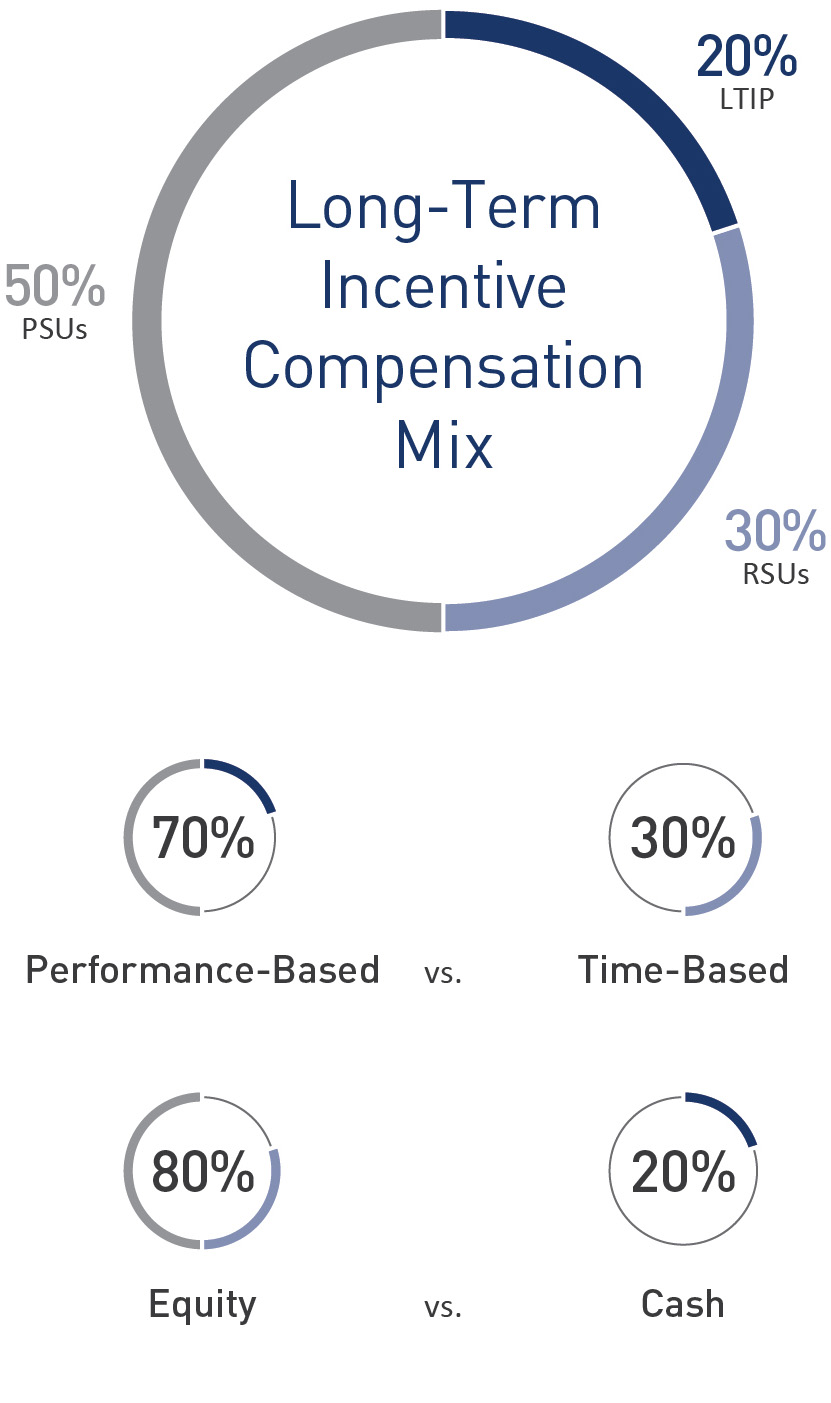 | ||||||||
PSUs (distributed in common stock): Performance Measures: Three-year Relative TSR (50%), ROIC (25%) & Free Cash Flow (25%) Caps: •200% of target shares •Relative TSR measure capped at 100% if the Company’s TSR is negative •Value capped at 400% of stock price on date of grant times shares earned | ||||||||
RSUs (distributed in common stock): Vesting Schedule: RSUs cliff vest 100% three years after the grant date | ||||||||
LTIP (paid in cash): Performance Measures: Three-year Relative TSR (50%), ROIC (25%) & Free Cash Flow (25%) Caps: •200% of target amount •Relative TSR measure capped at 100% if the Company’s TSR is negative •Individual payout capped at $10 million | ||||||||
In determining the appropriate level of equity grants for 2025, the Compensation Committee took into consideration the long-term incentive market rate (50th percentile) along with a variety of other factors, including the number of awards outstanding and shares remaining available for issuance under the Company’s equity incentive plan, the number of shares that would be issued under contemplated awards over the range of potential performance achievement, the total number of the Company’s outstanding shares, the resulting implications for stockholder dilution and the number of shares granted to our executives year-over-year.
 | |||||
| PSU Awards (50% of the LTI award) | |||||
PSU awards generally are calculated by multiplying the overall target LTI award value (as shown in the table on page 34) by the 50% weighting assigned to the PSU portion. The number of PSUs granted is determined based on the closing stock price of the Company’s common stock on the NYSE on the date of grant. Each NEO’s PSU target number of shares is determined as of the grant date of the award, and the actual number of shares earned at the end of the period is calculated based on our performance measured against the three financial metrics as follows: 50% Relative TSR, 25% Return on Invested Capital (ROIC) and 25% Free Cash Flow.
The number of shares granted at the end of the cycle can range from 0% to 200% of the applicable target number of shares. If absolute TSR is negative at the end of the performance cycle, the payout factor for the Relative TSR measure is capped at 100%. In addition, the maximum value that can be earned under a PSU award is 400% of the stock price on the date of grant times the shares earned. The award calculation is formulaic pursuant to the provisions of the award agreement, and no discretion can be applied to the final number of shares granted, which is determined based on the performance outcomes relative to our pre-set goals. Deferred dividend equivalents are accrued during the vesting period and paid on earned shares in cash following vesting of the underlying shares.
| | 2026 Proxy Statement | 37 | ||||||||||||
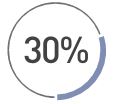 | |||||
| RSU Awards (30% of the LTI award) | |||||
RSU awards generally are calculated by multiplying the overall target LTI award value (as shown in the table on page 34) by the 30% weighting assigned to the RSU portion.
The number of RSUs granted is determined based on the closing stock price of the Company’s common stock on the NYSE on the date of grant. Deferred dividend equivalents are accrued during the vesting period and paid in cash following the vesting of the underlying shares.
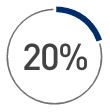 | |||||
| LTIP Awards (20% of the LTI award) | |||||
LTIP awards are cash-based and generally are calculated by multiplying the overall target LTI award value (as shown in the table on page 34) by the 20% weighting assigned to the LTIP portion. Each NEO’s LTIP target is determined at the time of grant, and the actual award earned at the end of the three-year performance period is calculated based on the same performance measures as those used for the PSUs (50% Relative TSR, 25% ROIC and 25% Free Cash Flow).
Payouts can range from 0% to 200% of the applicable target. If absolute TSR is negative at the end of the performance cycle, the payout factor for the Relative TSR measure is capped at 100%. The award calculation is formulaic pursuant to the provisions defined in the award agreement, and no discretion can be applied to the final payout factor, which is determined based on the performance outcomes relative to our pre-set goals. Any amount payable to a single participant in excess of $10 million will be forfeited.
Selection of LTI Performance Measures
The Compensation Committee sets LTI performance metrics that it believes effectively support our long-term business and strategic goals and directly tie the long-term focus of our executive leadership team to the interests of our stockholders. For 2025, those metrics of Relative TSR (50% weight), ROIC (25% weight) and Free Cash Flow (25% weight) represented good measures of value creation for the Company at the time the metrics were selected.
In 2025, the Compensation Committee approved the use of two Relative TSR peer groups weighted equally, our Aerospace and Defense peers and the S&P 500 Index.
The A&D Relative TSR Comparators for the 2025-2027 performance cycle are shown below:
2025-2027 A&D Relative TSR Comparators | ||||||||
BAE Systems plc | L3Harris Technologies, Inc. | Textron Inc. | ||||||
GE Aerospace | Northrop Grumman Corporation | The Boeing Company | ||||||
General Dynamics Corporation | RTX Corporation | TransDigm Group Incorporated | ||||||
Because the Relative TSR comparator group is not perfectly aligned with the businesses in which Lockheed Martin operates and because any number of macro-economic factors that could affect market performance are beyond the control of the Company, we consistently apply a cash-related metric to measure investment and long-term value creation, while mitigating the risk of short-term cash strategies that do not create long-term value.
38 | 2026 Proxy Statement | | ||||||||||||
Setting Performance Goals for PSUs and LTIP
Our long-range planning process is used to establish the target (100% level of payment) for the Free Cash Flow and ROIC metrics in the PSU and LTIP grants. In setting minimum and maximum levels of payment, we reviewed historical levels of performance against long-range plan commitments, and conducted sensitivity analyses on alternative outcomes focused on identifying likely minimum and maximum boundary performance levels. Levels between 100% and the minimum and maximum levels were derived using linear interpolation between the performance hurdles.
The specific Free Cash Flow and ROIC target values for the 2025-2027 PSU and LTIP grants were not publicly disclosed at the time of grant due to the proprietary nature and competitive sensitivity of that information. However, the method used to calculate the awards will be based on actual performance compared to the Company’s 2025-2027 targets, which uses linear interpolation between points.
The individual award agreements require certain adjustments to Free Cash Flow and ROIC so that the ultimate payouts are not impacted to the benefit or detriment of management by specified events that would result in a difference between planned and actual financial results. See Appendix A for more information on these potential adjustments and actual adjustments for the 2023-2025 award cycle.
The Compensation Committee does not have discretion to adjust the results of the PSU and LTIP awards beyond the adjustments specified in the award agreements.
2025-2027 Performance Goals
| Relative TSR (50%)* | Free Cash Flow (25%) | ROIC (25%) | |||||||||||||||||||||
| Percentile Rank | Payout Factor | Goals | Payout Factor | Goals | Payout Factor | ||||||||||||||||||
≥ 75th | 200% | Plan +15% | 200% | Plan +12% | 200% | ||||||||||||||||||
| 50th (Target) | 100% | Plan (Target) | 100% | Plan (Target) | 100% | ||||||||||||||||||
25th | 25% | Plan -10% | 25% | Plan -10% | 25% | ||||||||||||||||||
< 25th | 0% | Plan < -10% | 0% | Plan < -10% | 0% | ||||||||||||||||||
* 2025-2027 Relative TSR performance is measured against our Aerospace & Defense peers (50%) and the S&P 500 Index (50%) (See “Selection of LTI Performance Measures” above for Relative TSR Comparators).
2023-2025 LTIP and PSU Awards
The cash-based LTIP and share-based PSU payouts for the three-year performance period ended December 31, 2025 shown below were calculated by comparing actual corporate performance for each metric for the period January 1, 2023 through December 31, 2025, against payment levels from 0% to 200% (with the 100% payout level being considered target) established at the beginning of the performance period in February 2023. The Compensation Committee, per the LTIP and PSU award agreements, considered adjustments to the calculated results to neutralize the impact of certain items to ensure they do not affect payouts to a participant’s benefit or detriment. The Compensation Committee approved adjustments to Free Cash Flow and ROIC for the favorable tax impacts from the OBBB, to Free Cash Flow for unplanned pension contributions (net of tax) and tariffs and to ROIC for unplanned debt issuances, a non-operating pension settlement charge, a prior year change in interpretation of the law related to an uncertain tax position and a prior year loss on a specific strategic program.
For the 2023-2025 cycle, our Relative TSR performance, compared against the peer group disclosed in our 2024 Proxy Statement, was below threshold and did not generate a payout. Free Cash Flow result was above-target and ROIC result was below target. After applying the approved adjustments, these performance outcomes yielded a 47% of target overall payout.
| | 2026 Proxy Statement | 39 | ||||||||||||
Measure | Weight | Threshold (25% Payout) | Target (100% Payout) | Maximum (200% Payout) | Calculated Payout | Weighted Payout | ||||||||||||||
| Relative TSR | 50% |  | 0.0% | 0.0% | ||||||||||||||||
| Free Cash Flow* | 25% |  | 120.0% | 30.0% | ||||||||||||||||
| ROIC* | 25% |  | 66.0% | 17.0% | ||||||||||||||||
| Overall Payout Factor | 47.0% | |||||||||||||||||||
* See Appendix A for definitions of non-GAAP measures. For purposes of calculating 2023-2025 performance, Free Cash Flow and ROIC were adjusted for the favorable tax impacts from the OBBB, Free Cash Flow was adjusted for unplanned pension contributions (net of tax) and tariffs and ROIC was adjusted for unplanned debt issuances, a non-operating pension settlement charge, a prior year change in interpretation of the law related to an uncertain tax position and a prior year loss on a specific strategic program.
Based on a weighted payout factor of 47.0%, the following table shows the payouts for 2023-2025 LTIP and PSU awards paid in 2026.
| NEO* | LTIP Target ($) | LTIP Payout ($) | PSUs Target (#) | Total Shares Distributed / Earned | |||||||||||||
| Mr. Taiclet | 3,200,000 | 1,504,000 | 16,684 | 7,842 | |||||||||||||
| Mr. Scott** | 212,500 | 99,875 | 444 | 209 | |||||||||||||
Mr. St. John | 1,250,000 | 587,500 | 6,517 | 3,063 | |||||||||||||
Mr. Cahill | 840,000 | 394,800 | 4,380 | 2,059 | |||||||||||||
| Mr. O’Connor*** | — | — | — | — | |||||||||||||
* Mr. Malave forfeited his unvested 2023 - 2025 LTIP and PSU awards upon his termination of employment in April 2025.
** Mr. Scott’s targets and payouts reflect the 2023 - 2025 LTI awards he received as a Vice President.
*** Mr. O’Connor did not receive 2023 - 2025 LTI awards because he was not employed on the grant date of those awards.
2026 Compensation Design Changes
In February 2026, the Compensation Committee approved the target compensation opportunities for the Company’s executive officers for the 2026 performance year. In connection with this review, the Committee approved several updates to the design of the Company’s annual and long-term incentive programs to ensure the continued alignment of executive compensation with the Company’s strategic priorities, including operational excellence, customer expectations including as set forth in the January 7, 2026 Executive Order (Prioritizing the Warfighter in Defense Contracting), and sustainable long-term value creation.
For 2026, the Committee approved changes to the weighting and composition of performance measures under the annual incentive program. Financial goals will represent 50% and the Strategic and Operational goals will represent 50% of the annual incentive, compared to 70% and 30%, respectively. These changes are intended to better balance financial outcomes with customer-focused performance outcomes, including on-time delivery, production speed and quality, and overall operational excellence. The Committee also approved replacing Free Cash Flow with Cash from Operations, reflecting a continued emphasis on operational performance and cash generation aligned with day-to-day performance of the company.
In addition, the Committee approved changes to LTI awards for 2026, while maintaining the performance-based orientation of the program. Capital deployment will continue to be imperative for the Company and management will remain focused on investment decisions that create long-term stockholder value, which are sometimes not anticipated in our 3-year long range plan tied to our long-term incentives. The proposed measures better correspond to priorities around backlog conversion, enhance line of sight for all executives and align to stockholder interests. For the Company’s named executive officers, 70% of LTI compensation will continue to be performance-based and encompass the following changes:
•Replace the cash-based LTIP award with PSUs, resulting in an LTI mix of 70% PSUs and 30% RSUs which will still cliff-vest after 3 years.
•The performance measures and weightings will be Relative TSR (30%), Sales (30%), and Cash from Operations (40%), replacing the prior metrics.
•In addition, there will be a +/- 25% award modifier applicable to PSU awards, based on the Committee’s assessment of Company performance against customer-focused strategic and operational objectives measured over the three-year performance cycle.
40 | 2026 Proxy Statement | | ||||||||||||
The Committee believes this revised design strengthens alignment between long-term executive compensation and sustained operational and financial performance. The Committee approved these changes to incorporate objectives of the U.S. Government and its allies, which are foundational to the Company’s operating model. As the Company and the industry face a period of transformation, the Committee believes these changes reinforce our commitment to excellence to our customers and stockholders, including agility, increased capacity, production and resiliency.
Other Compensation Matters
Our Use of Independent Compensation Consultants
The independent compensation consultant provides important information about market practices, the types and amounts of compensation offered to executives generally and the role of corporate governance considerations in making compensation decisions. The Compensation Committee’s charter authorizes it to retain outside advisors that it believes are appropriate to assist in evaluating executive compensation.
For 2025, the Compensation Committee continued to retain Meridian as an independent compensation consultant. When retaining Meridian, the Compensation Committee considered the following factors in assessing Meridian’s independence:
•Meridian’s services for the Company are limited to executive and director compensation.
•The compensation paid to Meridian is less than 1% of Meridian’s revenues.
•Meridian has business ethics and insider trading and stock ownership policies, which are designed to avoid conflicts of interest.
•Meridian employees supporting the engagement and their immediate family members do not own Lockheed Martin securities.
•Meridian employees supporting the engagement have no business or personal relationships with members of the Compensation Committee or with any Lockheed Martin executive officer.
At its February 2026 meeting, the Compensation Committee renewed the engagement of Meridian. At that time, Meridian confirmed the continuing accuracy of each of the factors described above.
The nature and scope of Meridian’s engagement was determined by the Compensation Committee and not limited in any way by management.
Policy Regarding Timing of Equity Grants
We have a corporate policy concerning the grant of equity awards. Under that policy:
•The Compensation Committee is responsible for determining the grant date of all equity awards to executive officers.
•Annual equity awards for executive officers are generally presented to the Compensation Committee and granted in February of each year.
•Neither the timing of equity awards nor the timing of release of material nonpublic information about the Company may be influenced with the intent of improperly benefiting any awardee.
•No equity award may be backdated. A future date may be used if, among other reasons, the Compensation Committee’s action occurs in proximity to the release of earnings or during a trading blackout period to allow at least one business day to elapse after the date of the release of earnings or other material information.
•Equity plans explicitly prohibit repricing of stock options or paying cash for underwater stock options. The Company has not granted employee stock options since 2012.
•Off-cycle awards may be considered in special circumstances, which may include hiring, retention or acquisition transactions.
Clawback and Other Protective Provisions
In 2023, the Board adopted a mandatory clawback policy that implemented the new SEC and NYSE mandatory clawback rules. As stipulated in our Governance Guidelines, the policy requires the Company to recover from its executive officers certain incentive-based compensation that is erroneously paid in connection with an accounting restatement. The Compensation Committee administers this mandatory clawback policy.
| | 2026 Proxy Statement | 41 | ||||||||||||
Notably, our pre-existing clawback policy remains in our Governance Guidelines as a supplemental policy and continues to provide that if the Board of Directors determines that (i) an officer’s intentional misconduct, gross negligence or failure to report such acts by another person is a contributing factor in requiring us to restate any of our financial statements or constituted fraud, bribery or another illegal act (or contributed to another person’s fraud, bribery or other illegal act) that adversely impacts our financial position or reputation; (ii) an officer’s intentional misconduct or gross negligence causes severe reputational or financial harm to the Company; or (iii) an officer’s misappropriation of Lockheed Martin Proprietary Information (as defined in the policy) causes, or is intended to cause, severe reputational or financial harm to the Company, then the Board shall take such action as it deems in the best interest of the Company and necessary to remedy the misconduct and prevent its recurrence. Among other actions, the Board may seek to recover or require reimbursement of amounts awarded to the officer in the form of an annual incentive or LTI award.
This supplemental clawback policy is incorporated into our annual incentive plan and in the award agreements for the long-term incentive awards, covering all variable incentive compensation. There were no events requiring Board consideration of a clawback action during 2025 under either clawback policy.3 If the Board recoups incentive compensation under either policy, management intends to disclose the aggregate amount of incentive compensation recovered, so long as the underlying event has already been publicly disclosed in our filings with the SEC. This disclosure would appear in the proxy statement following any such Board action and would provide the aggregate amount of recovery for each event if there is more than one applicable event. All executive-level award agreements also contain post-employment restrictive covenants, and compensation awarded under those agreements may be subject to clawback in the event an executive breaches any of the post-employment restrictive covenants.
Insider Trading Policy
We have adopted an insider trading policy governing the purchase, sale, and other disposition of our securities by our directors, officers, and employees, and by the Company. We believe our policy is reasonably designed to promote compliance with insider trading laws, rules, and regulations and listing standards applicable to the Company. Among other things, our insider trading policy (i) prohibits trading by our directors, officers, and employees in our securities while in possession of material, non-public information about the Company or in the securities of other companies while in possession of material, non-public information about such companies gained as a result of their service with or relationship to the Company, and the unauthorized use or disclosure of such information, (ii) specifies our quarterly trading blackout periods (and the individuals subject to such blackout periods), (iii) sets forth additional restrictions applicable to our directors and executive officers (including pre-clearance requirements), and (iv) specifies requirements regarding pre-approved trading plans meeting the requirements of Rule 10b5-1 under the Securities Exchange Act of 1934, as amended. A copy of our insider trading policy is filed as Exhibit 19 to our Annual Report on Form 10-K for the year ended December 31, 2025.
Anti-Hedging and Anti-Pledging Policy
Our insider trading policy prohibits hedging and pledging of Lockheed Martin stock by all directors, officers and employees. Under our policy, Lockheed Martin directors, officers and employees may not purchase or sell derivative securities based on Lockheed Martin common stock or other Lockheed Martin securities. This policy also prohibits hedging or monetization transactions such as forward-sale contracts, equity swaps, collars and exchange funds, that are designed to hedge or offset any decrease in the market value of equity securities, lock in then-current market gains without the sale of the underlying security, or transactions in which the director or employee may divest aspects of the risks and rewards of ownership. This policy applies to shares of Lockheed Martin common stock that are either (i) granted to directors, officers or employees by Lockheed Martin as part of their compensation or (ii) otherwise held, directly or indirectly, by directors, officers or employees.
3 The stock Mr. Malave received upon vesting of LTI awards granted to him in 2022 was clawed back pursuant to an agreement with Mr. Malave involving a release of claims.
42 | 2026 Proxy Statement | | ||||||||||||
Stock Ownership Requirements for Key Employees
To better align their interests with the long-term interests of our stockholders, we expect our officers (including the NEOs) and other members of management to maintain an ownership interest in the Company based on the following guidelines:
6x base salary for CEO and Chairman | 4x base salary for Chief Financial Officer and Chief Operating Officer | 3x base salary for Business Segment Presidents | 2x base salary for Senior Vice Presidents and Elected Vice Presidents | |||||||||||||||||
NEOs are required to achieve ownership levels within five years of assuming their role and must hold net shares from vested RSUs and PSUs until the value of the shares equals the specified multiple of base salary. The securities counted toward their respective target threshold include common stock, unvested RSUs and stock units under our 401(k) plans and other deferral plans. Unvested PSUs do not count towards the stock ownership requirement. As of December 31, 2025, each of our currently-employed NEOs met the required stock ownership threshold or is on track to timely meet such threshold. NEOs who are no longer executive officers as of December 31, 2025 are not included in the chart below.
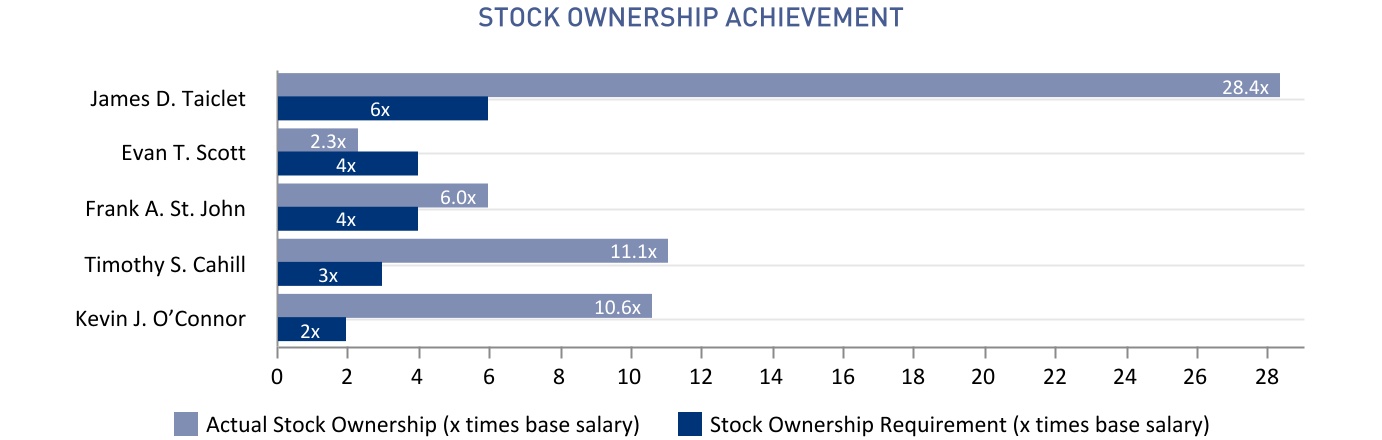
Benefit, Retirement and Perquisite Programs
We offer other compensatory arrangements to our NEOs. The purpose for these benefits is to ensure security of executives, provide assistance with business-related expenses and be competitive with the other companies in our industry. Below is a summary of programs available to our NEOs. Further details are described in footnotes to the Summary Compensation Table on page 45.
Health, Welfare and Retirement Benefits. Our NEOs are eligible for savings, pension, medical, disability and life insurance benefits under the plans available to salaried, non-union employees. We offer supplemental pension and savings plans to make up for benefits that otherwise would be unavailable due to Internal Revenue Service (IRS) limits on qualified plans. These plans are restorative and do not provide an enhanced benefit. We also offer a plan for the deferral of short-term and long-term cash performance incentive compensation. Pension and supplemental pension plans that certain NEOs participate in were completely frozen effective January 1, 2020. Messrs. Taiclet, O’Connor and Malave do not participate in any Company pension or supplemental pension plan.
Perquisites and Security. Perquisites provided to the NEOs include executive physicals, relocation assistance (when applicable), certain personal travel on the corporate aircraft, gifts for retirement or years of service milestones (when applicable), and home and personal security as needed to address security concerns arising out of our business.
The Board recognizes that the nature of our business requires heightened attention to the security of our executives and strongly believes that an employee should not be placed at personal risk due to his or her association with the Company. For well over a decade, our CEO and other senior executives have experienced, and continue to experience, direct security threats. The CBS Committee periodically reviews security recommendations from our Chief Security Officer and may authorize actions to respond to security risks and direct threats involving our executive officers. Our Chief Security Officer’s recommendations are based on an ongoing assessment of the risk environment, which is informed, in part, by his interactions with law enforcement and other third party security resources. Our approach to executive security is necessarily dynamic in nature and aims to respond to the changing risk environment facing our executives. We believe that providing personal security in response to concerns arising out of employment by the Company is business related.
| | 2026 Proxy Statement | 43 | ||||||||||||
Based on these reviews and recommendations, our Board has taken reasonable and appropriate measures necessary to protect against these threats and mitigate the personal safety risks borne by our CEO and others. Among other precautions, our Board has required our CEO to use corporate aircraft while on business and personal travel and has authorized other NEOs to use corporate aircraft for personal travel depending on circumstances and availability. Furthermore, in 2025, in response to elevated risks and certain incidents, enhanced security measures were implemented to ensure the safety of our CEO and other NEOs. As a result, Mr. Taiclet’s compensation for 2025 as reported in the Summary Compensation Table below includes (i) $1,399,731 for security and (ii) $866,601 for personal use of corporate aircraft. Our Board, informed by the recommendations of our Chief Security Officer, will continue to evaluate the security protocols for our CEO and other executives based on the evolving risk environment to determine whether any adjustments to security measures are appropriate.
Tax Assistance. We do not have agreements or severance arrangements that provide tax gross-ups for excise taxes imposed as a result of a change in control. In 2025, we provided tax assistance on taxable security expenses and travel expenses when a family member accompanies a NEO on business travel. In addition, we pay an amount estimated to cover the state income tax imposed on employees who became subject to income tax in a state other than their state of residence due to business travel. Tax assistance was provided for these items because the associated tax liability imposed on the executive would not have been incurred unless business reasons required the items to be provided or the executive to travel to the non-resident state. We do not provide tax assistance on personal use of the corporate aircraft.
Post-Employment, Change in Control, Divestiture and Severance Benefits
Our NEOs do not have individual employment or severance agreements, but participate in the Lockheed Martin Corporation Executive Severance Plan. Benefits are payable under this plan in the event of a Company-initiated termination of employment other than for cause. All currently-employed NEOs are covered under the plan. The benefit payable in a lump sum under the plan is a payment of one times the NEO’s base salary plus the equivalent of one year’s target annual incentive. For the CEO, the multiplier is 2.99 instead of one. NEOs participating in the plan also receive a lump sum payment to cover the cost of medical, dental and vision benefits for one year in addition to outplacement and relocation services. To receive the severance benefit, the NEO must execute a release of claims and an agreement containing post-employment, non-compete and non-solicitation covenants identical to those included in our NEOs’ LTI award agreements.
With respect to LTI, upon certain terminations of employment, including death, disability, retirement, layoff, divestiture or a change in control, the NEOs may be eligible for continued or pro rata vesting on the normal schedule, immediate payment of benefits previously earned or accelerated vesting of LTI awards in full or on a pro rata basis. The type of event and the nature of the benefit determine which of these approaches will apply. The purpose of these provisions is to protect previously earned or granted benefits by making them available following the specified event. We view the vesting (or continued vesting) to be an important retention feature for senior-level employees. Because benefits paid at termination consist of previously granted or earned benefits, we do not consider termination benefits as a separate item in compensation decisions. Our LTI awards do not provide for tax assistance.
In the event of a change in control, our plans provide for the acceleration of the payment of the non-qualified portion of earned pension benefits and non-qualified deferred compensation. All LTI awards require a “double trigger” for vesting to accelerate (both a change in control and a qualifying termination of employment), unless the successor does not assume or continue the awards or provide substitute awards.
Compensation and Risk
The Company’s executive and broad-based compensation programs are intended to promote decision-making that supports a pay for performance philosophy while mitigating risk by utilizing the following design features:
•Balance of fixed and variable pay opportunities •Multiple performance measures, multiple time periods and capped payouts under incentive plans •Stock ownership requirements •Risk oversight by independent Board committee •Incentive goals set at the enterprise or business segment level •Incentive plan caps on individual awards and pool size | •Moderate severance program that includes post-employment restrictive covenants •Institutional focus on ethical behavior •Annual risk assessment •Compensation Committee oversight of equity burn rate and dilution •Clawback policy •Anti-hedging and pledging policy | ||||
With the assistance of an annual risk assessment conducted by Meridian, the Compensation Committee concluded in 2025 that risks arising from our executive and broad-based incentive compensation programs are not reasonably likely to have a material adverse effect on the Company.
44 | 2026 Proxy Statement | | ||||||||||||
Summary Compensation Table
The following table shows annual and long-term compensation awarded, earned or paid for services in all capacities to the NEOs for the fiscal year ended December 31, 2025 and, where applicable, the prior fiscal years. Numbers are rounded to the nearest dollar.
Name and Principal Position(1) | Salary(2) | Bonus(3) | Stock Awards(4) | Non-Equity Incentive Plan Compensation(5) | Change in Pension Value and Nonqualified Deferred Compensation Earnings(6) | All Other Compensation(7) | Total | |||||||||||||||||||
| Year | ($) | ($) | ($) | ($) | ($) | ($) | ($) | |||||||||||||||||||
| (a) | (b) | (c) | (d) | (e) | (g) | (h) | (i) | (j) | ||||||||||||||||||
James D. Taiclet Chairman, President and Chief Executive Officer | 2025 | 1,751,000 | — | 13,667,645 | 5,496,300 | — | 2,538,363 | 23,453,308 | ||||||||||||||||||
| 2024 | 1,751,000 | — | 13,046,594 | 6,566,900 | — | 2,389,420 | 23,753,914 | |||||||||||||||||||
| 2023 | 1,751,000 | — | 13,008,681 | 6,655,900 | — | 1,398,194 | 22,813,775 | |||||||||||||||||||
Evan T. Scott Chief Financial Officer | 2025 | 783,144 | — | 637,810 | 1,097,975 | 75,478 | 174,877 | 2,769,284 | ||||||||||||||||||
Frank A. St. John Chief Operating Officer | 2025 | 1,089,423 | — | 5,386,762 | 2,348,800 | 418,238 | 617,938 | 9,861,161 | ||||||||||||||||||
| 2024 | 1,069,615 | — | 5,139,703 | 2,817,500 | — | 616,995 | 9,643,813 | |||||||||||||||||||
| 2023 | 1,064,039 | — | 5,081,551 | 2,914,700 | 395,731 | 495,840 | 9,951,861 | |||||||||||||||||||
Timothy S. Cahill President, Missiles and Fire Control | 2025 | 995,000 | — | 3,618,238 | 1,756,000 | 267,432 | 202,419 | 6,839,089 | ||||||||||||||||||
| 2024 | 1,015,570 | — | 3,400,048 | 1,543,500 | — | 169,582 | 6,128,700 | |||||||||||||||||||
| 2023 | 1,008,905 | — | 3,414,828 | 1,758,600 | 252,214 | 734,879 | 7,169,426 | |||||||||||||||||||
Kevin J. O’Connor Senior Vice President, General Counsel and Corporate Secretary | 2025 | 800,961 | 300,000 | 10,199,879 | 1,077,700 | — | 318,180 | 12,696,720 | ||||||||||||||||||
Jesus Malave* Former Chief Financial Officer | 2025 | 343,269 | — | 4,422,188 | — | — | 73,408 | 4,838,865 | ||||||||||||||||||
| 2024 | 1,014,808 | — | 4,269,880 | 3,012,600 | — | 235,326 | 8,532,614 | |||||||||||||||||||
| 2023 | 984,808 | — | 4,065,426 | 1,434,500 | — | 174,522 | 6,659,256 | |||||||||||||||||||
* Mr. Malave served as Chief Financial Officer from January 2022 to April 2025. In connection with his departure, Mr. Malave forfeited his right to annual incentive compensation for 2025 and all unvested long-term incentive (LTI) awards granted in 2023, 2024 and 2025.
(1)Information for Mr. Scott and Mr. O’Connor is provided only for 2025 because they were not NEOs in prior years.
(2)Salary is paid weekly in arrears. The amount reported may vary from the approved annual rate of pay because the salary reported in the table is based on the actual number of weekly pay periods in a year. Amounts for 2025 include payments of cash in lieu of vacation for Mr. St. John: $39,615 and Mr. Scott: $24,639.42; and a $18,025 payment for Mr. Scott in lieu of a merit increase due to Mr. Scott’s base salary being at the maximum for his then-Vice President role.
(3)Reflects the first installment of Mr. O’Connor’s cash sign-on bonus paid in 2025, which offset his forfeited 2024 annual incentive payout from his prior employer.
(4)Amounts reported in the Stock Awards column represent the aggregate grant date fair value computed in accordance with Financial Accounting Standards Board (FASB) Accounting Standards Codification Topic 718 (ASC 718) for RSUs and PSUs granted in 2025, 2024 and 2023, disregarding potential forfeitures based on service requirements.
Mr. Malave forfeited all unvested LTI awards granted in 2023, 2024, and 2025 upon his termination of employment.
2025 Aggregate Grant Date Fair Value RSUs | 2025 Aggregate Grant Date Fair Value PSUs | |||||||
| ($) | ($) | |||||||
| Mr. Taiclet | 5,075,740 | 8,591,905 | ||||||
Mr. Scott | 422,722 | 215,088 | ||||||
| Mr. St. John | 2,000,240 | 3,386,522 | ||||||
Mr. Cahill | 1,343,307 | 2,274,932 | ||||||
Mr. O’Connor | 8,177,959 | 2,021,920 | ||||||
Mr. Malave | 1,642,113 | 2,780,075 | ||||||
| | 2026 Proxy Statement | 45 | ||||||||||||
The ASC 718 grant date fair value of one 2025 RSU of $439.42 represents the closing price of one share of our stock on the date of grant, discounted to take into account the deferred dividend equivalents that are accrued until vesting.
Values for the PSUs, which are subject to performance conditions, are based on the probable outcome on the grant date of three separate performance conditions (50% of the target shares are earned based upon Relative TSR, 25% of the target shares are earned based upon Free Cash Flow, and 25% of the target shares are earned based upon ROIC).
The grant date fair value of $453.06 for the Relative TSR portion of the PSU award was determined using a Monte Carlo simulation model. The value was determined using the historical stock price volatilities of the companies in our comparator group over the most recent 2.84-year period assuming dividends for each company are reinvested on a continuous basis and a risk-free rate of interest of 4.00% and that deferred dividend equivalents accrued on shares earned will be paid in cash upon vesting. The grant date fair value of $439.42 for the Free Cash Flow and ROIC portions of the awards is based on the closing price of our stock on the date of grant, discounted to take into account the deferred dividend equivalents that are accrued until vesting. In addition to the level of performance achieved, the value of the PSUs earned will be determined by the price of our stock on the date any shares are issued at the end of the performance and vesting periods, which may be more or less than the grant date fair value.
The maximum grant date fair values of the 2025 PSU awards, using the Monte Carlo simulation model for the TSR metric and assuming a 200% maximum payout for the ROIC and Free Cash Flow metrics, are as follows: Mr. Taiclet: $12,822,201; Mr. Scott: $320,988; Mr. St. John: $5,053,682; Mr. Cahill: $3,395,013 and Mr. O’Connor: $3,017,207.
(5)Amounts reported in the Non-Equity Incentive Plan Compensation column represent (i) the annual incentive amounts paid under the amended and restated Lockheed Martin Corporation 2021 Management Incentive Compensation Plan (MICP), and (ii) the amounts earned under cashLTIP awards in the three-year period ending on December 31 of the year reported.
The table below shows the respective 2025 annual incentive payouts and the amount earned under the 2023-2025 cash LTIP and reported for each NEO:
2025 Annual Incentive Payout | 2023-2025 LTIP Payout | |||||||
| ($) | ($) | |||||||
| Mr. Taiclet | 3,992,300 | 1,504,000 | ||||||
Mr. Scott | 998,100 | 99,875 | ||||||
| Mr. St. John | 1,761,300 | 587,500 | ||||||
Mr. Cahill | 1,361,200 | 394,800 | ||||||
Mr. O’Connor | 1,077,700 | — | ||||||
| Mr. Malave | — | — | ||||||
(6)Amounts reported in the Change in Pension Value and Nonqualified Deferred Compensation Earnings column represent the change in the present value of the pension benefit for the NEO for the year reported and is not the amount that will be paid to the NEO. The increase in present value for 2025 was primarily driven by the decrease in the discount rate used in the present value calculation. There were no earnings on nonqualified deferred compensation to report for any NEOs for 2025, 2024 or 2023.
(7)The amounts reported in the All Other Compensation column include perquisites and other personal benefits provided to the NEOs in 2025 including: security; relocation benefits; annual executive physicals; home office support; use of corporate aircraft for personal travel and other related expenses; and travel and other expenses for a family member accompanying the NEO while on business travel. Not all of the listed perquisites or personal benefits were provided to each NEO. In addition, the Company made available a Company-provided car and driver for personal commuting to some of the NEOs in 2025 and may provide event tickets from time to time, but requires the NEOs to reimburse the Company for the incremental cost to the Company of such items. The cost of any category of the listed perquisites and personal benefits in 2025 did not exceed the greater of $25,000 or 10% of total perquisites and personal benefits for any NEO, except for: (i) security for Mr. Taiclet $1,399,731; Mr. Scott $39,105; Mr. St. John $70,480; Mr. Cahill $9,600 and Mr. O’Connor $14,038; (ii) personal use of the corporate aircraft for Mr. Taiclet $866,601; Mr. Scott $10,932; Mr. St. John $407,664; Mr. Cahill $13,327 and Mr. O’Connor $5,410; and (iii) relocation expenses for Mr. Cahill $26,186 and Mr. O’Connor $115,353. Incremental cost for use of corporate aircraft for personal travel was calculated based on the costs associated with personal flights (including fuel, landing and parking fees, incremental maintenance costs, staff travel expenses, catering and other variable costs, but excluding fixed capital costs for the aircraft, Company hangar facilities and staff salaries). Our Board has directed our CEO to use corporate aircraft for security reasons while on business and personal travel. The incremental cost for personal security is calculated based on billings for services and equipment from third parties and for overtime and related expenses where the services are provided by the Company’s personnel. Given the nature of our business, additional security may be provided for travel in high-risk areas or to address particular situations. We believe that providing personal security in response to concerns arising out of employment by the Company is business related.
In addition to perquisites, the amounts in this column include the items of compensation listed in the following table. All items are paid under broad-based programs for U.S. salaried employees except for tax assistance and the match or Company contributions to the Company’s nonqualified defined contribution plans (the Lockheed Martin Corporation Supplemental Savings Plan (NQSSP) and the Lockheed Martin Corporation Nonqualified Capital Accumulation Plan (NCAP)). Amounts under Matching Gift Programs include matching contributions made to non-profit organizations under the Lockheed Martin Political Action Committee (LMEPAC)’s charity match program in accordance with the LMEPAC’s guidelines applicable to all contributors. Amounts under Company Contributions to Health Savings Accounts reflect the Company’s annual contribution to the health savings accounts of all employees who have a high-deductible health insurance plan and additional wellness incentives available to all enrolled employees and spouses for completing specific wellness actions. Amounts under Term Life Insurance Opt-Out Credit reflect cash payments made to NEOs who opt out of the Company’s broad-based employee term life insurance program, which option is available to all salaried employees of the Company. As permitted by SEC rules, the premium cost for the NEOs’ participation in the Company’s broad-based employee term life insurance has not been included.
46 | 2026 Proxy Statement | | ||||||||||||
In 2025, the Company provided tax assistance on taxable security expenses, non-resident state income taxes incurred because of business travel and travel expenses for a family member accompanying the NEO on travel determined to be business travel. Tax assistance was provided for these items because the associated tax liability imposed on the executive would not have been incurred unless business reasons required the items to be provided or the executive to travel to the non-resident state. For Mr. Taiclet, the total tax assistance amount reported for 2025 includes (i) a payment of $66,464.82 attributable to non-resident income taxes, which was incurred as a result of business travel to a state other than his state of residence, and (ii) $27,021.10 associated with security expenses. For Mr. St. John, the total tax assistance amount reported for 2025 includes (i) $15,507.74 associated with security expenses and (ii) $6,043.75 associated with travel expenses for a family member accompanying Mr. St. John on travel determined to be business travel.
Other Items of Compensation Included in “All Other Compensation” Column
| Tax Assistance for Business- Related Items | Company Contributions to Qualified Defined Contribution Plans | Company Contributions to Nonqualified Defined Contribution Plans | Company Contributions to Health Savings Accounts | Term Life Insurance Opt-Out Credit | Matching Gift Programs | |||||||||||||||
| Name | ($) | ($) | ($) | ($) | ($) | ($) | ||||||||||||||
| Mr. Taiclet | 93,498 | 24,917 | 150,183 | 1,000 | — | — | ||||||||||||||
| Mr. Scott | 43,282 | 30,400 | 45,451 | 1,000 | — | 1,000 | ||||||||||||||
| Mr. St. John | 26,150 | 24,760 | 78,240 | 1,000 | 2,620 | 1,000 | ||||||||||||||
| Mr. Cahill | 35,781 | 30,400 | 69,100 | 1,800 | — | 1,000 | ||||||||||||||
| Mr. O’Connor | 117,534 | 33,692 | 27,058 | — | 2,162 | — | ||||||||||||||
| Mr. Malave | 170 | 32,750 | 2,558 | 1,000 | — | — | ||||||||||||||
| | 2026 Proxy Statement | 47 | ||||||||||||
Other Executive Compensation Information and Tables
2025 Grants of Plan-Based Awards
Estimated Future Payouts Under Non-Equity Incentive Plan Awards(1) | Estimated Future Payouts Under Equity Incentive Plan Awards(2) | All Other Stock Awards: Number of Shares of Stock or Units(3) | Grant Date Fair Value of Stock Awards(4) | ||||||||||||||||||||||||||||||||
| Grant Date | Award Type | Threshold | Target | Maximum | Threshold | Target | Maximum | ||||||||||||||||||||||||||||
| Name | ($) | ($) | ($) | (#) | (#) | (#) | (#) | ($) | |||||||||||||||||||||||||||
| (a) | (b) | (c) | (d) | (e) | (f) | (g) | (h) | (i) | (l) | ||||||||||||||||||||||||||
| James D. Taiclet | — | MICP | 245,140 | 3,502,000 | 7,004,000 | — | — | — | — | — | |||||||||||||||||||||||||
| 2/26/2025 | RSU | — | — | — | — | — | — | 11,551 | 5,075,740 | ||||||||||||||||||||||||||
| — | LTIP | 212,500 | 3,400,000 | 6,800,000 | — | — | — | — | — | ||||||||||||||||||||||||||
| 2/26/2025 | PSU | — | — | — | 1,204 | 19,254 | 38,508 | — | 8,591,905 | ||||||||||||||||||||||||||
Evan T. Scott | — | MICP | 59,563 | 850,900 | 1,701,800 | — | — | — | — | — | |||||||||||||||||||||||||
| 2/26/2025 | RSU | — | — | — | — | — | — | 962 | 422,722 | ||||||||||||||||||||||||||
| — | LTIP | 13,281 | 212,500 | 425,000 | — | — | — | — | — | ||||||||||||||||||||||||||
| 2/26/2025 | PSU | — | — | — | 31 | 482 | 964 | — | 215,088 | ||||||||||||||||||||||||||
| Frank A. St. John | — | MICP | 108,150 | 1,545,000 | 3,090,000 | — | — | — | — | — | |||||||||||||||||||||||||
| 2/26/2025 | RSU | — | — | — | — | — | — | 4,552 | 2,000,240 | ||||||||||||||||||||||||||
| — | LTIP | 83,750 | 1,340,000 | 2,680,000 | — | — | — | — | — | ||||||||||||||||||||||||||
| 2/26/2025 | PSU | — | — | — | 475 | 7,589 | 15,178 | — | 3,386,522 | ||||||||||||||||||||||||||
Timothy S. Cahill | — | MICP | 83,580 | 1,194,000 | 2,388,000 | — | — | — | — | — | |||||||||||||||||||||||||
| 2/26/2025 | RSU | — | — | — | — | — | — | 3,057 | 1,343,307 | ||||||||||||||||||||||||||
| — | LTIP | 56,250 | 900,000 | 1,800,000 | — | — | — | — | — | ||||||||||||||||||||||||||
| 2/26/2025 | PSU | — | — | — | 319 | 5,098 | 10,196 | — | 2,274,932 | ||||||||||||||||||||||||||
Kevin J. O’Connor | — | MICP | 66,178 | 945,400 | 1,890,800 | — | — | — | — | — | |||||||||||||||||||||||||
| 2/26/2025 | RSU | — | — | — | — | — | — | 18,574 | 8,177,959 | ||||||||||||||||||||||||||
| — | LTIP | 50,000 | 800,000 | 1,600,000 | — | — | — | — | — | ||||||||||||||||||||||||||
| 2/26/2025 | PSU | — | — | — | 284 | 4,531 | 9,062 | — | 2,021,920 | ||||||||||||||||||||||||||
Jesus Malave | — | MICP | — | — | — | — | — | — | — | — | |||||||||||||||||||||||||
| 2/26/2025 | RSU | — | — | — | — | — | — | — | 1,642,113 | ||||||||||||||||||||||||||
| — | LTIP | — | — | — | — | — | — | — | — | ||||||||||||||||||||||||||
| 2/26/2025 | PSU | — | — | — | — | — | — | — | 2,780,075 | ||||||||||||||||||||||||||
(1)The amounts reported in the Estimated Future Payouts Under Non-Equity Incentive Plan Awards columns include annual incentive grants (MICP) for 2025 and LTIP grants for the 2025-2027 performance period ending December 31, 2027.
The MICP measures performance over a one-year period and is described under “2025 Annual Incentive” in the CD&A. The threshold, or minimum amount payable (assuming an award is earned), is 7% of target while the maximum is 200% of target.
The LTIP award measures performance against three separate metrics described under “2025 Long-Term Incentive Compensation” in the CD&A. The threshold is the minimum amount payable for a specified level of performance stated in the LTIP award agreement. For the 2025-2027 award, the threshold amount payable is 6.25% of the target award. The maximum award payable under the LTIP award is 200% of target value. Awards are subject to forfeiture upon termination of employment prior to the end of the performance period, except in the event of retirement or layoff occurring after six months from the date of grant or in the event of death, disability, or divestiture. In any of these events, LTIP awards are paid at the end of the performance period on a prorated basis. Following a change in control, the 2025-2027 LTIP awards vest at the target amount upon involuntary termination without cause or voluntary termination with good reason or if the successor does not assume the LTIP awards.
(2)The amounts reported in the Estimated Future Payouts Under Equity Incentive Plan Awards columns of the table include PSU awards for the 2025-2027 performance period ending December 31, 2027. PSU awards typically have a three-year vesting period ending on the third anniversary of the date of grant (i.e., February 28, 2028 for the February 26, 2025 grants). At the end of the vesting period, the amount earned is payable in shares of stock and cash representing deferred dividend equivalents accrued on the earned shares. PSU awards are subject to forfeiture upon termination of employment prior to the end of the vesting period, except in the event of retirement or layoff occurring after six months from the date of grant or in the event of death, disability or divestiture. In any of these events, PSU awards are paid out at the end of the vesting period on a prorated basis. Following a change in control, the PSUs vest at the target amount upon involuntary termination without cause or voluntary termination with good reason or if the successor does not assume the PSUs.
48 | 2026 Proxy Statement | | ||||||||||||
Shares are earned under the PSU awards based upon performance against three separate metrics described under “PSU Awards” in the CD&A. If performance falls below the threshold level of performance, no shares would be earned. Assuming any payment is earned, the minimum amount payable under the PSU award is 6.25% of the target shares, the lowest level payable under any of these metrics. The maximum number of shares payable under the PSU is 200% of the number of target shares.
(3)The amounts reported in the All Other Stock Awards: Number of Shares of Stock or Units column show the number of RSUs granted on February 26, 2025. 2025 RSU awards vest on the third anniversary of the date of grant. RSU awards are subject to forfeiture upon termination of employment prior to the end of the vesting period, except in the event of retirement or layoff occurring after six months from the date of grant or death, disability or divestiture. RSU awards vest in full immediately upon death or disability and, upon layoff after six months from the date of grant, pro rata vest and are paid following the third anniversary of the grant date. RSU awards are prorated upon divestiture if not assumed by the successor. Following a change in control, the RSUs vest upon involuntary termination without cause or voluntary termination for good reason or if the successor does not assume the RSUs. If the employee retires after six months from the date of grant, but prior to the third anniversary of the date of grant, the RSUs become nonforfeitable and are paid at the end of the vesting period.
During the vesting period, deferred dividend equivalents are accrued and subject to the same vesting schedule as the underlying RSUs. At the end of the vesting period, the RSUs are paid in shares of stock and the deferred dividend equivalents are paid in cash. If any tax withholding is required on the RSUs and deferred dividend equivalents during the vesting period (for example, on account of retirement eligibility), the RSUs provide for accelerated vesting of the number of shares and deferred dividend equivalents required to satisfy the tax withholding. The award is then reduced by the number of shares and deferred dividend equivalents subject to acceleration of vesting for tax withholding.
(4)The amounts reported in the Grant Date Fair Value of Stock Awards column represent the aggregate grant date fair value computed in accordance with FASB ASC 718 for RSUs and PSUs granted in 2025, disregarding potential forfeitures based on service requirements.
The grant date fair value of the 2025 RSU grant is $439.42 per RSU, which represents the closing price of one share of our common stock on the date of grant, discounted to take into account the deferred dividend equivalents accrued until vesting.
The grant date fair value for the 2025 PSUs, which are subject to performance conditions, is based on the probable outcome of each of the three performance conditions. The grant date fair value of $453.06 for the Relative TSR portion of the award is determined using a Monte Carlo simulation model. The grant date fair value of $439.42 for the Free Cash Flow and ROIC portions of the awards is based on the closing price of one share of our stock on the date of grant, discounted to take into account the deferred dividend equivalents accrued until vesting.
As described in the CD&A, in determining 2025 awards of RSUs and PSUs, the closing price of Lockheed Martin common stock on the date of grant ($441.50 on February 26, 2025) was used as opposed to the grant date fair value. The use of the closing stock price versus the grant date fair value results in a difference between the amounts described in the CD&A and the amount reported in this column.
Mr. Malave forfeited the unvested LTI awards granted in 2025 upon his termination of employment.
| | 2026 Proxy Statement | 49 | ||||||||||||
Outstanding Equity Awards at 2025 Fiscal Year-End
| Stock Awards | ||||||||||||||||||||||||||
Grant Date | Award Type | Number of Shares or Units of Stock That Have Not Vested(1) | Market Value of Shares or Units of Stock That Have Not Vested(2) | Equity Incentive Plan Awards: Number of Unearned Shares, Units or Other Rights That Have Not Vested(3) | Equity Incentive Plan Awards: Market or Payout Value of Unearned Shares, Units or Other Rights That Have Not Vested(4) | |||||||||||||||||||||
| Name | (#) | ($) | (#) | ($) | ||||||||||||||||||||||
| (a) | (g) | (h) | (i) | (j) | ||||||||||||||||||||||
| James D. Taiclet | 2/22/2023 | RSU | 9,618 | 4,651,938 | — | — | ||||||||||||||||||||
| 2/22/2023 | PSU | 7,838 | 3,791,005 | — | — | |||||||||||||||||||||
| 2/22/2024 | RSU | 11,247 | 5,439,836 | — | — | |||||||||||||||||||||
| 2/22/2024 | PSU | — | — | 10,364 | 5,012,756 | |||||||||||||||||||||
| 2/26/2025 | RSU | 11,417 | 5,522,060 | — | ||||||||||||||||||||||
| 2/26/2025 | PSU | — | — | 10,879 | 5,261,846 | |||||||||||||||||||||
Evan T. Scott | 2/22/2023 | RSU | 886 | 428,532 | — | — | ||||||||||||||||||||
| 2/22/2023 | PSU | 209 | 101,087 | — | — | |||||||||||||||||||||
| 2/22/2024 | RSU | 990 | 478,833 | — | — | |||||||||||||||||||||
| 2/22/2024 | PSU | — | — | 268 | 129,624 | |||||||||||||||||||||
| 2/26/2025 | RSU | 962 | 465,291 | — | — | |||||||||||||||||||||
| 2/26/2025 | PSU | — | — | 273 | 132,042 | |||||||||||||||||||||
| Frank A. St. John | 2/22/2023 | RSU | 3,756 | 1,816,665 | — | — | ||||||||||||||||||||
| 2/22/2023 | PSU | 3,062 | 1,480,998 | — | — | |||||||||||||||||||||
| 2/22/2024 | RSU | 4,429 | 2,142,174 | — | — | |||||||||||||||||||||
| 2/22/2024 | PSU | — | — | 4,084 | 1,975,308 | |||||||||||||||||||||
| 2/26/2025 | RSU | 4,499 | 2,176,031 | — | — | |||||||||||||||||||||
| 2/26/2025 | PSU | — | — | 4,288 | 2,073,977 | |||||||||||||||||||||
Timothy S. Cahill | 2/22/2023 | RSU | 2,533 | 1,225,136 | — | — | ||||||||||||||||||||
| 2/22/2023 | PSU | 2,058 | 995,393 | — | — | |||||||||||||||||||||
| 2/22/2024 | RSU | 2,936 | 1,420,055 | — | — | |||||||||||||||||||||
| 2/22/2024 | PSU | — | — | 2,702 | 1,306,876 | |||||||||||||||||||||
| 2/26/2025 | RSU | 3,024 | 1,462,618 | — | — | |||||||||||||||||||||
| 2/26/2025 | PSU | — | — | 2,881 | 1,393,453 | |||||||||||||||||||||
| Kevin J. O’Connor | 2/26/2025 | RSU | 18,574 | 8,983,687 | — | — | ||||||||||||||||||||
| 2/26/2025 | PSU | — | — | 2,561 | 1,238,679 | |||||||||||||||||||||
(1)Includes all unvested RSUs. RSUs vest on the third anniversary of the grant date. Also includes the PSUs granted on February 22, 2023, which had a performance period ending December 31, 2025 and a vest date of February 22, 2026. The number of shares shown in this column for the 2023-2025 PSUs is the number of shares earned based on the performance period and that were paid upon vesting.
(2)The market value is calculated by multiplying the number of shares shown in the preceding column by the December 31, 2025 per share closing price of our stock ($483.67). At the end of the vesting period, NEOs also receive a cash payment representing deferred dividend equivalents accrued on earned shares for PSUs and vested shares for RSUs.
(3)Represents PSUs granted on February 22, 2024 for the 2024-2026 performance period and on February 26, 2025 for the 2025-2027 performance period. The PSUs are earned and paid out in shares of our common stock at the end of the three-year vesting period based upon performance on three separate metrics (Relative TSR, Free Cash Flow and ROIC). The number of shares of stock shown in this column is based upon the threshold level of performance for each of the three metrics or, if performance on the metric has exceeded the threshold level as of December 31, 2025, the estimated level of performance as of December 31, 2025. PSUs have a vesting period ending on the third anniversary of the date of grant.
(4)The market value is calculated by multiplying the number of PSUs reported in the preceding column by the December 31, 2025 per share closing price of our stock ($483.67). At the end of the vesting period, NEOs also receive a cash payment representing deferred dividend equivalents accrued on earned shares for PSUs and vested shares for RSUs.
Mr. Malave is not included in this table because he forfeited all unvested RSU and PSU awards granted in 2023, 2024, and 2025 upon his termination of employment.
50 | 2026 Proxy Statement | | ||||||||||||
Stock Vested During 2025
| Stock Awards | ||||||||
Number of Shares Acquired on Vesting(1) | Value Realized on Vesting (2) | |||||||
| Name | (#) | ($) | ||||||
| (a) | (d) | (e) | ||||||
| James D. Taiclet | 35,572 | 15,711,113 | ||||||
Evan T. Scott | 958 | 422,210 | ||||||
| Frank A. St. John | 13,889 | 6,127,535 | ||||||
Timothy S. Cahill | 4,684 | 2,068,225 | ||||||
Kevin J. O’Connor | — | — | ||||||
Jesus Malave | — | — | ||||||
(1)Represents (i) vesting on February 23, 2025 of RSUs and PSUs granted on February 23, 2022 following the three-year vesting period; and (ii) accelerated vesting on December 5, 2025 of a portion of RSUs granted on February 22, 2023, February 22, 2024, and February 26, 2025 equal to the value of the tax withholding obligation due because the NEO is retirement-eligible (for Mr. Taiclet, Mr. St. John, and Mr. Cahill). The amounts for the accelerated vesting for tax withholding represent the aggregate number of shares vested prior to the concurrent disposition of the vested shares to the Company to satisfy the tax withholding obligation. Mr. O’Connor did not vest in LTI awards during 2025. The Company clawed back the shares Mr. Malave received in 2025 upon vesting of the RSUs and PSUs granted on February 23, 2022 (18,535 gross shares; 9,582 net shares; $8,168,745 gross value realized upon vesting).
(2)Value realized was calculated based on the number of shares acquired on vesting multiplied by the per share closing price of our common stock on the date of vesting (February 23, 2025: $440.72 and December 5, 2025: $452.20).
Pension Benefits
Certain NEOs (i.e., Mr. Scott, Mr. St. John and Mr. Cahill) have frozen benefits under (1) the Lockheed Martin Corporation Salaried Employee Retirement Program (LMRP), which is a tax-qualified plan that includes several prior plans (the Prior Plans), and (2) the Lockheed Martin Corporation Consolidated Supplemental Retirement Benefit Plan (Supplemental Pension), which is a restorative plan that provides benefits in excess of the benefit payable under IRS rules through the LMRP. These plans were frozen in two steps. Increases in compensation ceased to be taken into account effective January 1, 2016 and increases in service ceased to be taken into account effective January 1, 2020.
The annual pension benefit for all participants under the LMRP is determined by a final average compensation formula that multiplies (x) a percentage (1.25% of compensation below the social security wage base and 1.5% above that level) times (y) years of credited service ending with 2019 times (z) the average of the employee’s highest three years of compensation in the last ten years ending with 2015. Average compensation includes the NEO’s base salary and annual incentive payouts. None of the participating NEOs has been credited with any extra years of service or provided a benefit from a special or enhanced formula. Normal retirement age is 65; however, benefits are payable as early as age 55 at a reduced amount or without reduction for early retirement at age 60. Benefits are payable as a monthly annuity for the lifetime of the employee, as a joint and survivor annuity, as a life annuity with a five- or ten-year guarantee, or as a level income annuity. In addition, a portion of the retirement benefits for the participating NEOs may be calculated based on the formulas specified by the Prior Plans. The Prior Plans have a number of formulas and are based on the final average compensation and credited service of the employee as of a specified date. Pay under certain Prior Plans’ formulas included salary, commissions, lump sum pay in lieu of a salary increase and annual incentive payouts awarded that year.
The Supplemental Pension uses the same formula for benefits as the tax-qualified plan uses for calculating the NEO’s benefit. Although all service recognized under the tax-qualified plan is recognized under the Supplemental Pension, a benefit would have been earned under the Supplemental Pension only in years when the NEO’s total accrued benefit would have exceeded the maximum allowable benefit accrued under the tax-qualified plan. The Supplemental Pension benefits are payable in the same forms as benefits are paid under the LMRP.
The NEOs who participate in the LMRP (with the exception of Mr. Scott), including any portion with respect to Prior Plans, and the Supplemental Pension were vested and are eligible for early retirement as of December 31, 2025.
| | 2026 Proxy Statement | 51 | ||||||||||||
Pension Benefits Table
Number of Years of Credited Service(1) | Present Value of Accumulated Benefit(2) | Payments During Last Fiscal Year | ||||||||||||
| Name | Plan Name | (#) | ($) | ($) | ||||||||||
| (a) | (b) | (c) | (d) | (e) | ||||||||||
James D. Taiclet | Lockheed Martin Corporation Salaried Employee Retirement Program | — | — | — | ||||||||||
| Lockheed Martin Corporation Consolidated Supplemental Retirement Benefit Plan | — | — | — | |||||||||||
Evan T. Scott | Lockheed Martin Corporation Salaried Employee Retirement Program | 20.6 | 592,284 | — | ||||||||||
| Lockheed Martin Corporation Consolidated Supplemental Retirement Benefit Plan | — | 153,224 | — | |||||||||||
| Frank A. St. John | Lockheed Martin Corporation Salaried Employee Retirement Program | 32.6 | 1,565,033 | — | ||||||||||
| Lockheed Martin Corporation Consolidated Supplemental Retirement Benefit Plan | — | 3,706,542 | — | |||||||||||
Timothy S. Cahill | Lockheed Martin Corporation Salaried Employee Retirement Program | 25.1 | 1,287,050 | — | ||||||||||
| Lockheed Martin Corporation Consolidated Supplemental Retirement Benefit Plan | 2,180,921 | — | ||||||||||||
Kevin J. O’Connor | Lockheed Martin Corporation Salaried Employee Retirement Program | — | — | — | ||||||||||
Lockheed Martin Corporation Consolidated Supplemental Retirement Benefit Plan | — | — | — | |||||||||||
Jesus Malave | Lockheed Martin Corporation Salaried Employee Retirement Program | — | — | — | ||||||||||
| Lockheed Martin Corporation Consolidated Supplemental Retirement Benefit Plan | — | — | — | |||||||||||
(1)The Number of Years of Credited Service is six years less than the actual number of years of service for the NEOs listed in the table as increases in service ceased to be taken into account effective January 1, 2020.
(2)The amounts reported in the Present Value of Accumulated Benefit column were computed using the same assumptions we used to account for pension liabilities in our financial statements and as described in Note 11 to our financial statements contained in our 2025 Annual Report. The amounts were calculated based on benefits commencing at age 60 (or current age if greater). We used these ages rather than the plan’s normal retirement age of 65 because an employee may commence receiving pension benefits at age 60 without any reduction for early commencement. Amounts paid under our plans use assumptions contained in the plans and may be different than those used for financial statement reporting purposes. If a NEO is eligible to elect a lump sum payment under the Supplemental Pension, the amount of the lump sum would be based on plan assumptions and not the assumptions used for financial statement reporting purposes. As a result, the actual lump sum payment would be an amount different than what is reported in this table. The age of the NEO at retirement would also impact the size of the lump sum payment.
Nonqualified Deferred Compensation
In general, participants in our tax-qualified defined contribution plan may elect to defer up to 40% of base salary on a pre-tax, Roth, and/or after-tax basis. In addition, we make a matching contribution equal to 50% of up to the first 8% of base salary contributed by the participant plus a nonelective contribution equal to 6% of the participant’s base pay. Employee and Company matching contributions in excess of the Internal Revenue Code limitations may be contributed to a nonqualified defined contribution plan called the Lockheed Martin Corporation Supplemental Savings Plan (NQSSP) on a pre-tax basis at the election of the NEO. We also make Company nonelective contributions in excess of the Internal Revenue Code limitations to a nonqualified defined contribution excess plan called the Lockheed Martin Corporation Nonqualified Capital Accumulation Plan (NCAP) equal to 6% of the NEO’s base salary. Employee contributions and Company matching and nonelective contributions to the NQSSP and NCAP are nonforfeitable. NQSSP and NCAP contributions are credited with earnings or losses based on the investment options elected by the participant. Each of the NQSSP and NCAP investment options is available under our tax-qualified defined contribution plan for salaried employees, although the NQSSP and NCAP contributions are notionally invested in those options. The NQSSP and NCAP provide for payment following termination of employment in a lump sum or up to 25 annual installments at the participant’s election. All amounts accumulated and unpaid under the NQSSP and NCAP must be paid in a lump sum within 15 calendar days following a change in control.
The Deferred Management Incentive Compensation Plan (DMICP) is a nonqualified deferred compensation plan that provides the opportunity to defer, until termination of employment or beyond, the receipt of all or a portion of annual incentive payouts and LTIP awards. NEOs may elect any of the investment funds available in the NQSSP (with the exception of the Company Stock Fund) and two investment alternatives available only under the DMICP for crediting earnings (losses). Under the DMICP Company Stock Investment Option, earnings (losses) on deferred amounts will accrue at a rate that tracks the performance of our common stock, including reinvestment of dividends. Under the DMICP Interest Investment Option, earnings accrue at a rate equivalent to the then published rate for computing the present value of future benefits under Cost Accounting Standards 415, Deferred Compensation (CAS 415 rate).
52 | 2026 Proxy Statement | | ||||||||||||
The Interest Investment Option was closed to new deferrals and transfers from other investment options effective July 1, 2009. Amounts credited to the Company Stock Investment Option may not be reallocated to other options and will be paid in shares of our common stock upon distribution. The DMICP provides for payment in January or July following termination of employment in a lump sum or up to 25 annual installments at the NEO’s election. All amounts accumulated under the DMICP must be paid in a lump sum within 15 days following a change in control.
The following table reports compensation earned by the NEOs and deferred under NQSSP, NCAP and DMICP.
Nonqualified Deferred Compensation Table
Executive Contributions in Last FY(1) | Registrant Contributions in Last FY(2) | Aggregate Earnings in Last FY | Aggregate Withdrawals/ Distributions in Last FY | Aggregate Balance at Last FYE(3) | ||||||||||||||||
| Name | ($) | ($) | ($) | ($) | ($) | |||||||||||||||
| (a) | (b) | (c) | (d) | (e) | (f) | |||||||||||||||
| James D. Taiclet | NQSSP | 396,740 | 66,123 | 236,928 | — | 2,773,685 | ||||||||||||||
| NCAP | — | 84,060 | 53,339 | — | 561,939 | |||||||||||||||
| DMICP | — | — | — | — | — | |||||||||||||||
| TOTAL | 396,740 | 150,183 | 290,267 | — | 3,335,623 | |||||||||||||||
Evan T. Scott | NQSSP | 52,351 | 20,940 | 37,981 | — | 400,186 | ||||||||||||||
| NCAP | — | 24,510 | 10,020 | — | 91,995 | |||||||||||||||
| DMICP | — | — | 21,107 | — | 139,406 | |||||||||||||||
| TOTAL | 52,351 | 45,451 | 69,108 | — | 631,587 | |||||||||||||||
| Frank A. St. John | NQSSP | 234,000 | 37,440 | 483,554 | — | 3,589,683 | ||||||||||||||
| NCAP | — | 40,800 | 51,686 | — | 394,928 | |||||||||||||||
| DMICP | — | — | 1,185,370 | — | 8,480,517 | |||||||||||||||
| TOTAL | 234,000 | 78,240 | 1,720,609 | — | 12,465,127 | |||||||||||||||
Timothy S. Cahill | NQSSP | 76,000 | 30,400 | 694,839 | — | 5,462,797 | ||||||||||||||
| NCAP | — | 38,700 | 29,331 | — | 255,982 | |||||||||||||||
| DMICP | — | — | 2,145,579 | — | 16,995,012 | |||||||||||||||
| TOTAL | 76,000 | 69,100 | 2,869,749 | — | 22,713,790 | |||||||||||||||
Kevin J. O’Connor | NQSSP | — | — | — | — | — | ||||||||||||||
| NCAP | — | 27,058 | 747 | — | 27,805 | |||||||||||||||
| DMICP | — | — | — | — | — | |||||||||||||||
| TOTAL | — | 27,058 | 747 | — | 27,805 | |||||||||||||||
Jesus Malave | NQSP | 4,746 | 2,373 | 23,011 | (23,890) | 215,634 | ||||||||||||||
NCAP | — | 185 | 17,566 | (146,048) | — | |||||||||||||||
DMICP | — | — | 251,778 | (169,097) | 1,526,981 | |||||||||||||||
TOTAL | 4,746 | 2,558 | 292,354 | (339,035) | 1,742,615 | |||||||||||||||
(1)The amounts reported in the Executive Contributions in Last Fiscal Year column include salary deferrals to the NQSSP in 2025 and any deferrals to the DMICP of annual incentive and LTIP payouts that were payable in 2025 for performance periods ending in 2024. Any deferrals to the DMICP of annual incentive and LTIP payouts for performance periods ending in 2025 are not credited until 2026, and are not included in the table.
(2)The amounts reported in the Registrant Contributions in Last Fiscal Year column include Company matching contributions to the NQSSP made in 2025 and Company nonelective contributions made to the NCAP in 2025. The NQSSP Company match and NCAP Company nonelective contributions are also included in the “All Other Compensation” column of the Summary Compensation Table.
(3)The amount of 2025 contributions and earnings reported in this table that is also reported as compensation in our Summary Compensation Table for 2025 is for Mr. Taiclet: $546,923; Mr. Scott: $97,802; Mr. St. John: $312,240; Mr. Cahill: $145,100; Mr. O’Connor: $27,058 and Mr. Malave: $7,304. The amount in “Aggregate Balance at Last Fiscal Year End” column reported as compensation in our Summary Compensation Tables for years prior to 2025 is for Mr. Taiclet: $2,240,231; Mr. Scott: $0; Mr. St. John: $2,955,808; Mr. Cahill: $785,717 and Mr. O’Connor: $0; and Mr. Malave $1,561,828.
| | 2026 Proxy Statement | 53 | ||||||||||||
Potential Payments Upon Termination or Change in Control
The chart below summarizes the benefits that become payable to a NEO at, following, or in connection with retirement, change in control, death, disability, layoff, divestiture, termination or resignation under the terms of our benefit plans.
Retirement | Change in Control | Death/Disability/Layoff | Divestiture(1) | Termination/Resignation | |||||||||||||
Annual Incentive(2) | Payment (at age 55 and five years of service or age 65) may be prorated based on year-end performance results for retirement during the year with six months of participation in the year. | No provision. | Payment may be prorated at target for death or disability during the year. Payment may be prorated based on year-end performance results for layoff with six months of participation in the year. No payment if layoff occurs at any time during the year, including on the last day of the year, and benefits are paid to the Executive under the Executive Severance Plan. | No provision. | No payment will be made for termination/resignation during the year. | ||||||||||||
RSUs | Continued vesting of RSUs and dividend equivalents subject to six-month minimum service from date of grant. | Immediate vesting of RSUs, PSUs at Target, LTIP at Target and dividend equivalents on RSUs and PSUs if not assumed by successor. Immediate vesting following involuntary termination without cause or voluntary termination with good reason within 24 months of change in control if assumed by successor. | Upon layoff and subject to six-month minimum service from date of grant and execution of a release of claims, prorated vesting of RSUs and dividend equivalents. Full immediate vesting following death or disability. | Unless assumed by the successor, RSUs and dividend equivalents will vest on a pro rata basis based on the days into the vesting period at closing unless the employee is retirement-eligible in which case the RSU grant will continue to vest until the vesting date. | Forfeit unvested RSUs, PSUs and LTIP and dividend equivalents on RSUs and PSUs if termination occurs prior to becoming retirement-eligible or anytime if termination is due to misconduct. Termination on or after the six-month anniversary of the grant date and either (i) age 55 and ten years of service or (ii) age 65 is treated as retirement-eligible. | ||||||||||||
PSUs & LTIP | Prorated payment of PSUs and LTIP (and dividend equivalents on PSUs) based on the performance at the end of the three-year performance period, subject to six-month minimum service from date of grant. | Prorated payment of PSUs and LTIP (and dividend equivalents on PSUs) based on the performance at end of the three-year performance period, subject to six-month minimum service from date of grant and execution of a release of claims for layoff. | Prorated payment of PSUs and LTIP (and dividend equivalents on PSUs) based on the performance at the end of the three-year performance period. | ||||||||||||||
Executive Severance Plan | No payment. | No payment unless terminated. | No payment in the case of death or disability. Payment of a lump sum amount equal to a multiple of salary and annual bonus equivalent, health care continuation costs and outplacement services for one year, and relocation assistance. The multiple of salary and annual bonus equivalent for the CEO is 2.99; for all other NEOs it is 1.0. | No payment. | No payment. | ||||||||||||
54 | 2026 Proxy Statement | | ||||||||||||
Retirement | Change in Control | Death/Disability/Layoff | Divestiture(1) | Termination/Resignation | |||||||||||||
Pension(3) | Qualified: Annuity payable on a reduced basis at age 55; annuity payable on a non-reduced basis at age 60; steeper reduction for early commencement at age 55 for terminations prior to age 55 than for terminations after age 55. Supplemental: Annuity or, for NEOs eligible before Dec. 16, 2005, lump sum at later of age 55 or termination, same early commencement reductions applied as for Pension-Qualified. | Qualified: No acceleration. Supplemental: Lump Sum within 15 calendar days of the change in control. | Qualified: Spousal annuity benefit as required by law in event of death unless waived by spouse. For either (i) disability between age 53 and 55 with eight years of service or (ii) layoff between age 53 and 55 with eight years of service or before age 55 with 25 years of service, participant is eligible for the more favorable actuarial reductions for participants terminating after age 55. Supplemental: Annuity or, for NEOs eligible before Dec. 16, 2005, lump sum at later of age 55 or termination, same provisions as Pension-Qualified for spousal waiver, disability, and layoff. | No provisions; absent a negotiated transfer of liability to buyer, treated as retirement or termination. | Qualified: Annuity payable on a reduced basis at age 55; annuity payable on a non-reduced basis at age 60; steeper reduction for early commencement at age 55 for terminations prior to age 55 than for terminations after age 55. Supplemental: Annuity or, for NEOs eligible before Dec. 16, 2005, lump sum, same early commencement reductions applied as for Pension-Qualified. | ||||||||||||
DMICP(4) / NQSSP(4) / NCAP(4) | Lump sum or installment payment in accordance with NEO elections. | Immediate lump sum payment. | DMICP: Lump sum or installment payments in accordance with NEO elections, except lump sum for layoff prior to age 55 or disability. NQSSP/NCAP: Lump sum for death; for disability or layoff, lump sum or installment payments in accordance with NEO elections. | Follows termination provisions. | DMICP: Lump sum or installment payments in accordance with NEO elections, except lump sum only if termination is prior to age 55. NQSSP/NCAP: Lump sum or installment payments in accordance with NEO elections. | ||||||||||||
(1)Divestiture is defined as a transaction which results in the transfer of control of a business operation to any person, corporation, association, partnership, joint venture, or other business entity of which less than 50 percent of the voting stock or other equity interests (in the case of entities other than corporations) is owned or controlled directly or indirectly by us, one or more of our subsidiaries, or by a combination thereof following the transaction.
(2)See “Compensation Discussion and Analysis” for discussion of annual incentive payment calculation.
(3)See “Pension Benefits Table” for present value of accumulated benefit. Amounts paid under the Pension and Supplemental Pension use assumptions set forth in the plans and are different from the assumptions used to calculate the accrued benefit reported in the Pension Benefits Table or Summary Compensation Table or for financial reporting; therefore, actual payouts would be different from those disclosed in such tables. Payments under the Supplemental Pension would be payable to eligible NEOs in accordance with their individual elections and would not commence prior to age 55, except in the case of a change in control, in which case benefits would be paid in a lump sum payment shortly following the change in control regardless of age. All forms of payment, whether lump sum or annuities and regardless of the payment triggering event, would be calculated using the plan assumptions to be actuarially equivalent so that there is no incremental benefit associated with any of the events or payment forms.
(4)See “Aggregate Balance at Last FYE” column in the Nonqualified Deferred Compensation Table for amounts payable.
| | 2026 Proxy Statement | 55 | ||||||||||||
The following table quantifies the payments under our executive compensation programs in RSU, LTIP and PSU awards and the Executive Severance Plan that would be made for each NEO assuming a termination event occurred on December 31, 2025. Payments under other plans do not change as a result of the termination event, and quantification of those payments is found elsewhere in this Proxy Statement; benefits under plans available generally to salaried employees also are not included. The table shows amounts that would actually be paid on or shortly after December 31, 2025 on account of the trigger event. Amounts that are contingent upon future performance, continued vesting or already earned as of December 31, 2025 are described and quantified in the footnotes following the table. Award agreements for the NEOs contain clawback provisions and post-employment restrictive covenants. To receive a supplemental severance benefit or favorable vesting of RSU, LTIP and PSU awards on layoff, an executive must execute a release of claims and, for the supplemental severance benefit, an agreement containing two-year post-employment non-compete and non-solicitation covenants.
Potential Payments Upon Termination or Change in Control Table
| Retirement | Change In Control | Death/ Disability | Layoff | Divestiture | Termination/ Resignation(1) | ||||||||||||||||||
| Name | ($) | ($) | ($) | ($) | ($) | ($) | |||||||||||||||||
| James D. Taiclet | Supplemental Pension | — | — | — | — | — | — | ||||||||||||||||
LTIP(2) | — | 6,700,000 | — | — | — | — | |||||||||||||||||
RSUs(3) | — | 16,427,686 | 16,427,686 | — | — | — | |||||||||||||||||
PSUs(4) | — | 28,083,782 | — | — | — | — | |||||||||||||||||
Executive Severance(5) | — | — | — | 15,728,710 | — | — | |||||||||||||||||
| TOTAL | — | 51,211,468 | 16,427,686 | 15,728,710 | — | — | |||||||||||||||||
| Evan T. Scott | Supplemental Pension | — | 299,328 | — | — | — | — | ||||||||||||||||
LTIP(2) | — | 425,000 | — | — | — | — | |||||||||||||||||
RSUs(3) | — | 1,445,227 | 1,445,227 | — | 886,650 | — | |||||||||||||||||
PSUs(4) | — | 724,652 | — | — | — | — | |||||||||||||||||
Executive Severance(5) | — | — | — | 1,945,618 | — | — | |||||||||||||||||
| TOTAL | — | 2,894,207 | 1,445,227 | 1,945,618 | 886,650 | — | |||||||||||||||||
| Frank A. St. John | Supplemental Pension | 4,248,312 | 4,248,312 | 4,248,312 | 4,248,312 | 4,248,312 | 4,248,312 | ||||||||||||||||
LTIP(2) | — | 2,640,000 | — | — | — | — | |||||||||||||||||
RSUs(3) | — | 6,454,180 | 6,454,180 | — | — | — | |||||||||||||||||
PSUs(4) | — | 11,036,784 | — | — | — | — | |||||||||||||||||
Executive Severance(5) | — | — | — | 2,607,152 | — | — | |||||||||||||||||
| TOTAL | 4,248,312 | 24,379,276 | 10,702,492 | 6,855,464 | 4,248,312 | 4,248,312 | |||||||||||||||||
Timothy S. Cahill | Supplemental Pension | 2,421,433 | 2,421,433 | 2,421,433 | 2,421,433 | 2,421,433 | 2,421,433 | ||||||||||||||||
LTIP(2) | — | 1,760,000 | — | — | — | — | |||||||||||||||||
RSUs(3) | — | 4,321,688 | 4,321,688 | — | — | — | |||||||||||||||||
PSUs(4) | — | 7,375,804 | — | — | — | — | |||||||||||||||||
Executive Severance(5) | — | — | — | 2,206,906 | — | — | |||||||||||||||||
| TOTAL | 2,421,433 | 15,878,925 | 6,743,121 | 4,628,339 | 2,421,433 | 2,421,433 | |||||||||||||||||
| Kevin J. O’Connor | Supplemental Pension | — | — | — | — | — | — | ||||||||||||||||
LTIP(2) | — | 800,000 | — | — | — | — | |||||||||||||||||
RSUs(3) | — | 9,231,649 | 9,231,649 | — | 4,435,904 | — | |||||||||||||||||
PSUs(4) | — | 2,251,998 | — | — | — | — | |||||||||||||||||
Executive Severance(5) | — | — | — | 1,858,613 | — | — | |||||||||||||||||
| TOTAL | — | 12,283,647 | 9,231,649 | 1,858,613 | 4,435,904 | — | |||||||||||||||||
(1)Termination/Resignation: Resignation by executives who are eligible for retirement, for purposes of this table, is treated as retirement. All NEO who participate in the pension plans except Mr. Scott were eligible for retirement as of December 31, 2025.
56 | 2026 Proxy Statement | | ||||||||||||
(2)Long-Term Incentive Performance Awards: The table shows an amount payable in the event of a change in control trigger event for the 2024-2026 and 2025-2027 LTIP performance periods. The amount shown for the LTIP upon a change in control is the target level. The table assumes the double trigger occurred. For a trigger event based upon death, disability, retirement (or resignation after satisfying the requirements for retirement), layoff or divestiture on December 31, 2025, amounts (if any) for the 2024-2026 and 2025-2027 LTIP performance periods would be paid on a prorated basis after the end of the performance period. The estimated prorated amounts payable for the 2024-2026 performance cycle based on performance through December 31, 2025 are: Mr. Taiclet $1,156,300; Mr. Scott $74,458; Mr. St. John $455,512 and Mr. Cahill $301,339. The estimated prorated amounts payable for the 2025-2027 performance cycle based on performance through December 31, 2025 are: Mr. Taiclet $571,308; Mr. Scott $35,707; Mr. St. John $225,163; Mr. Cahill $151,228 and Mr. O’Connor $134,425. The table does not include amounts for the 2023-2025 performance cycle as these amounts are reported in the Summary Compensation Table (see footnote to the “Non-Equity Incentive Plan Compensation” column).
(3)Restricted Stock Units: For a change in control (assuming satisfaction of the double trigger), death, disability or divestiture, the reported value of the RSUs was based upon the closing price of our stock on December 31, 2025 ($483.67) plus deferred dividend equivalents that accrued. RSUs would continue to vest for retirement or vest pro-rata for layoff, in each case occurring on December 31, 2025 and would not become payable until their normal vesting date, and are not included in the table. If a NEO is retirement-eligible, then in the case of a divestiture occurring on December 31, 2025, the RSUs will continue to vest and are treated as a retirement. For retirement under the 2023, 2024 and 2025 RSUs, the RSUs to be received upon vesting would have the same value on December 31, 2025 as the amounts shown for immediate payment on account of death or disability. For 2023, 2024 and 2025 RSUs that pay out a prorated amount upon vesting in the event of a layoff, the value as of December 31, 2025 was (i) for the 2023 RSUs: Mr. Taiclet $4,967,113; Mr. Scott $439,979; Mr. St. John $1,940,499 and Mr. Cahill $1,303,756; and (ii) for the 2024 RSUs: Mr. Taiclet $3,636,189; Mr. Scott $311,979; Mr. St. John $1,432,454 and Mr. Cahill $947,662; and (iii) for the 2025 RSUs: Mr. Taiclet $1,613,824; Mr. Scott $134,692; Mr. St. John $636,186; Mr. Cahill $427,437 and Mr. O’Connor $4,435,904.
(4)Performance Stock Units: The table shows an amount payable in the event of a change in control trigger event for the 2023-2025, 2024-2026, and 2025-2027 performance periods. The amount shown for the PSUs upon a change in control is the target level of the shares valued using the closing price of our stock on December 31, 2025 ($483.67) plus deferred dividend equivalents that accrued. The table assumes the double trigger occurred. For a trigger event based upon death, disability, retirement (or resignation after satisfying the requirements for retirement), layoff or divestiture on December 31, 2025, amounts (if any) for the 2023-2025, 2024-2026, and 2025-2027 PSU performance periods would be paid on a prorated basis following the end of the applicable performance period. The payments estimated to be paid on a non-prorated basis following the end of the performance cycle using the December 31, 2025 stock price are reported for the 2023-2025 PSU performance cycle in the “Market Value of Shares or Units of Stock That Have Not Vested” column of the Outstanding Equity Awards at 2025 Fiscal Year-End table and for 2024-2026 and 2025-2027 in the “Equity Incentive Plan Awards: Market or Payout Value of Unearned Shares, Units or Other Rights That Have Not Vested” column of that table. The estimated prorated amounts for a trigger event occurring on December 31, 2025 plus deferred dividend equivalents that accrued are for each cycle: (i) 2023-2025 cycle: Mr. Taiclet $3,895,089; Mr. Scott $103,862; Mr. St. John $1,521,919 and Mr. Cahill $1,022,963; and (ii) 2024-2026 cycle: Mr. Taiclet $3,270,175; Mr. Scott $84,622; Mr. St. John $1,288,699 and Mr. Cahill $852,845; and (iii) 2025-2027 cycle: Mr. Taiclet $1,524,858; Mr. Scott $38,271; Mr. St. John $601,395; Mr. Cahill $404,078 and Mr. O’Connor $359,345. The prorated amounts are based on the stock price and estimated performance as of December 31, 2025.
(5)Executive Severance: The total amounts projected for severance payments due to layoff are based on the Executive Severance Plan. It includes payment for one year of salary (2.99 years for Mr. Taiclet) and one year of target annual incentive (2.99 for Mr. Taiclet), estimated costs for benefits continuation for one year, outplacement services and relocation assistance (if required under the plan terms).
Mr. Malave is not included in the preceding table because his employment with the Company terminated in April 2025. In connection with his termination of employment, Mr. Malave forfeited all unvested LTI awards granted in 2023, 2024 and 2025. Mr. Malave is receiving payments under the nonqualified savings and deferred compensation plans according to elections he made under each plan, with no acceleration or enhanced benefits. The Company did not provide any severance or other special benefits to Mr. Malave in connection with his termination of employment.
CEO Pay Ratio
As required by Section 953(b) of the Dodd-Frank Wall Street Reform and Consumer Protection Act, and Item 402(u) of Regulation S-K, the Company must annually disclose in its proxy statement the median of the annual total compensation of all of its employees (excluding the CEO), the annual total compensation of its CEO, and the ratio of the CEO compensation to the employee median compensation. The ratio of CEO pay to the pay of the Company’s median employee for fiscal year 2025 is 180 to one.
Lockheed Martin employs approximately 123,000 employees that are, in large part, highly skilled professionals located primarily in the United States, but also in numerous other countries.
As required by SEC rules, we conducted an analysis to determine our median employee in 2025, three years after our prior determination. A new median employee was determined for 2025 by calculating the total annual cash compensation (base salary plus annual incentive) of all employees except the CEO as of December 31, 2025, sorting those employees from highest to lowest compensation; and determining the median employee from that list. The same approach was utilized in identifying the median employee three years ago.
The total annual compensation for our CEO for fiscal year 2025 was $23,453,308 as set forth in the Total column in the Summary Compensation Table. The total annual compensation for the median employee for fiscal year 2025 was $130,614 encompassing base salary, incentives/recognition awards and Company contributions to defined contribution plans. The annual total compensation of the median employee was determined in the same manner as the total compensation shown for our CEO. Like Mr. Taiclet, the median employee does not participate in our pension plan.
| | 2026 Proxy Statement | 57 | ||||||||||||
Pay Versus Performance
The disclosure included in this section is prescribed by SEC rules and does not necessarily align with how the Company or the Compensation Committee views the link between the Company’s performance and its NEOs’ pay. For a discussion of how the Company views its executive compensation structure, including alignment with Company performance, see “Compensation Discussion and Analysis” beginning on page 29.
The use of the term “compensation actually paid” (CAP) is required by SEC rules. Neither CAP nor the total amount reported in the Summary Compensation Table reflect the amount of compensation actually paid, earned, or received during the applicable year. Per SEC rules, CAP was calculated by adjusting the Summary Compensation Table Total values for the applicable year as described in the footnotes to the following table.
| Year | Summary Compensation Table Total for PEO ( | Compensation Actually Paid to PEO (Taiclet)(2) | Average Summary Compensation Table Total for Non-PEO NEOs(1) | Average Compensation Actually Paid to Non-PEO NEOs(2) | Value of Initial Fixed $100 Investment Based On: | Net Income(4) | Free Cash Flow(5) | |||||||||||||||||||
Total Shareholder Return | Peer Group Total Shareholder Return(3) | |||||||||||||||||||||||||
| ($) | ($) | ($) | ($) | ($) | ($) | ($) | ($) | |||||||||||||||||||
| (a) | (b) | (c) | (d) | (e) | (f) | (g) | (h) | (i) | ||||||||||||||||||
| 2025 | ||||||||||||||||||||||||||
| 2024 | ||||||||||||||||||||||||||
| 2023 | ||||||||||||||||||||||||||
| 2022 | ||||||||||||||||||||||||||
| 2021 | ||||||||||||||||||||||||||
(1)The individuals comprising the Non-PEO NEOs are for 2025: Mr. Scott, Mr. St. John, Mr. Cahill, Mr. O’Connor, and Mr. Malave; for 2024: Mr. Malave, Mr. St. John, Ms. Hill and Mr. Lightfoot; for 2023: Mr. Malave, Mr. St. John, Mr. Cahill and Mr. Ulmer; for 2022: Mr. Malave, Mr. John W. Mollard, Mr. St. John, Mr. Scott T. Greene, Ms. Maryanne R. Lavan and Mr. Ulmer; and for 2021: Mr. Mollard, Mr. Kenneth P. Possenriede, Mr. St. John, Mr. Richard F. Ambrose, Ms. Hill and Ms. Marillyn A. Hewson.
(2)CAP reflects the total compensation reported in the Summary Compensation Table for the applicable year adjusted to include or exclude the amounts shown in the tables below for the NEOs. Amounts in the “Exclusion of Change in Pension Value” column reflect the amounts attributable to the Change in Pension Value reported in the Summary Compensation Table. Amounts in the “Exclusion of Stock Awards” column are the totals from the “Stock Awards” column set forth in the Summary Compensation Table. The “Inclusion of Pension Service Cost” column would report amounts based on the pension service cost for services rendered during the listed year and any prior service cost or credit attributable to a plan amendment for services rendered prior to the amendment. There are no amounts listed in this column because the Company’s pension plan was frozen effective January 1, 2020 and there have not been any plan amendments triggering additional costs or credits in the years covered. Equity values are calculated in accordance with FASB ASC Topic 718.
Summary Compensation Table Total | Exclusion of Change in Pension Value | Exclusion of Stock Awards | Inclusion of Pension Service Cost | Inclusion of Equity Values* | Compensation Actually Paid | |||||||||||||||
| ($) | ($) | ($) | ($) | ($) | ($) | |||||||||||||||
| James D. Taiclet | ||||||||||||||||||||
2025 | ( | |||||||||||||||||||
2024 | ( | |||||||||||||||||||
2023 | ( | |||||||||||||||||||
2022 | ( | |||||||||||||||||||
2021 | ( | |||||||||||||||||||
| Average of Non-PEO NEOs | ||||||||||||||||||||
| 2025 | ( | ( | ||||||||||||||||||
| 2024 | ( | |||||||||||||||||||
2023 | ( | ( | ||||||||||||||||||
2022 | ( | |||||||||||||||||||
2021 | ( | |||||||||||||||||||
* The amounts in the “Inclusion of Equity Values” column in the table above are derived from the amounts set forth in the following table, which reflects the forfeiture and clawback of Mr. Malave’s equity awards as described in the CD&A:
58 | 2026 Proxy Statement | | ||||||||||||
Year-End Fair Value of Equity Awards Granted During Year That Remained Unvested as of Last Day of Year | Change in Fair Value from Last Day of Prior Year to Last Day of Year of Unvested Equity Awards | Vesting-Date Fair Value of Equity Awards Granted During Year that Vested During Year | Change in Fair Value from Last Day of Prior Year to Vesting Date of Unvested Equity Awards that Vested During Year | Fair Value at Last Day of Prior Year of Equity Awards Forfeited During Year | Value of Dividends or Other Earnings Paid on Stock or Option Awards Not Otherwise Included | Total - Inclusion of Equity Values | |||||||||||||||||
| ($) | ($) | ($) | ($) | ($) | ($) | ($) | |||||||||||||||||
| James D. Taiclet | |||||||||||||||||||||||
| 2025 | ( | ( | |||||||||||||||||||||
| 2024 | ( | ||||||||||||||||||||||
| 2023 | ( | ( | |||||||||||||||||||||
2022 | |||||||||||||||||||||||
2021 | ( | ||||||||||||||||||||||
| Average of Non-PEO NEOs | |||||||||||||||||||||||
| 2025 | ( | ( | ( | ||||||||||||||||||||
| 2024 | ( | ||||||||||||||||||||||
2023 | ( | ( | |||||||||||||||||||||
2022 | |||||||||||||||||||||||
2021 | ( | ( | ( | ||||||||||||||||||||
(3)Reflects S&P Aerospace & Defense Index.
(4)“Net income” is equivalent to “Net earnings” as reported in the Company’s financial statements.
(5)SEC rules require us to designate a “company-selected measure” that in our assessment represents the most important financial performance measure (that is not total stockholder return or net income) used by the Company to link the CAP of our NEOs, for the most recently completed fiscal year, to our performance. We selected Free Cash Flow as this measure for 2022, 2023, 2024 and 2025 as reflected in column (i) in the first table above. Free Cash Flow is a non-GAAP measure and is defined as cash from operations less capital expenditures. See Appendix A for more information on Free Cash Flow and how it is calculated. This performance measure may not have been the most important financial performance measure for 2021 and we may determine a different financial performance measure to be the most important financial performance measure in future years.
Relationship Between CAP and Cumulative TSR, Net Income and Free Cash Flow
The following chart sets forth the relationship between CAP for our PEO, the CAP average for our other NEOs, and our cumulative total stockholder returns during the five most recently completed years. As illustrated, CAP generally correlates with our total stockholder returns as the majority of executive compensation is delivered through long-term incentives, the value of which is largely dependent on total stockholder return, including changes to our stock price and our forecasted performance factor for the unvested PSUs granted over the last three years.
The stockholder return performance indicated on the graph below is not a guarantee of future performance.
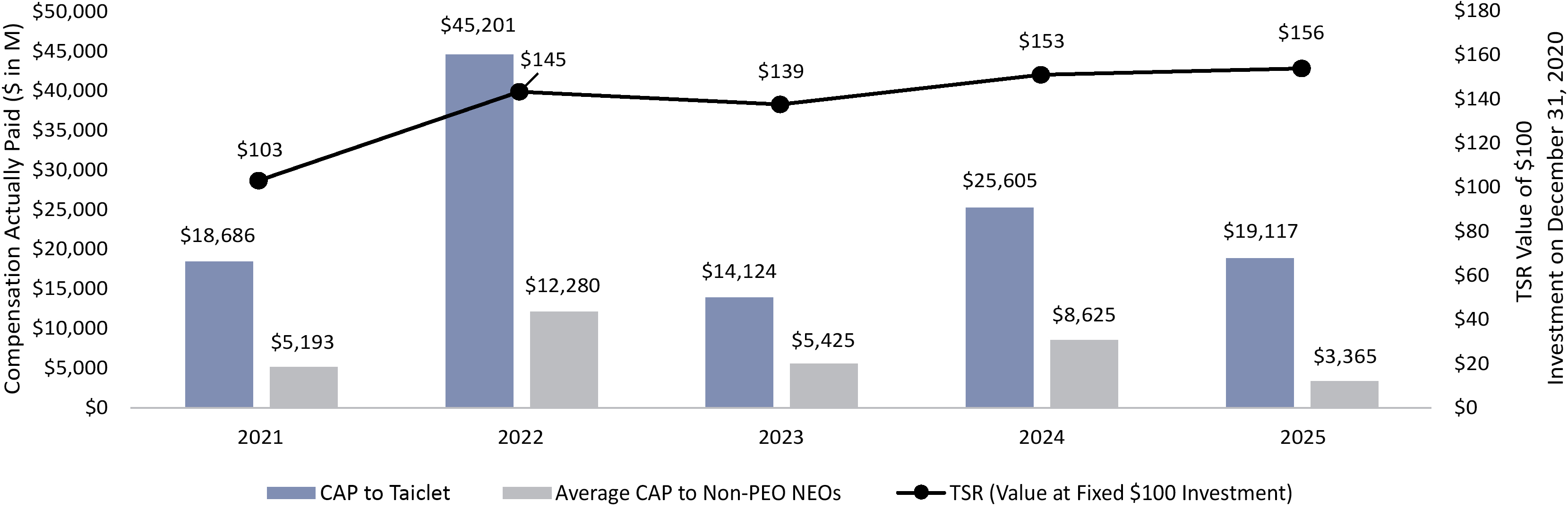
Net Income and Free Cash Flow are also important components of our executive compensation incentive plans. Free Cash Flow is incorporated in both our annual and long-term incentive plans, while Net Income is part of the formula for our ROIC calculation in our long-term incentive program. While Net Income and Free Cash Flow are key financial measures that can also affect our TSRs, they do not have as strong of a relation to CAP given that the methodology in determining CAP is primarily based on changes to equity-based award values tied to our annual stock price performance.
| | 2026 Proxy Statement | 59 | ||||||||||||
As shown in the Pay Versus Performance table on page 58 above, CAP increased from 2021 to 2022, decreased from 2022 to 2023, increased from 2023 to 2024 and decreased from 2024 to 2025, while Net Income decreased from 2021 to 2022, increased from 2022 to 2023, decreased from 2023 to 2024 and 2024 to 2025, while Free Cash Flow decreased from 2021 to 2022, increased from 2022 to 2023, decreased from 2023 to 2024 and increased from 2024 to 2025. See “2025 Compensation Elements” in the CD&A for more information on the impact of these measures to 2025 incentive awards.
Stockholder Returns Versus Peer Group
For purposes of the Pay Versus Performance disclosure, we measure our TSR performance against the industry-focused index disclosed in the stock performance graph of our Annual Report on Form 10-K. The comparison assumes $100 was invested in the Company and in the S&P Aerospace & Defense Index for the period starting December 31, 2020 and was held through the end of each year listed in the first table set forth above. All dollar values assume reinvestment of dividends paid by companies in the index. Historical stock performance is not necessarily indicative of future stock performance. This table does not reflect how the Compensation Committee considers TSR in setting executive pay or linking executive pay to Company performance.
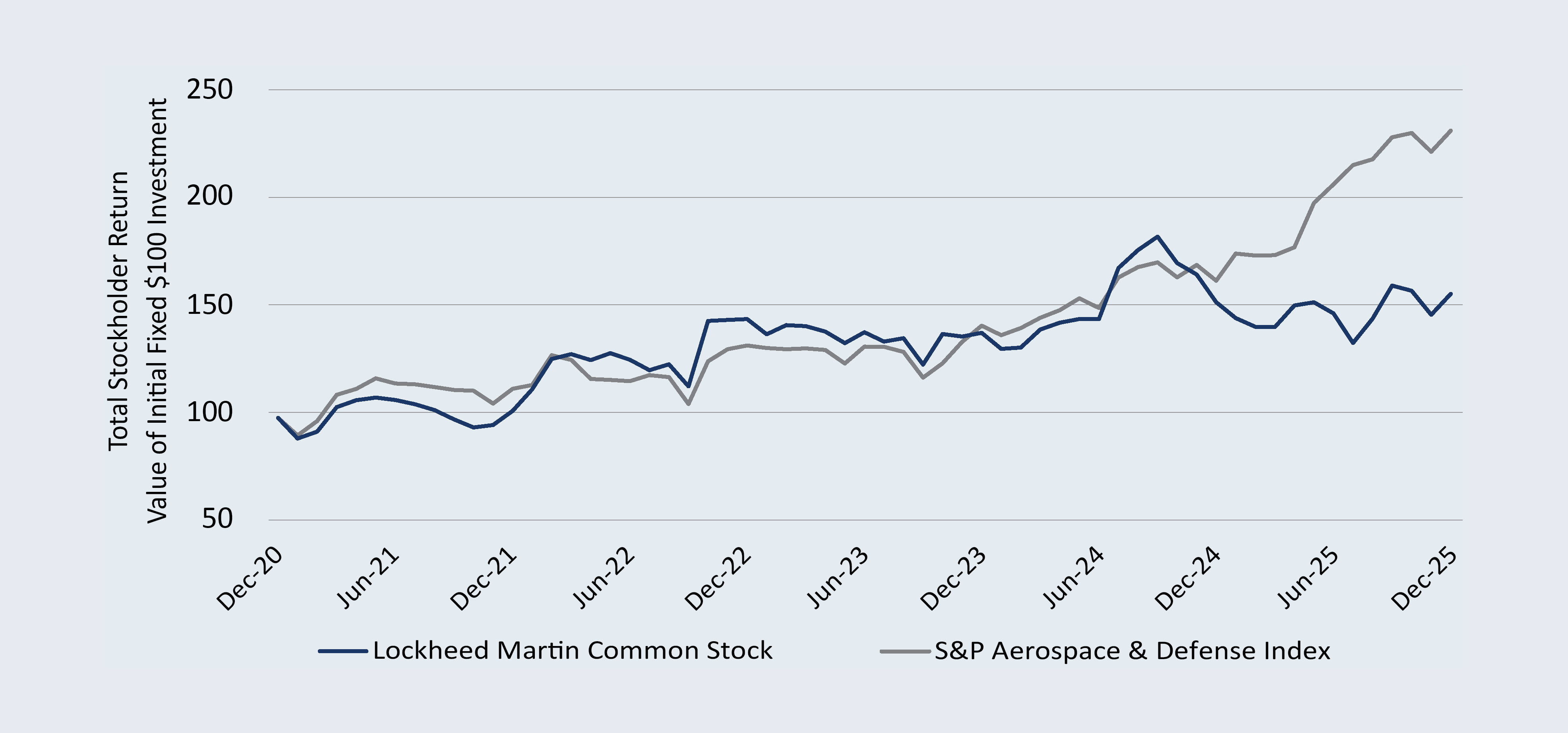
Other Most Important Performance Measures
The table to the right lists what in the Company’s assessment are the most important financial performance measures used by the Company to link the CAP of our NEOs for 2025 to Company performance. The measures in the table are listed alphabetically and are not ranked by relative importance or otherwise. See "Compensation Discussion and Analysis” and Appendix A for more information on Free Cash Flow, ROIC, and Segment Operating Profit. | Most Important Performance Measures | ||||||||||
60 | 2026 Proxy Statement | | ||||||||||||
Audit Matters
Proposal 3: Ratification of Appointment of Independent Auditors | | The Board recommends a vote FOR this proposal | |||||||||||||||
The Audit Committee has reappointed Ernst & Young LLP (EY), an independent registered public accounting firm, as the independent auditors to perform an integrated audit of the Company’s consolidated financial statements and internal control over financial reporting for the year ending December 31, 2026. The services provided to the Company by EY for the last two fiscal years are described under the caption “Fees for Independent Auditors” on the following page.
The Audit Committee is directly responsible for the appointment, compensation, retention, oversight and termination of the Company’s independent auditors in accordance with the NYSE listing standards. The Audit Committee also is responsible for the audit fee negotiations associated with the retention of EY. The Audit Committee and its Chairman are involved in the selection of EY’s lead engagement partner. The Audit Committee regularly meets with EY without management present.
EY has served as the Company’s independent auditors since 1994. The Audit Committee reviews the engagement of EY annually following completion of EY’s audit of the prior year’s financial statements. The Audit Committee also conducts a mid-year assessment of the quality of EY’s work. As part of its annual and mid-year assessment of EY, the Audit Committee has considered:
•the materials on independence provided by EY;
•work quality;
•management’s level of satisfaction with EY’s services;
•the adequacy of EY’s staffing and the use of digital audit tools to successfully perform the audit;
•the breadth of knowledge, support and expertise of its national office;
•the length of time EY has been engaged;
•external data regarding EY’s audit quality and performance, including recent Public Company Accounting Oversight Board (PCAOB) reports on EY and its peer firms, including the results of any internal or external inspections of the EY audit of Lockheed Martin;
•EY’s institutional knowledge and expertise with respect to the Company’s business and government contracting practices;
•EY’s quality and cost-effective services;
•EY’s familiarity with the Company’s accounts;
•the potential impact of changing independent auditors, including the high-level security clearances held by EY staff in support of its review of classified programs and the difficulty in replacing those clearances in a timely manner without disruption to the ongoing audit activities;
•EY’s level of expertise in accounting issues relating to government contracts; and
•EY’s performance in providing independent analysis of management positions.
While the length of EY’s tenure may implicate some stockholders’ stewardship guidelines, the Board believes that EY’s continued engagement is appropriate and in the best interest of the Company. Any potential risks or concerns associated with EY’s tenure are outweighed by its independence and objectivity, work quality, expertise, communications, security clearances and deep institutional knowledge of the Company’s industry, operations, business, accounting policies and internal controls.
| | 2026 Proxy Statement | 61 | ||||||||||||
Stockholder approval of the appointment is not required. However, the Board believes that obtaining stockholder ratification of the appointment is a sound corporate governance practice. If the stockholders do not vote on an advisory basis in favor of the appointment of EY, the Audit Committee will reconsider whether or not to hire the firm and may retain EY or hire another firm without resubmitting the matter for stockholders’ approval. The Audit Committee retains the discretion at any time to appoint a different independent auditor.
Representatives of EY are expected to be present at the Annual Meeting, and such representatives will be available to respond to appropriate questions and will have the opportunity to make a statement if they desire.
Pre-Approval of Independent Auditors’ Services
The Audit Committee pre-approves all audit, audit-related, tax and other services performed by the independent auditors. The Audit Committee pre-approves specific categories of services up to pre-established fee thresholds. Unless the type of service has previously been pre-approved, the Audit Committee must approve that specific service before the independent auditors may perform such service. In addition, separate approval is required if the amount of fees for any pre-approved category of service exceeds the fee thresholds established by the Audit Committee. The Audit Committee also has delegated to the Committee Chairman or any other committee member pre-approval authority with respect to permitted services up to $500,000, provided that the Committee Chairman or the approving committee member must report any pre-approval decisions to the Audit Committee at its next scheduled meeting.
Fees for Independent Auditors
The following table sets forth the fees billed and expected to be billed by EY, the Company’s independent auditors, for audit services, audit-related services, tax services and all other services rendered for 2025 and 2024. All fees were pre-approved in accordance with the Audit Committee’s pre-approval policy. The Audit Committee considered and concluded that the provision of these services by EY was compatible with the maintenance of the auditor’s independence.
2025 | 2024 | |||||||
| ($) | ($) | |||||||
Audit Fees(a) | 24,750,000 | 22,070,000 | ||||||
Audit-Related Fees(b) | 95,000 | 94,000 | ||||||
Tax Fees(c) | 2,200,000 | 2,109,000 | ||||||
| All Other Fees | — | — | ||||||
(a)Audit fees are for services related to the annual audit of the Company’s consolidated financial statements, including the audit of internal control over financial reporting, the interim reviews of the Company’s quarterly financial statements, statutory audits of the Company’s foreign subsidiaries and consultations on accounting matters.
(b)Audit-related fees are primarily related to audits of the Company’s employee benefit plans and due diligence services in connection with acquisitions.
(c)Tax fees are for domestic and international tax compliance and advisory services. Tax compliance fees were $1.1 million and $1.0 million in 2025 and 2024, respectively, and fees for advisory services were $1.1 million in both 2025 and 2024.
62 | 2026 Proxy Statement | | ||||||||||||
Audit Committee Report
On behalf of the Board, the Audit Committee of the Board of Directors is responsible for overseeing the Company’s accounting, auditing and financial reporting process and financial risk assessment and management process. The Audit Committee also monitors compliance with certain legal and regulatory matters.
The Company’s management is responsible for preparing the quarterly and annual consolidated financial statements, the financial reporting process, and maintaining and evaluating disclosure controls and procedures and a system of internal control over financial reporting.
In addition to its oversight of the Company’s internal audit organization, the Audit Committee is directly responsible for the appointment, compensation, retention and oversight of the Company’s independent auditors, Ernst & Young LLP (EY), an independent registered public accounting firm. The independent auditors are responsible for performing an independent audit of the Company’s annual consolidated financial statements and internal control over financial reporting and expressing an opinion on the material conformity of those consolidated financial statements with U.S. generally accepted accounting principles and on the effectiveness of the Company’s internal control over financial reporting.
In connection with the preparation of the Company’s consolidated financial statements as of and for the year ended December 31, 2025, the Audit Committee reviewed and discussed with management and EY the Company’s audited consolidated financial statements, including discussions regarding critical accounting policies, financial accounting and reporting principles and practices, the quality of such principles and practices, the reasonableness of significant judgments and estimates, and the effectiveness of internal control over financial reporting. The Audit Committee also discussed with EY, with and without management, the quality of the financial statements, clarity of the related disclosures, effectiveness of internal control over financial reporting and other items required by the applicable requirements of the Public Company Accounting Oversight Board (PCAOB) and the Securities and Exchange Commission (SEC). Additionally, the Audit Committee received and reviewed the written disclosures and letter from EY required by applicable requirements of the PCAOB regarding EY’s communications with the Audit Committee concerning independence, and has discussed with EY its independence.
Based on the Audit Committee’s reviews and discussions described in this report, the Audit Committee recommended to the Board of Directors that the audited consolidated financial statements as of and for the year ended December 31, 2025 be included in Lockheed Martin Corporation’s Annual Report on Form 10-K for 2025 for filing with the SEC. The Audit Committee also reappointed EY to serve as the Company’s independent auditors for 2026, and requested that this appointment be submitted to the Company’s stockholders for ratification at the Annual Meeting. The Board of Directors approved the Audit Committee’s recommendations.
| | | ||||||||||||
Patricia E. Yarrington, Chairman | David B. Burritt | Vicki A. Hollub | ||||||||||||
| | 2026 Proxy Statement | 63 | ||||||||||||
Stockholder Proposal
Proposal 4
Stockholder Proposal Requiring Independent Board Chairman | | The Board recommends a vote AGAINST this proposal | |||||||||||||||
Mr. John Chevedden intends to introduce the proposal set forth below at the Annual Meeting.
Beginning of Stockholder Proposal—Text and Graphic are Reprinted from the Stockholder Submission:
Proposal 4 - Independent Board Chairman | ||||||||||||||
 | ||||||||||||||
Shareholders request that the Board of Directors adopt an enduring policy, and amend the governing documents as necessary in order that 2 separate people hold the office of the Chairman and the office of the CEO as soon as possible. The Chairman of the Board shall be an Independent Director. A Lead Director shall not be a substitute for an independent Board Chairman. The Board shall have the discretion to select an interim Chairman of the Board, who is not an Independent Director, to serve while the Board is required to seek an Independent Chairman of the Board on an accelerated basis. This policy could be phased in when there is a contract renewal for our current CEO or for the next CEO transition although it is better to adopt it now. An independent Board Chairman at all times improves corporate governance by bringing impartiality, objective oversight, and external expertise to board decisions, mitigating conflicts of interest, enhancing transparency, and boosting investor confidence. This detached perspective allows the chairman to focus on shareholder interests, strengthen management accountability, and provide critical checks and balances, ultimately contributing to the Company's long-term sustainability and credibility. This may be a particularly good time to consider the merits of this proposal. Lockheed Martin stock was at $440 in 2020 and at only $500 in late 2025. 2025 news reports have reflected unfavorably on Lockheed Martin, primarily due to financial losses, program challenges, and a related investor lawsuit. This includes a $1.8 billion pre-tax loss, related to classified aeronautics and missile programs in January 2025. An additional $950 million pre-tax loss on a highly-classified "Skunk Works" program and a $570 million pre-tax loss on the Canadian Maritime Helicopter Program in June 2025. An August 2025 lawsuit alleged that Lockheed Martin misled shareholders about its financial health between January 2024 and July 2025. The complaint claims the company lacked effective internal controls and failed to disclose risks that led to billions in program write-downs. Lockheed Martin's chief financial officer, Jay Malave, left the company in April 2025, just months before the significant second-quarter losses were revealed. The F-35 fighter jet program, which accounts for a substantial portion of Lockheed Martin's revenue, experienced delivery delays again in 2025. An October 2025 Government Accountability Office report stated that the F-35 will never live up to its ambitious promises, following nearly a quarter-century of development. In October 2025, it was reported that delays from engine supplier Pratt & Whitney would postpone the finalization of contracts for F-35 engines until the spring of 2026. Throughout 2025, Elon Musk criticized legacy defense programs, including the F-35, and has called for the mass production of cheaper, AI-powered drones. Lockheed Martin accrued $100 million in interest as it contests a claim from the IRS for an additional $4.6 billion in income tax liability. | ||||||||||||||
| Please vote yes: | ||||||||||||||
| Independent Board Chairman - Proposal 4 | ||||||||||||||
End of Stockholder Proposal—Board Vote Recommendation on Proposal 4 on Following Page
64 | 2026 Proxy Statement | | ||||||||||||
The Board of Directors Recommends Voting AGAINST Proposal 4 The Board of Directors recommends that stockholders vote AGAINST this proposal for the following reasons: Forcing a one-size-fits-all approach to Board leadership is not in the best interests of the Company and its stockholders and usurps the Board’s duty to determine the most effective leadership structure for Lockheed Martin using its business judgment. The Board believes that determining the leadership structure of the Company is one of its most important fiduciary duties, and a flexible leadership model best enables the Board to exercise independent and effective oversight of the Company’s business and affairs. The proposal’s rigid, one-size-fits-all, permanent policy will prohibit the Board, regardless of the circumstances, from exercising its judgment to determine the leadership structure that best serves the interests of our stockholders. The Board believes this is why less than half of the S&P 500 have an independent chair according to Spencer Stuart’s 2025 U.S. Board Index. The Board has viewed its flexible leadership structure as an important enabler for Lockheed Martin. For instance, when Mr. Taiclet was elected CEO in 2020, the Board separated the roles of Chair and CEO, with our former CEO serving as Executive Chairman to provide continuity during the transition. In 2021 and annually since, the independent directors – 90% of the Board as of year-end 2025 – determined that the best leadership structure was to have a combined Chair and CEO balanced by a strong independent Lead Director. The Board has created a robust independent Lead Director role and strong corporate governance practices and policies that enable Lockheed Martin’s experienced and independent directors to provide oversight in the best interests of our stockholders. All directors other than our CEO are independent and all members of our Board committees are independent, which ensures that our independent directors have primary oversight of critical matters, including the integrity of the Company’s financial statements, the compensation of our executive officers, the selection and evaluation of directors, and the development of corporate governance policies and practices. The independent Lead Director plays a critical role in Lockheed Martin's governance structure as the person charged with ensuring that the Board provides appropriate independent oversight of management. Among the other authorities described in this proxy, the Lead Director engages directly with the other independent directors, the Chairman, and management to ensure that the Board is provided the information it needs to make decisions, holds regular, candid discussions with the independent directors without the Chairman or management present, and provides unvarnished feedback to the Chairman and management as part of the Board’s oversight processes. Furthermore, as a result of the Company’s Board refreshment efforts, 55% of the Company’s independent directors have joined the Board in the past six years, resulting in a balanced range of tenures and ensuring both continuity and fresh perspectives among our Board members. The strength and experience of our independent directors, all of whom have served in senior leadership roles outside the Company, combined with the strong and effective corporate governance practices memorialized in our Corporate Governance Guidelines, Bylaws, and other governance policies and practices, reinforce the Board’s alignment with, and accountability to, stockholders. Annual election of both the Chairman and the independent Lead Director by the independent members of the Board keeps both roles accountable to the Company’s stockholders. Our directors are elected annually by our stockholders and, once elected, vote on the leadership structure of the Board for the year ahead. This annual action, coupled with the flexibility provided for by allowing a combined Chairman and CEO or separating the roles noted above, gives the Board maximum flexibility to ensure that the Company’s needs are met across changing times and circumstances. In 2025, Lockheed Martin's independent directors unanimously re-elected Mr. Falk to serve as independent Lead Director. Mr. Falk brings to the role a deep knowledge of the Company, our industry and our customers, and his experience leading a large public company, his governance experience from past and current service on other Boards of Directors and his strategic perspective on global trends and business transformation enable him to serve as an effective and independent Lead Director. During his tenure as Lead Director, Mr. Falk has engaged with many of our largest stockholders to ensure he and the Board receive direct stockholder feedback. Our stockholders have considered iterations of this proposal three times and consistently declined to require separation of the Chairman and CEO roles. Lockheed Martin has received an independent chair proposal three times. Our stockholders have previously rejected all prior proposals on this topic, with less than 29% of stockholders supporting this proposal at the 2023 Annual Meeting of Stockholders. THE BOARD OF DIRECTORS UNANIMOUSLY RECOMMENDS A VOTE AGAINST PROPOSAL 4. | ||||||||||||||
| | 2026 Proxy Statement | 65 | ||||||||||||
Other Information
Security Ownership of Management and Certain Beneficial Owners
Directors and Executive Officers
The following table shows Lockheed Martin common stock beneficially owned by, and stock units credited to, each NEO, director, nominee and all NEOs, directors, nominees and other executive officers as a group as of March 2, 2026. Except as otherwise noted, the named individuals have sole voting and investment power with respect to such securities. No director, nominee or NEO, individually or as a group, beneficially owned more than one percent of our outstanding common stock. All amounts are rounded to the nearest whole share and may cause totals not to sum. No shares have been pledged. The address of each director, nominee and executive officer is c/o Lockheed Martin Corporation, 6801 Rockledge Drive, Bethesda, MD 20817.
| Name | Common Stock | (1)(2) | Stock Units | (3) | Total | ||||||||||||
| John C. Aquilino | 413 | 261 | 6 | 674 | |||||||||||||
| David B. Burritt | 6,586 | 4 | 24,607 | 6,7 | 31,193 | ||||||||||||
Timothy S. Cahill | 14,284 | 11,064 | 8,9,10 | 25,347 | |||||||||||||
| John M. Donovan | 5,156 | 1,623 | 6,7 | 6,778 | |||||||||||||
| Joseph F. Dunford, Jr. | 2,676 | 261 | 6 | 2,936 | |||||||||||||
Thomas J. Falk | 5,250 | 5 | 15,454 | 6 | 20,704 | ||||||||||||
| Vicki A. Hollub | 3,637 | 2,772 | 6,7 | 6,409 | |||||||||||||
| Jesus Malave | 101 | 122 | 9,10 | 224 | |||||||||||||
| Kevin J. O'Connor | 2,757 | 15,281 | 10 | 18,038 | |||||||||||||
| Debra L. Reed-Klages | 2,934 | 261 | 6 | 3,194 | |||||||||||||
Evan T. Scott | 1,474 | 4,960 | 9,10 | 6,433 | |||||||||||||
| Frank A. St. John | 3,833 | 12,353 | 8,9,10 | 16,186 | |||||||||||||
| James D. Taiclet | 78,052 | 32,298 | 9,10 | 110,349 | |||||||||||||
Heather A. Wilson | 634 | 261 | 6 | 895 | |||||||||||||
| Patricia E. Yarrington | 1,130 | 1,098 | 6 | 2,228 | |||||||||||||
All NEOs, directors, nominees and other executive officers as a group (19 individuals) | 156,078 | 151,652 | 307,730 | ||||||||||||||
(1)Includes shares payable at termination with respect to vested stock units credited under the Directors Equity Plan for which a director has elected payment in stock for Adm. Aquilino 413, Mr. Burritt 583; Mr. Donovan 1,778; Gen. Dunford 2,676; Ms. Hollub 3,637; Ms. Reed-Klages 2,779; Mr. Taiclet 1,188; Dr. Wilson 634 and Ms. Yarrington 1,130. Units for which a director has elected payment in cash are reported in the “Stock Units” column.
(2)Includes shares attributable to the participant’s account in the Lockheed Martin Salaried Savings Plan for Mr. Taiclet 70; Mr. Scott 529; Mr. St. John 7; Mr. Cahill 73; Mr. O’Connor 38 and Mr. Malave 101. Participants have voting power and investment power over the shares.
(3)Does not include performance stock units (PSUs). There are no voting rights associated with stock units or restricted stock units (RSUs).
(4)For Mr. Burritt, includes 4,207 shares held by his spouse’s revocable trust and 1,796 shares held by an irrevocable trust for the benefit of members of his immediate family.
(5)Represents shares beneficially owned by Mr. Falk and his spouse through a family limited partnership.
(6)Includes vested stock units under the Directors Equity Plan for which directors have elected to receive distributions of units in the form of cash as well as unvested stock units credited on February 13, 2026 for the annual equity award as follows: Adm. Aquilino 261, Mr. Burritt 13,427; Mr. Donovan 261; Gen. Dunford 261; Mr. Falk 15,454; Ms. Hollub 261; Ms. Reed-Klages 261; Dr. Wilson 261 and Ms. Yarrington 1,098.
(7)Includes stock units under the Directors Deferred Compensation Plan representing deferred cash compensation for Mr. Burritt 11,180; Mr. Donovan 1,362; and Ms. Hollub 2,511. The stock units (including dividend equivalents credited as stock units) are distributed in the form of cash.
(8)Includes stock units attributable to the participant’s account under the DMICP for Mr. St. John 160 and Mr. Cahill 2,446. Although most of the units will be distributed in shares of stock following termination or retirement, none of the units are convertible into shares of stock within 60 days of March 2, 2026.
(9)Includes stock units attributable to the participant’s account under the NQSSP for Mr. Taiclet 831; Mr. Scott 229; Mr. St. John 22; Mr. Cahill 435 and Mr. Malave 122. Amounts credited to a participant’s account in the NQSSP are distributed in cash following termination of employment.
(10)Includes unvested RSUs for Mr. Taiclet 31,467; Mr. Scott 4,731; Mr. St. John 12,171; Mr. Cahill 8,183 and Mr. O’Connor 15,281. Each RSU represents a contingent right to receive one share of common stock.
66 | 2026 Proxy Statement | | ||||||||||||
Certain Beneficial Owners
The following table shows information regarding each person known to be a “beneficial owner” of more than 5% of our common stock. For purposes of this table, beneficial ownership of securities generally means the power to vote or dispose of securities, or the right to acquire securities within 60 days that may be voted or disposed of, regardless of any economic interest in the securities. All information shown is based on information reported by the stockholders on Schedule 13G/As filed with the SEC on the dates indicated in the footnotes to this table.
| Name and Address | Amount of Common Stock | Percent of Outstanding Shares | ||||||
State Street Corporation(1) State Street Financial Center 1 Congress Street, Suite 1 Boston, MA 02114 | 37,056,708 | 14.9 | % | |||||
The Vanguard Group(2) 100 Vanguard Boulevard Malvern, PA 19355 | 22,098,899 | 8.9 | % | |||||
BlackRock, Inc.(3) 50 Hudson Yards New York, NY 10001 | 18,292,313 | 7.4 | % | |||||
(1)As reported on a Schedule 13G/A filed on January 30, 2024 by State Street Corporation on behalf of itself and specified direct and indirect subsidiaries (State Street) in their various fiduciary and other capacities. State Street had shared voting power with respect to 33,487,726 shares and shared dispositive power with respect to 37,049,916 shares and did not have sole dispositive or sole voting power over any shares. State Street Bank and Trust Company (SSBTC) is the trustee and State Street Global Advisors Trust Company (SSGA) is the independent fiduciary and investment manager for Lockheed Martin common stock held in a master trust for Lockheed Martin benefit plans. SSBTC beneficially owns 27,695,096 of the shares held by State Street, all of which are held in its capacity as trustee for various Lockheed Martin benefit plans, and SSBTC had shared voting power over 27,695,096 shares and shared dispositive power over 1,098,325 shares. SSGA beneficially owns 32,214,809 of the shares held by State Street, of which 26,596,771 were held by SSGA as independent fiduciary and investment manager for Lockheed Martin employee benefit plans, and SSGA had shared voting power over 2,257,256 shares and shared dispositive power over 32,214,145 shares. The Schedule 13G/A reports State Street’s beneficial ownership as of December 31, 2023. The number and percentage of shares held by State Street may have changed since the filing of the Schedule 13G/A.
(2)As reported on a Schedule 13G/A filed on February 13, 2024 by The Vanguard Group (Vanguard). Vanguard had sole dispositive power over 21,149,603 shares, shared dispositive power over 949,296 shares, shared voting power over 275,335 shares and did not have sole voting power over any shares. The Schedule 13G/A reports Vanguard’s beneficial ownership as of December 31, 2023. The number and percentage of shares held by Vanguard may have changed since the filing of the Schedule 13G/A.
(3)As reported on a Schedule 13G/A filed on January 26, 2024 by BlackRock, Inc. (BlackRock). BlackRock had sole dispositive power over 17,167,976 shares and sole voting power over all reported shares and did not have shared dispositive or shared voting power over any shares. The Schedule 13G/A reports BlackRock’s beneficial ownership as of December 31, 2023. The number and percentage of shares held by BlackRock may have changed since the filing of the Schedule 13G/A.
| | 2026 Proxy Statement | 67 | ||||||||||||
Frequently Asked Questions
Your vote matters to us. We encourage all stockholders to vote on the proposals prior to the Annual Meeting in accordance with the instructions that you receive with your proxy materials. | ||
Voting Information
Who is entitled to vote?
All holders of our common stock (stockholders) at the close of business on March 2, 2026 (the Record Date) are entitled to vote their shares. This includes registered stockholders, Company savings plan participants and beneficial owners. As of the Record Date, there were 230,462,118 shares issued and outstanding. Common stock is the only class of securities entitled to vote at the meeting and each outstanding share entitles its holder to one vote.
How do I vote?
The following table indicates the applicable voting methods for each type of share ownership prior to the meeting. See “How do I know what type of share ownership I have” below for more information on the types of share ownership. For information on how to vote during the Annual Meeting, see “How do I participate and vote in the Annual Meeting?” If you hold shares in multiple accounts, you may receive multiple proxy material packages (electronically and/or by mail). Please be sure to vote all of your Lockheed Martin shares in each of your accounts in accordance with the voting instructions you receive.
Voting Methods | Registered Stockholder | Savings Plan Participant | Beneficial Owner | ||||||||||||||||||||
| By Internet (Recommended) | Visit www.investorvote.com/LMT Enter the Control Number printed on your proxy form. Available twenty four hours a day, seven days a week | Follow the instructions received from your broker, bank or other nominee. We expect the vast majority of beneficial owners will be able to vote by Internet, phone, mail or at the meeting. | ||||||||||||||||||||
| By Phone | Call toll free 1-800-652-8683 in the U.S., Canada and Puerto Rico; or 1-781-575-2300 from other locations. Have your control number available. Available twenty four hours a day, seven days a week | |||||||||||||||||||||
| By Mail | Complete, sign, date and return your proxy or voting instruction card in the mail. It must be received prior to your applicable voting deadline. | |||||||||||||||||||||
 | At the Meeting | Yes See page 72 for more information | No | ||||||||||||||||||||
How do I know what type of share ownership I have?
The table below provides descriptions of the different share ownership types, which are referenced throughout these FAQs. If you have multiple accounts, you may hold shares via multiple methods. If you have additional questions, contact the entity from which you received the proxy materials.
Registered Stockholder | Savings Plan Participant | Beneficial Owner | ||||||||||||
Your shares are registered directly in your name with the Company’s transfer agent, Computershare Trust Company, N.A. (“Computershare”). | Your shares are allocated to a Company savings plan account, such as a 401(k) or other defined contribution plan. | Your shares are held in a stock brokerage account or by a bank or another nominee and registered in “street name.” | ||||||||||||
68 | 2026 Proxy Statement | | ||||||||||||
How will I receive the proxy voting materials, and what materials should I expect to receive?
We are furnishing proxy materials to our stockholders primarily via “Notice and Access” delivery pursuant to SEC rules. On or about March 26, 2026, we mailed to our stockholders (other than those who previously requested a printed set) a “Notice Regarding the Availability of Proxy Materials” containing instructions on how to access the proxy materials via the Internet. This method of proxy delivery reduces the cost of producing and mailing the full set of proxy materials, and we encourage you to sign up for electronic delivery to further these goals. Stockholders who previously consented to electronic delivery and certain savings plan participants will receive their proxy materials via email. Most active employees who participate in the Company’s savings plans will receive an email notification announcing Internet availability of the proxy materials. A paper copy will not be provided unless requested by the employee following the instruction in the email notification.
The Proxy Statement and Annual Report are available to the public at www.edocumentview.com/LMT or www.lockheedmartin.com/investor. The SEC also maintains a website at www.sec.gov that contains reports, proxy statements and other information regarding Lockheed Martin. If you are a registered stockholder and would like to receive electronic copies of the proxy materials in the future, you may visit www.lockheedmartin.com/investor and complete the online consent form under the “Shareholder Services” section. Requests for electronic copies will remain in effect for all future proxy voting materials, including the Annual Report, unless withdrawn. Withdrawal procedures are also available at www.lockheedmartin.com/investor. If you are a beneficial owner, contact your broker, bank or other nominee for information on electronic delivery of proxy materials.
How do you handle “householding”?
Our Company has adopted a procedure approved by the SEC called “householding.” Under this procedure, we send a single hard copy of the Notice of Internet Availability or, if you requested full printed versions by mail, only one hard copy Proxy Statement and one hard copy Annual Report to eligible stockholders who share the same address, unless we have received instructions to the contrary from any stockholder at that address. Eligible stockholders who participate in householding will continue to receive separate proxy cards. This practice is designed to reduce our Company’s printing and postage costs. We do not use householding for any other stockholder mailings, such as dividend checks, IRS Forms 1099 or account statements. If you are a beneficial owner, please contact your broker, bank or other nominee to inquire about any specific householding procedure.
If you are eligible for householding but received multiple copies of the Notice of Internet Availability, Annual Report and Proxy Statement, and prefer to receive only a single copy of each of these documents for your household, please contact Computershare, Shareholder Relations, P.O. Box 43006, Providence, RI 02940-3006, or call 1-877-498-8861. If you are a registered stockholder residing at an address with any other registered stockholder and wish to receive a separate Notice of Internet Availability, Annual Report or Proxy Statement, we will promptly provide you with a separate copy or send you a separate copy in the future upon written or oral request to Computershare as indicated above.
How early can I vote, and when are the voting deadlines?
Stockholders may vote as soon as they receive their proxy voting materials. We recommend that stockholders vote prior to the Annual Meeting and before any earlier deadline specified below. Early voting will ensure that your votes are properly received and tallied before the 2026 proxy voting deadlines, provided below:
Registered Stockholder | Savings Plan Participant | Beneficial Owner | ||||||||||||||||||
| Voting Deadlines | May 12, 2026 Upon Poll Closure during Annual Meeting | May 7, 2026 Before 11:59 PM ET | Follow applicable deadlines on the information received from your broker, bank or other nominee | |||||||||||||||||
How do I change or revoke my vote?
For registered stockholders and savings plan participants, you may change or revoke your proxy or voting instructions prior to the meeting by submitting later-dated instructions by Internet, telephone or mail or providing written notice to Lockheed Martin Corporation, Attention: Senior Vice President, General Counsel and Corporate Secretary, 6801 Rockledge Drive, Bethesda, MD 20817, before your original proxy is voted at the Annual Meeting. To be effective, revocation instructions must be received by the applicable voting deadlines. Registered stockholders may also revoke their proxy by attending and voting their shares at the Annual Meeting. Attending the meeting, by itself, will not revoke a proxy. Beneficial owners should contact their broker, bank or nominee for information on how to change or revoke any prior votes.
| | 2026 Proxy Statement | 69 | ||||||||||||
What will happen if I return my proxy without voting instructions, or if I do not return my proxy?
Voting outcomes will vary, per the scenarios as provided below:
Scenario | Registered Stockholder | Savings Plan Participant | Beneficial Owner | |||||||||||||||||
I return my proxy without my voting instructions. | Your shares will be voted according to the voting recommendations of the Board of Directors. It is in the best judgment of the named proxy holders if any other matters are properly brought before the Annual Meeting. | If the plan trustee does not timely receive your voting instructions, the trustee will vote the shares allocated to your plan account in proportion to those shares for which voting instructions were timely received from plan participants. If the plan trustee determines that voting in this fashion is not in the best interest of the plan participants, the trustee will make an independent determination as to how to vote such shares. | Under New York Stock Exchange rules, your broker, bank or other nominee may vote your shares on routine matters only. For this annual meeting, the only routine matter is Proposal 3 (Ratification of Appointment of Ernst & Young LLP). | |||||||||||||||||
I do not return my proxy. | Your shares will not be voted unless you vote. Your vote must be received before the voting deadline. | |||||||||||||||||||
Note: The Company cannot provide a single proxy or instruction card for stockholders who own shares in multiple forms as registered stockholders, savings plan participants or beneficial owners. As a result, if your shares are held in multiple stockholder accounts, you must submit your votes for each type of account in accordance with the instructions that you receive for the respective account.
What am I voting on and what are the Board’s voting recommendations?
The following table summarizes the Board’s voting recommendations for each proposal, if properly presented during the Annual Meeting, the vote required for each proposal to pass, and the effect of abstentions and uninstructed shares on each proposal.
| Proposal | Description | Page | Board Voting Recommendations | Required Vote to Pass(1) | Effect of Abstentions on Votes Cast(2) | Effect of Broker Non- Votes(3) | ||||||||||||||
| 1 | Election of Directors | FOR ALL DIRECTOR NOMINEES | Majority of votes cast for each nominee | None | None | |||||||||||||||
| 2 | Advisory Vote to Approve the Compensation of our Named Executive Officers (Say-on-Pay) | FOR | Majority of votes cast; advisory and non-binding | None | None | |||||||||||||||
| 3 | Ratification of the Appointment of Ernst & Young LLP as our Independent Auditors for 2026 | FOR | Majority of votes cast; advisory and non-binding | None | Discretionary voting permitted | |||||||||||||||
| 4 | Stockholder Proposal Requiring Independent Board Chairman | AGAINST | Majority of votes cast; advisory and non-binding | None | None | |||||||||||||||
(1)“Votes cast” excludes broker non-votes and excludes abstentions.
(2)A stockholder who abstains on some or all matters is considered present for purposes of determining if a quorum is present at the Annual Meeting, but an abstention is not counted as a vote cast under Maryland law. Accordingly, an abstention has no effect on the vote on any proposal.
(3)Brokers only have discretionary authority to vote on Proposal 3. If a broker casts a vote on Proposal 3, the vote will be included in determining whether a quorum exists for holding the meeting. Brokers do not have authority to vote on the other proposals (non-routine matters) absent directions from the beneficial owner. Votes withheld by brokers in the absence of voting instructions from a beneficial owner are referred to as “broker non-votes” and will not count as votes cast for that proposal and have no effect on the proposal outcome. A broker non-vote on these proposals will not impact our ability to obtain a quorum.
70 | 2026 Proxy Statement | | ||||||||||||
Can other matters be decided at the Annual Meeting?
We were not aware of any other matters to be presented at the Annual Meeting at the time this Proxy Statement went to press. If other matters are properly presented for consideration at the Annual Meeting, the proxy holders appointed by our Board (who are named on your proxy card if you are a Registered Stockholder) will have the discretion to vote on those matters in accordance with their best judgment on behalf of stockholders who provide a valid proxy by Internet, telephone or mail.
Are my votes confidential?
Voting instructions for Company savings plan participants are confidential as required by law. Individual votes of stockholders are kept confidential by the Company and its agents, except as necessary to meet legal requirements.
Who will tally the votes?
Representatives from our authorized transfer agent, Computershare, will tabulate the votes and act as inspectors of election for the Annual Meeting.
How will I be notified of the voting results of the Annual Meeting?
The preliminary voting results will be announced during the Annual Meeting. The final voting results will be tallied by the inspectors of election and disclosed by the Company in a Current Report on Form 8-K filed with the SEC within four business days following the Annual Meeting and posted on our investor relations website, www.lockheedmartin.com/investor.
Who is soliciting proxies and who pays the cost of this proxy solicitation?
The Company’s Board of Directors solicits proxies for the Annual Meeting. We may solicit proxies by Internet, telephone, mail or in person. To the extent necessary to ensure sufficient representation at the Annual Meeting, we may request the return of proxies by mail, express delivery, courier, telephone, Internet or other means. The Company pays the cost of soliciting proxies on behalf of the Board for the Annual Meeting. We may make arrangements with brokerage houses or other custodians, nominees and fiduciaries to send the proxy voting materials to beneficial owners on our behalf. We reimburse these entities for their reasonable expenses. We have retained Sodali & Co, 333 Ludlow Street, 5th floor, South Tower, Stamford, CT 06902 to aid in the solicitation of proxies and to verify related records for a fee of $35,000, plus expenses.
Annual Meeting Information
Why does Lockheed Martin conduct a virtual Annual Meeting?
We will conduct our 2026 Annual Meeting exclusively online through a live audio webcast. We utilize this format to facilitate attendance and to enable stockholders to attend fully and equally, regardless of size of holdings, resources or physical location.
What is a quorum and how many shares must be present to hold the Annual Meeting?
In order for Lockheed Martin to lawfully conduct business at our Annual Meeting, a majority of the shares outstanding and entitled to vote as of the Record Date must be present by virtual attendance or by proxy. This majority is referred to as a quorum. Your shares will be counted as present at the 2026 Annual Meeting if you attend the Annual Meeting virtually (whether you vote or abstain from voting) or if you properly return a proxy in advance of the Annual Meeting and do not revoke your proxy. Broker non-votes will also be considered for determining a quorum.
How do I access the virtual Annual Meeting?
Go to https://meetnow.global/LMT2026. You will have the option to either:
1.Attend as a Guest Without a Control Number by selecting “Guest” and entering the required information.
2.Attend as a Participant With a Control Number by entering your Control Number.
After accepting the terms and conditions, you will be automatically directed to the page for the Annual Meeting from which you can view the meeting agenda and other materials and ask questions and vote depending on whether you are a Participant.
| | 2026 Proxy Statement | 71 | ||||||||||||
When should I log into the virtual Annual Meeting?
The Annual Meeting will begin promptly at 9:00 a.m. EDT, on May 12, 2026. You may log into the meeting platform beginning approximately 30 minutes before the meeting start time. We encourage attendees to log into the meeting at least 15 minutes before the start time to test your audio system.
Can I attend the virtual Annual Meeting from a mobile device?
Yes, you should be able to access the Annual Meeting using any device capable of running the most common internet browsers.
Who can assist me if I have technical difficulties prior to or during the meeting?
If you encounter technical difficulties, please call Computershare’s live Technical Assistance Line for immediate support at 1-888-724-2416 (toll-free) or +1-781-575-2748 (international).
Who is eligible to attend the Annual Meeting?
Anyone is welcome to view the meeting, however, only stockholders with a control number will be able to participate in the meeting.
| Features: | Guest | Participant | ||||||||||||
View the Meeting |  | | ||||||||||||
| View Meeting Documents | | | ||||||||||||
| Ask Question During the Meeting |  | | ||||||||||||
| Vote During the Meeting | | Registered Stockholder: Yes Savings Plan Participant: No Beneficial Owner: Depends; refer to the question below for additional information | ||||||||||||
How do I participate and vote in the Annual Meeting?
Stockholders may attend the Annual Meeting via the Internet by visiting https://meetnow.global/LMT2026. You will be prompted to enter the unique control number received with your proxy materials to join and participate in the meeting. Company savings plan participants who join the Annual Meeting by using their control number will be able to ask questions but not vote during the meeting.
The vast majority of beneficial owners will be able to participate using the control number received with their voting instruction form, but we recommend that beneficial owners confirm this ability with the broker, bank or other nominee through which they hold their shares. If your broker, bank or other nominee does not provide the ability to access the virtual Annual Meeting, then you will be required to request a legal proxy from them to participate in the Annual Meeting. See “What is a legal proxy and how do I request one?”
Who can submit a question during the Annual Meeting?
Stockholders attending the meeting as a Participant using their control number will be able to submit questions via the virtual meeting platform in accordance with the Annual Meeting rules and procedures, which will be available on the meeting website. If you do not have a control number, you may attend the Annual Meeting as a Guest, but you will not be able to ask a question.
When will my question be answered?
A live question and answer session will take place after the formal business is completed, during which our Company representatives will respond to questions submitted via the virtual meeting platform before and during the meeting in accordance with the Company’s annual meeting procedures.
What is a legal proxy and how do I request one?
A legal proxy is a legal authorization from you to another person or from you to your broker, bank or other nominee if you are a beneficial owner who authorizes the other person or entity to vote the shares held in your name or in the nominee’s name that satisfies Maryland law. If you are a beneficial owner and your control number does not enable you to attend the Annual Meeting as a Participant, then to participate in the Annual Meeting, you will need to request a legal proxy from your broker, bank or other nominee and register with Computershare in advance of the Annual Meeting.
72 | 2026 Proxy Statement | | ||||||||||||
To register you must present the legal proxy you obtained from your broker, bank or other nominee to Computershare by email to Computershare at legalproxy@computershare.com or mail to “Computershare, Lockheed Martin Corporation Legal Proxy, P.O. Box 43001, Providence, RI 02940-3001.” In each case, your communication should be labeled “Legal Proxy” and include proof from your broker, bank or other nominee of your valid proxy (e.g., a forwarded email from your broker, bank or other nominee with your valid proxy attached, or an image of your valid proxy attached to your email or included in your mailing). Computershare will then confirm your registration and provide you with a 15-digit control number that you may use to attend the Annual Meeting as a Participant and vote during the meeting. The legal proxy must be received by Computershare no later than 5:00 p.m. EDT, on May 7, 2026.
Stockholder Proposals or Nominations for 2027
How do I submit a proposal or nomination for the 2027 Annual Meeting of Stockholders?
Stockholders who wish to submit a proposal or nominate a director for consideration at the 2027 Annual Meeting may do so electronically or by mail: Lead.Director@lmco.com; or Lockheed Martin Corporation, Attention: Senior Vice President, General Counsel and Corporate Secretary, 6801 Rockledge Drive, Bethesda, MD 20817.
The table below provides the requirements for how to submit a stockholder proposal or nomination, in compliance with the SEC rules, including Rule 14a-8, and our Company’s Proxy Access Bylaw Provision.
| Type of Proposal | Deadline | Submission Requirements | ||||||||||||
Proposal to be Considered for Inclusion in Lockheed Martin’s Proxy Materials. Stockholders who wish to present proposals for inclusion in the proxy materials to be distributed by us in connection with our 2027 Annual Meeting. | November 26, 2026 | Must comply with applicable SEC rules (including SEC Rule 14a-8); see also Staff Legal Bulletin 14, which may be found at www.sec.gov, and Sections 1.10 and 1.11 of our Bylaws. | ||||||||||||
Director Nomination for Inclusion in Lockheed Martin’s Proxy Materials (Proxy Access). Stockholders who wish to present a proxy access nomination for consideration at our 2027 Annual Meeting. | Must be received between October 27, 2026 and November 26, 2026 | Must provide the information required under our Bylaws, including Section 1.11. | ||||||||||||
Other Proposals and Nominations. Under our Bylaws, certain procedures must be followed for a stockholder to nominate persons for election as directors or to introduce an item of business at our 2027 Annual Meeting. | Must be received between October 27, 2026 and November 26, 2026 | Must provide the information required under our Bylaws, including Section 1.10. Stockholders who intend to solicit proxies in support of nominees other than our nominees (Universal Proxy Nominees), in addition to providing all information required by our Bylaws by the deadline referenced in the preceding column, must timely comply with all other requirements of our Bylaws and SEC Rule 14a-19. | ||||||||||||
How do I find additional information about the stockholder proponent?
As required by SEC rules, we will provide the address and the number of Lockheed Martin shares held by the sponsor of the stockholder proposal included within this Proxy Statement upon receiving an oral or written request from the stockholder. These requests should be directed to: Corporate Secretary, Lockheed Martin Corporation, 6801 Rockledge Drive, Bethesda, MD 20817 or (301) 897-6000. The Company is not responsible for the contents of the stockholder proposal or the related supporting statement.
| | 2026 Proxy Statement | 73 | ||||||||||||
Communicating with Us and Additional Information
How do I communicate with the Company’s independent Lead Director or other non-management directors if I have questions or comments?
Company stockholders may communicate with the independent Lead Director or with the non-management directors as a group, as follows:
•By Email: Lead.Director@lmco.com
•By Mail: Independent Lead Director or Non-Management Directors, c/o Senior Vice President, General Counsel and Corporate Secretary, Lockheed Martin Corporation, 6801 Rockledge Drive, Bethesda, MD 20817.
Our Senior Vice President, General Counsel and Corporate Secretary (or his delegate) reviews all correspondence sent to the Board. The Board has authorized our Senior Vice President, General Counsel and Corporate Secretary (or his delegate) to respond to correspondence regarding routine stockholder matters and services (e.g., stock transfers, dividends, etc.). Correspondence from stockholders relating to accounting, internal controls or auditing matters is brought to the attention of the Audit Committee. All other correspondence is forwarded to the independent Lead Director, who determines whether distribution to a Board committee or to the full Board for review is appropriate. Any director may review a log of all correspondence addressed to the Board and request copies of such correspondence.
What additional information will I find on the Company’s website?
You will find information about the Company and our corporate governance practices at www.lockheedmartin.com/corporate-governance. Our website contains information about our Board, Board committees, Charter, Bylaws, Code of Conduct, Governance Guidelines and information about insider transactions. Stockholders may obtain, without charge, hard copies of the above documents by writing to Investor Relations, Lockheed Martin Corporation, 6801 Rockledge Drive, Bethesda, MD 20817. Information contained on or made available through our website or other websites mentioned in this Proxy Statement is not incorporated into, and is not a part of, this Proxy Statement, and any references to our website are intended to be inactive textual references only.
74 | 2026 Proxy Statement | | ||||||||||||
Appendix A: Definition of Non-GAAP Measures
Certain financial and performance metrics in this Proxy Statement are considered non-GAAP financial measures under the SEC’s rules because they are calculated by adjusting a comparable measure calculated in accordance with U.S. generally accepted accounting principles (GAAP). Although we believe that these non-GAAP financial measures may be useful in evaluating the Company and its compensation plans, this information should be considered supplemental to, and is not a substitute for, financial information prepared in accordance with GAAP. In addition, our definitions for non-GAAP measures may differ from similarly titled measures used by other companies or analysts. Furthermore, Segment Operating Profit and Free Cash Flow used for compensation purposes may differ from the amounts reported in our periodic reports filed with the SEC and our earnings releases because the Compensation Committee requires certain adjustments to those measures for compensation purposes as described below.
Free Cash Flow
We define Free Cash Flow as cash from operations less capital expenditures. Our capital expenditures consist of equipment and facilities infrastructure and information technology (inclusive of costs for the development or purchase of internal-use software that are capitalized). We use Free Cash Flow to evaluate our business performance and overall liquidity and it was a performance goal in our annual and long-term incentive plans in 2025 and prior years.
Free Cash Flow is subject to mandatory adjustment for purposes of determining performance under the PSU and LTIP awards and the annual incentive plan. These mandatory adjustments are set forth in the PSU or LTIP award agreement or, in the case of the annual incentive plan, a Compensation Committee resolution, as applicable, and include unplanned pension contributions (net of tax), acquisitions and divestitures greater than $1 billion in value, tax reform, unplanned changes in tax laws or interpretations of law related to the amortization of R&D expenditures for tax purposes, unplanned tax payments or benefits of divestitures, changes in GAAP accounting standards, unplanned debt issuances, and unusual or non-recurring events affecting the Company by items of gain, loss or expense that are extraordinary or unusual in nature or infrequent in occurrence, including changes in applicable law or regulations. There was a $931 million adjustment required to Free Cash Flow for 2025 related to unplanned pension contributions (net of tax), a ($600) million adjustment to neutralize the impact of the change in law related to the One Big Beautiful Bill Act, and a $465 million adjustment related to Tariffs. The following table reconciles Cash from Operations to Free Cash Flow.
2025 | 2024 | 2023 | |||||||||
| ($M) | ($) | ($) | ($) | ||||||||
| Cash from Operations (GAAP) | 8,557 | 6,972 | 7,920 | ||||||||
| Capital Expenditures | (1,649) | (1,685) | (1,691) | ||||||||
| Free Cash Flow (Non-GAAP) | 6,908 | 5,287 | 6,229 | ||||||||
Adjustment for the Unplanned Pension Contributions (Net of Tax) | 931 | 966 | — | ||||||||
Adjustment for the One Big Beautiful Bill Act | (600) | — | — | ||||||||
Adjustment for Tariffs | 465 | — | — | ||||||||
| Adjusted Free Cash Flow (Non-GAAP) | 7,704 | 6,253 | 6,229 | ||||||||
For the 2023-2025 LTI award agreements, Free Cash Flow was adjusted for the items in the table below.
2023-2025 | |||||
Cash Flow ($M) | ($) | ||||
Free Cash Flow (Non-GAAP) | 18,424 | ||||
Pension Funding Adjustment | |||||
Actual Pension Funding | 1,981 | ||||
Planned Pension Funding | 979 | ||||
Delta: Forecasted vs. Actual Pension Contributions | 1,002 | ||||
Adjustment for Unplanned Tax Payments related to Divestitures | (9) | ||||
Adjustment for Unplanned Tax Payments related to Reduction in Planned Pension Contributions | 62 | ||||
Adjustment for the One Big Beautiful Bill Act | (600) | ||||
Adjustment for Tariffs | 465 | ||||
Net Adjusting Items | 920 | ||||
Adjusted Free Cash Flow (Non-GAAP) | 19,344 | ||||
| | 2026 Proxy Statement | 75 | ||||||||||||
Return on Invested Capital (ROIC)
We define Return on Invested Capital (ROIC) as the Company’s net earnings plus after-tax interest expense divided by average invested capital (total equity plus debt) after adjusting total equity by adding back adjustments related to the Company’s post-retirement benefit plans. We used ROIC as a performance measure for PSUs and LTIP awards, and this metric is subject to mandatory adjustments for purposes of determining performance under the PSU and LTIP awards. The required adjustments are set out in the applicable PSU and LTIP award agreement and include changes in accounting (GAAP) standards, impacts of an acquisition or divestiture valued at more than $1 billion, tax reform or changes in tax laws or interpretations of law related to the amortization of R&D expenditures for tax purposes, noncash settlement charges associated with pension risk transfer transactions, limitations on the deductibility of interest expense, unplanned debt issuances, and unusual or non-recurring events affecting the Company by items of gain, loss or expense that are extraordinary or unusual in nature or infrequent in occurrence, including changes in applicable law or regulations and the timing or recognition of a loss on a program. For the 2023-2025 performance cycle award agreements, ROIC was calculated as set forth in the table below:
ROIC Calculation ($M) | Three-Year 2023–2025 | ||||
Net Earnings(a) | $ | 5,758 | |||
Adjustments to Net Earnings (b) | (55) | ||||
Interest Expense (multiplied by 79%) (a)(c) | 1,023 | ||||
Return | $ | 6,726 | |||
Average Debt(d)(e) | $ | 18,280 | |||
Average Equity(e) | 7,349 | ||||
Average Adjustments to Equity(b)(e) | 92 | ||||
Average Benefit Plan Adjustments(e) | 8,208 | ||||
Average Invested Capital | $ | 33,929 | |||
ROIC | 19.82 | % | |||
(a)Three-year 2023-2025 values for Net Earnings and Interest Expense reflect average values over the period.
(b)Net earnings and equity were adjusted to exclude the impact of the noncash, non-operating pension settlement charge of $479 million ($377 million after-tax) due to the 2025 pension risk transfer event. Net earnings and equity were also adjusted by $176 million to neutralize the change in the law related to the One Big Beautiful Bill Act, and net earnings and equity results were adjusted by $433 million ($342 million after tax) for the timing of the recognition of a prior year loss on a specific strategic program. Net earnings and equity were also adjusted to neutralize the prior year change in interpretation of the law related to an uncertain tax position.
(c)Represents after-tax interest expense utilizing the U.S. federal statutory tax rate of 21% in 2023-2025. Interest expense is added back to net earnings as it represents the return to debt holders. Debt is included as a component of average invested capital.
(d)Debt consists of long-term debt, including current maturities, and short-term borrowings (if any).
(e)The three-year averages are calculated using thirteen quarter point balances at the start of the plan performance period and at the end of each quarter for each of the three years in the performance period.
Segment Operating Profit
We define Segment Operating Profit as operating profit from our business segments before items of unallocated income and expense. This measure is used by our senior management in evaluating the performance of our business segments and is a performance goal in our annual incentive plan. This metric is subject to mandatory adjustments, which are set forth in a Compensation Committee resolution, for purposes of determining performance for the annual incentive plan. For 2025, none of the mandatory adjustments were implicated.
2025 | |||||
| ($M) | ($) | ||||
| Consolidated Operating Profit (GAAP) | 7,731 | ||||
| Unallocated Items | |||||
| FAS/CAS operating adjustment | (1,518) | ||||
| Severance and other charges | 66 | ||||
| Intangible asset amortization expense | 254 | ||||
| Other, net | 210 | ||||
| Segment Operating Profit (Non-GAAP) | 6,743 | ||||
76 | 2026 Proxy Statement | | ||||||||||||
Disclosure Regarding Forward-Looking Statements
This Proxy Statement contains statements that, to the extent they are not recitations of historical fact, constitute forward-looking statements within the meaning of the federal securities laws, and are based on Lockheed Martin’s current expectations and assumptions. The words “believe,” “estimate,” “anticipate,” “project,” “intend,” “expect,” “plan,” “outlook,” “scheduled,” “forecast” and similar expressions are intended to identify forward-looking statements. These statements are not guarantees of future performance and are subject to risks and uncertainties. Actual results may differ materially due to factors such as:
•the Company’s reliance on contracts with the U.S. Government, which are dependent on U.S. Government funding and can be terminated for convenience, and the Company’s ability to negotiate favorable contract terms; •budget uncertainty, the risk of future budget cuts, the impact of continuing resolution funding mechanisms, the debt ceiling and government shutdowns, and changing funding and acquisition priorities; •risks related to the development, production, sustainment, performance, schedule, cost and requirements of complex and technologically advanced programs, including the F-35 program; •planned production rates and orders for significant programs, compliance with stringent performance and reliability standards, and materials availability, including government furnished equipment and rare earth minerals; •the timing of contract awards or contract definitization, decisions by government customers to impose contract terms following undefinitized contract actions, achievement of performance milestones, customer acceptance of product deliveries, and receipt of customer payments; •the Company’s ability to recover costs under U.S. Government contracts, the mix of fixed-price and cost-reimbursable contracts and the risks inherent in preparing estimates for fixed-price contracts (particularly for complex and technologically advanced programs); •customer procurement and other policies, laws, regulations and executive actions that affect the Company and its industry programs, future opportunities, and financial performance, including those related to mission priorities, competing domestic and international spending, contracting terms (such as fixed-price requirements), acquisition process reforms, treatment of contractor performance issues, and contractor access to competitive opportunities; •performance and/or financial viability of key suppliers, teammates, joint ventures (including United Launch Alliance), joint venture partners, subcontractors and customers; •economic, industry, business and political conditions including their effects on governmental policy; •the impact of inflation and other cost pressures; •government actions that restrict or prevent the sale or delivery of the Company’s products (such as delays in approvals for exports requiring Congressional notification); •foreign policy and international trade actions taken by governments such as tariffs, sanctions, embargoes, export and import controls, buying preferences and other trade restrictions; •the Company’s success expanding into and doing business in adjacent markets and internationally and the risks posed by international sales, including potential effects from fluctuations in currency exchange rates; | •changes in non-U.S. national priorities and government budgets and planned orders; •the competitive environment for the Company’s products and services; •the Company’s ability to develop and commercialize new technologies and products, including emerging digital and network technologies and capabilities; •the Company’s ability to benefit fully from or adequately protect its intellectual property rights; •the Company’s ability to attract and retain a highly skilled workforce and execute an effective executive incentive program, and the impact of work stoppages or other labor disruptions; •cyber or other security threats or other disruptions faced by the Company or its suppliers; •the Company’s ability to implement and continue, and the timing and impact of, capitalization changes such as share repurchases, dividend payments and financing transactions, including as a result of presidential executive orders; •the accuracy of the Company’s estimates and projections; •changes in pension plan assumptions and actual returns on pension assets; cash funding requirements and pension annuity contracts and associated charges; •realizing the anticipated benefits of acquisitions or divestitures, investments, joint ventures, teaming arrangements or internal reorganizations, and market volatility affecting the fair value of investments that are marked to market; •the Company’s efforts to fund and increase production capabilities and the efficiency of its operations and improve the affordability of its products and services, including through digital transformation and cost reduction initiatives; •the risk of an impairment of the Company’s assets, including the potential impairment of goodwill and intangibles; •the availability and adequacy of the Company’s insurance and indemnities; •compliance with laws, regulations, policies, and customer requirements relating to environmental matters; •the impact of public health crises, natural disasters and other severe weather conditions on the Company’s business and financial results, including supply chain disruptions and delays, employee absences, and program delays; •changes in accounting, U.S. or foreign tax, export or other laws, regulations, and policies and their interpretation or application, and changes in the amount or reevaluation of uncertain tax positions; and •the outcome of legal proceedings, bid protests, environmental remediation efforts, audits, administrative reviews, government investigations or government allegations that the Company has failed to comply with law, other contingencies and U.S. Government identification of deficiencies in its business systems. | ||||
These are only some of the factors that may affect the forward-looking statements contained in this Proxy Statement. For a discussion identifying additional important factors that could cause actual results to differ materially from those anticipated in the forward-looking statements, see the company’s filings with the SEC, including, but not limited to, “Management’s Discussion and Analysis of Financial Condition and Results of Operations” and “Risk Factors” in the company’s most recent Annual Report on Form 10-K and subsequent quarterly reports on Form 10-Q. The company’s filings may be accessed through the Investor Relations page of its website, www.lockheedmartin.com/investor, or through the website maintained by the SEC at www.sec.gov.
The company’s actual financial results likely will be different from those projected due to the inherent nature of projections. Given these uncertainties, forward-looking statements should not be relied on in making investment decisions. The forward-looking statements contained in this Proxy Statement speak only as of the date of its issuance. Except where required by applicable law, the company expressly disclaims a duty to provide updates to forward-looking statements after the date of this Proxy Statement to reflect subsequent events, changed circumstances, changes in expectations, or the estimates and assumptions associated with them. The forward-looking statements in this Proxy Statement are intended to be subject to the safe harbor protection provided by the federal securities laws.
| | 2026 Proxy Statement | 77 | ||||||||||||
Lockheed Martin Performance Summary
2025 Financial Highlights | |||||||||||||||||||||||||||||||||||||||||||||||||||||
$75.0 billion Sales | $5.0 billion ($21.49 / share) Net Earnings | $6.7 billion Segment Operating Profit* | $8.6 billion Cash From Operations | ||||||||||||||||||||||||||||||||||||||||||||||||||
$6.9 billion Free Cash Flow* | $193.6 billion Year End Backlog | $3.6 billion Indep. R&D and Cap Ex | ||||||||||||||||||||||||||||||||||||||||||
* See Appendix A for definitions of non-GAAP Measures.
In 2025, we:
•Grew our top-line sales by 6%
•Ended the year with record backlog, positioning us for future growth
•Invested $2.0B in Independent Research & Development and $1.6B in Capital Expenditures
Our Industry Leading Portfolio (2025 sales) | |||||||||||||||||||||||||||||||||||||||||||||||
 | $30.3 billion Aeronautics |  | $14.5 billion Missiles and Fire Control |  | $17.3 billion Rotary and Mission Systems |  | $13.0 billion Space | ||||||||||||||||||||||||||||||||||||||||
Advancing integrated multi-domain air superiority: | Modernizing precision strike and missile defense: | Furthering future flight, maritime security, battle management and mission technology: | Pioneering space exploration and security: | ||||||||||||||||||||||||||||||||||||||||||||
•F-35 Lightning II •F-16 Fighting Falcon •C-130 Hercules •F-22 Raptor •Skunkworks® | •GMLRS •HIMARS •PAC-3, THAAD •PrSM •JASSM, LRASM •SNIPER and IRST21 | •Black Hawk •CH-53K •Aegis •C2BMC •C6ISR •Training and Logistics | •Next Gen OPIR GEO •Trident II / D5 •Orion •Next Generation Interceptor •GPS III •Conventional Prompt Strike | ||||||||||||||||||||||||||||||||||||||||||||
| Lockheed Martin Corporation 6801 Rockledge Drive Bethesda, MD 20817 www.lockheedmartin.com | |||||
© 2026 Lockheed Martin Corporation | |||||