


Lockheed Martin, Verizon, Keysight, ODC and Astris AI Demonstrate Technology for Public Airspace Protection with NVIDIA Technology
NetSense™ system combines 5G, commercial technology and AI to detect Unmanned Aerial Systems
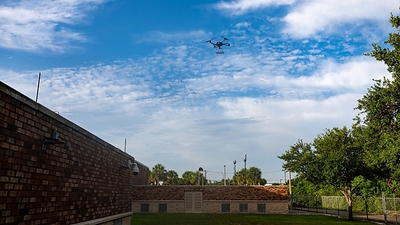
In a July demonstration in the
The technology has broad commercial applications across critical infrastructure, large-scale events at stadiums, utilities like power plants, and the everyday places people depend on, like schools, hospitals and airports. City, state and federal government customers can also gain proactive monitoring and alerts from the NetSense solution.
THE BIG PICTURE
As drones become more affordable, capable and widely available, the need for persistent, intelligent airspace awareness to protect the public grows. By leveraging existing technology, the NetSense solution can help protect people and critical infrastructure across a wide range of environments.
The successful live demonstration took place in a critical, high-traffic, urban area important for American protection, showcasing NetSense's components, capabilities, and UAS detection and alert systems in real-time. Leveraging an existing
HOW IT WORKS
The NetSense solution combines Lockheed Martin's warning and tracking systems, which work together using AI to read RF disturbances, predict and track a UAS's flight path and automatically send real-time alerts.
The NetSense solution revolutionizes airspace awareness through:
- AI-native sensing: Uses NVIDIA AI Aerial to analyze RF signal disturbances in real time and feed them to
Lockheed Martin's NetSense algorithms. - Speed and agility: Can be procured and deployed faster than traditional or custom-built systems leveraging COTS.
- Innovation and cost-effectiveness: The competitive commercial market can drive down costs and foster innovation.
- Integration potential: Open architecture commercial systems let new interceptors and technologies be added to existing platforms without the need for entirely new hardware.
- Scalability: The solution can grow from protecting a single critical site to supporting a mobile command and control system for larger operations.
- Open architecture design: Makes continuous enhancements of the offering possible, including deployment of existing
Lockheed Martin capabilities for improved data interpretation and target classification.
The demonstration proved the NetSense system can sense UAS without changing existing cellular radio deployments. This approach means at-scale, cost-effective sensing is available without recapitalization of cellular infrastructure, ahead of the timeline for 6G Integrated Sensing and Communication (ISAC).
The NetSense system and its algorithms are also complementary to 6G ISAC and can enhance those systems when they are available. The NetSense system currently leverages
NEXT STEPS
The NetSense system will be delivered as a subscription that interfaces with customer's existing security operations. Pilot deployments are planned for the second half of 2026 and early 2027, with commercial general availability planned for 2027. Early deployments will be limited to select customers that urgently need the capability. Interested organizations can contact Astris AI,
EXPERT PERSPECTIVES
"As drones become more affordable and accessible, airspace awareness technology needs to evolve rapidly to outpace potential threats. That's why we developed the NetSense solution," said
"By applying AI to the RF signal measurement data already traversing our 5G infrastructure, we can effectively turn our network into an intelligent sensing platform," said Anil Guntupali, senior vice president of Technology and Product Development at
"The NetSense system demonstrates how AI can transform existing telecommunications infrastructure into a real-time sensing platform," said
"By providing RF modeling, simulation, digital twin, emulation and test capabilities across the full engineering workflow, we are helping customers prove out feasibility, reduce complexity, and bring mission-critical technologies to market faster," said
"This strategic collaboration marks a decisive milestone in the evolution of joint Counter-UAS and layered homeland air defense for low-flying objects," said
About
About
About Keysight
At Keysight (NYSE: KEYS), we inspire and empower innovators to bring world-changing technologies to life. As an S&P 500 company, we're delivering market-leading design, emulation, and test solutions to help engineers develop and deploy faster, with less risk, throughout the entire product life cycle. We're a global innovation partner enabling customers in communications, industrial automation, aerospace and defense, automotive, semiconductor, and general electronics markets to accelerate innovation to connect and secure the world. Learn more at Keysight Newsroom and www.keysight.com.
About ODC
ODC is a leader in AI-Native Radio Access Network ("AI-RAN") technology and the architect of the
About Astris AI
Astris AI, a subsidiary of Lockheed Martin, is committed to enabling the adoption of AI solutions across the U.S. defense industrial base and other industries seeking high assurance solutions. Astris AI provides customers access to foundational AI tools, processes and talent to enable the deployment of secure AI solutions at scale, ensuring they stay ahead of rapid technological advancements. Astris AI is part of the Lockheed Martin Evolve portfolio, an organization that creates and scales new commercial and non-traditional businesses to bolster the defense industrial base. Astris AI is the commercial home of NetSense™ Airspace Awareness-as-a-Service™. Visit AstrisAI.com to learn more.

 View original content to download multimedia:https://www.prnewswire.com/news-releases/lockheed-martin-verizon-keysight-odc-and-astris-ai-demonstrate-technology-for-public-airspace-protection-with-nvidia-technology-302849010.html
SOURCE Lockheed Martin
Lockheed Martin: Trent Perrotto, +1 (321) 272-8027, trent.perrotto@lmco.com